

Archive position — measured, not model output
1 like on Devpost
505 of the 7,850 archived projects have more likes, and 1,758 share exactly 1 — so this project's #1,686 place in the like-ranked listing is a tie-break inside that group, not a ranking.
Projects (log scale)
Likes on Devpost. ▲ marks this project's group.
Show the figures
| Likes | Projects | Share of archive |
|---|---|---|
| 0 | 5,587 | 71.2% |
| 1 | 1,758 | 22.4% |
| 2 | 284 | 3.6% |
| 3–4 | 132 | 1.7% |
| 5–9 | 75 | 1.0% |
| 10+ | 14 | 0.2% |
 User Stories BotA demo video on every pull request
Get a demo video on every new feature
GitHub App that watches your pull requests and records a narrated, captioned demo.
Save time on demo prep and make informed decisions faster with a video walkthrough of every new feature.
Executive Summary
What the company appears to be: PonoLens is a self-reported macOS-first privacy monitoring tool for AI coding agents. The author states it is designed to make AI agent activity understandable to non-technical users by showing what data is shared, where it goes, and when privacy risks need attention.
What changed: The project description indicates this is a hackathon submission (Devpost entry for OpenAI 2026 hackathon). It represents an initial build with limited support for specific AI coding agents (Codex, Claude Code CLI, Cursor, Windsurf/Devin Desktop) and focuses on local monitoring and privacy risk detection.
Single most important open question: Does PonoLens actually function as described in a real-world environment beyond the hackathon context, or is it a demonstration-only tool?
What The Product Actually Is
The description states that PonoLens is:
- A "local-first privacy monitor for AI coding agents"
- Designed to show what data is shared, where it goes, and when privacy risks need attention
- A macOS-first JavaScript application built with Node.js, SQLite, HTML/CSS/JS
- Currently supports Codex, Claude Code CLI, Cursor, and Windsurf/Devin Desktop
- Uses a local SQLite database (~/.ponolens/ponolens.db) for audit storage
- Does not send data to the cloud or synchronize databases
The product includes:
- Pono Trail: plain-language privacy receipts showing activity details
- Pono Guard: user-selectable handling of sensitive categories (Report Only, Block, Redact, Custom)
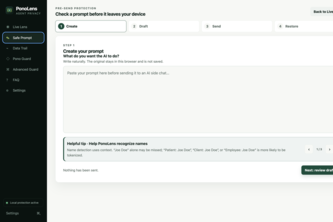
- Safe Prompt: controlled workflow for professionals handling sensitive information
- Data Trail and reporting features including filtering, search, CSV/PDF reports
Evidence: The author's own write-up, technology tags, and project description.
Confidence: Low. No independent verification of functionality or actual use beyond the hackathon context.
Positioning & Claim Evolution
The description states:
- PonoLens began with the question: "What if AI agent activity were understandable to everyone?"
- Its guiding principle is: "Agent activity → Destination → Privacy risk → Plain-language explanation"
- The name combines "pono" (Hawaiian concept of integrity, balance) with "lens"
- It aims to make privacy protection accessible without requiring technical knowledge or raw log reading
Evidence: Author's own write-up and tagline.
Confidence: Low. This is a stated positioning claim, not evidence of traction or adoption.
Target Customer & ICP
The description states:
- Intended for developers who may not understand what AI agents are sending
- Also targets non-developers like doctors, lawyers, financial professionals, small-business owners
- Focuses on professionals handling sensitive information (healthcare, legal, financial)
- Aims to be usable by both technical and nontechnical users
Evidence: Author's own write-up.
Confidence: Low. No evidence of actual customers or market validation beyond stated intent.
Business Model & Pricing Evidence
The description states:
- The current beta has no third-party runtime packages
- No mention of pricing, subscriptions, or monetization model
- The macOS beta can be installed with one command via curl script
- No indication of commercial use cases or revenue streams
Evidence: Author's own write-up.
Confidence: Very low. No evidence of any business model or pricing structure.
Technical & Delivery Signals
The description states:
- Built with Node.js, native SQLite, HTML/CSS/JS
- Uses macOS Keychain for API-key storage
- Local processing flow: Supported harness event → Normalize → Resolve destination → Inspect → Apply policy → Redact → Store receipt → Explain in plain language
- No cloud audit account or synchronization
- Local service binds only to 127.0.0.1 with request protection, body-size limits, security headers
- Uses GPT-5.6 and Codex for development assistance during the hackathon build
Evidence: Author's own write-up.
Confidence: Low. This is a self-reported technical description; no independent verification of actual implementation or delivery.
Traction & Maturity Signals
The description states:
- The project is a hackathon submission (OpenAI 2026)
- Team size: 1 person (Tim Holmgren)
- Current beta has no third-party runtime packages
- No mention of users, customers, revenue, or adoption metrics
- No evidence of product-market fit or growth
Evidence: Author's own write-up.
Confidence: Very low. No traction data or maturity indicators beyond the hackathon context.
Competitive Context
The description states:
- No direct competitors mentioned
- Focuses on local monitoring for AI coding agents
- Addresses privacy concerns around AI agent activity
- Targets professionals who may not understand technical details of AI agent behavior
Evidence: Author's own write-up.
Confidence: Low. No evidence of competitive landscape or market positioning beyond stated intent.
Open Questions & Risks
The description indicates:
- Single-person team (1 member)
- Hackathon submission with no commercial traction
- No third-party runtime packages in current beta
- No evidence of actual user base or adoption
- Limited platform support (macOS only, for now)
- Experimental features (Block, Redact modes)
- No mention of regulatory compliance claims beyond privacy detection
Evidence: Author's own write-up.
Confidence: Medium. These are inherent risks in a hackathon project with no commercial validation.
Questions the description leaves open
- What is the actual usage context for PonoLens? Is it being used by real users or just tested internally?
- How does PonoLens handle edge cases or unsupported AI agents beyond the four mentioned?
- Has there been any testing with actual enterprise users or professionals in healthcare, legal, or financial domains?
- What are the plans for expanding platform support beyond macOS?
- Are there any commercial partnerships or integration opportunities planned?
- How does PonoLens ensure accuracy of destination resolution across different tools and configurations?
- What is the expected timeline for moving from beta to a stable release?
Overall Assessment
Assessment: Not evidenced.
The description provides no information about:
- Revenue or financial performance
- Customer base or adoption metrics
- Market size or competitive positioning
- Product-market fit or traction data
- Commercial viability or scalability
This is a hackathon project with no evidence of commercialization, user adoption, or revenue generation. The author's own account describes it as a beta tool for macOS users, but there is no indication that it has moved beyond the prototype stage.
Confidence: Very low. No basis for investment or partnership decision based on this information alone.
User Stories BotA demo video on every pull request
Get a demo video on every new feature
GitHub App that watches your pull requests and records a narrated, captioned demo.
Save time on demo prep and make informed decisions faster with a video walkthrough of every new feature.
Source
Submitted to the OpenAI 2026 hackathon on Devpost. Project home on Devpost. Back to the full gallery on Devpost.
This competitive analysis was produced by top-founders.com (opens in a new tab)
Generated by a language model from this project's public Devpost page — its tagline, the author's own write-up and any built-with tags listed there — as captured in August 2026. Short quotations are the author's words. It is an opinion on the idea as a business, not on the people behind it, and it reflects the description as published then. If the project has moved on, request a correction below. The analysis is not independent research and contains no verified traction, revenue or customer data.
An independent guide by KFG International LLC — not affiliated with, endorsed by, or connected to Devpost or OpenAI.