

Archive position — measured, not model output
0 likes on Devpost
2,263 of the 7,850 archived projects have more likes, and 5,587 share exactly 0 — so this project's #5,612 place in the like-ranked listing is a tie-break inside that group, not a ranking.
Projects (log scale)
Likes on Devpost. ▲ marks this project's group.
Show the figures
| Likes | Projects | Share of archive |
|---|---|---|
| 0 | 5,587 | 71.2% |
| 1 | 1,758 | 22.4% |
| 2 | 284 | 3.6% |
| 3–4 | 132 | 1.7% |
| 5–9 | 75 | 1.0% |
| 10+ | 14 | 0.2% |
 User Stories BotA demo video on every pull request
Get a demo video on every new feature
GitHub App that watches your pull requests and records a narrated, captioned demo.
Save time on demo prep and make informed decisions faster with a video walkthrough of every new feature.
Executive Summary
What the company appears to be
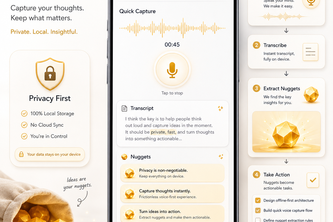
Nugget is a mobile-first web app that allows users to capture voice notes on-the-go and later organize them into structured ideas using GPT-5.6. The product is built as an installable PWA, stores all data locally in the browser (IndexedDB), and does not require accounts or cloud sync. It uses AI to separate a rambling transcript into distinct ideas, categorize them, and suggest next actions.
What changed
The author states that this project was built during a single week as part of the OpenAI 2026 hackathon. The MVP includes core functionality for capturing, transcribing, organizing, reviewing, and storing ideas locally in the browser. It does not include features like cloud sync, user accounts, or AI learning from corrections.
The single most important open question
Is there evidence of any traction, revenue, or customer adoption beyond the author’s own use case? The description contains no claims about users, customers, or monetization — only self-reported development and personal utility.
What The Product Actually Is
- The description states that Nugget is a mobile-first web app built as an installable PWA.
- It records voice notes using a browser-based interface.
- Voice recordings are transcribed using Whisper-1.
- GPT-5.6 is used in two stages: first to identify distinct ideas from the transcript, then to organize each idea into categories and suggest tags, goals, blockers, research needs, and next actions.
- All data (captures, recordings, transcripts, ideas) is stored locally in browser IndexedDB.
- No accounts or cloud sync are supported; processing begins only after user chooses to use it.
- The app allows review of AI-generated suggestions before saving any idea into a searchable local library.
- It supports exporting individual ideas and uses deterministic evaluation methods for testing.
Inference The product is a personal productivity tool focused on capturing and organizing thoughts via voice, with an emphasis on local-first storage and minimal cloud processing.
Positioning & Claim Evolution
- The author claims that Nugget addresses the problem of capturing ideas when they come “in the middle of something else,” not when at a computer.
- It positions itself as a tool for turning messy, unstructured voice notes into useful, organized ideas.
- The name "Nugget" reflects the idea of finding small, valuable insights buried in larger thoughts.
- The product is described as being built around a rhythm: capture now, organize later.
- The author emphasizes that nothing gets filed away without human review and confirmation.
Inference The positioning is centered on personal productivity and idea capture, not enterprise or team collaboration. It does not claim to be a marketplace, platform, or SaaS product for sale.
Target Customer & ICP
- The description states that the author built this tool for himself — someone who captures ideas while walking or between errands.
- The target user is described as someone who has “best ideas almost never show up when [they’re] actually at a computer.”
- There is no mention of any other personas, teams, or customer segments beyond the individual user.
Inference The ICP appears to be an individual user — likely a creative professional, researcher, or thinker — who values capturing spontaneous thoughts and wants them organized without requiring full-time attention or cloud-based workflows.
Business Model & Pricing Evidence
- The description does not state anything about pricing, monetization, or business model.
- There is no mention of subscriptions, freemium tiers, or any commercial offering.
- The app stores all data locally in the browser and does not require accounts or cloud processing until the user chooses to use it.
Inference No evidence exists for a defined business model or pricing strategy. The product seems to be a personal utility, not a commercial offering.
Technical & Delivery Signals
- Built with: Next.js, React, TypeScript, Vercel, OpenAI API, Codex, GPT-5.6, IndexedDB.
- Uses Whisper-1 for transcription and GPT-5.6-Terra for idea organization.
- The app is a PWA (Progressive Web App) that works offline and stores data locally before cloud processing begins.
- Includes deterministic evaluation harnesses to test structured output, grounding, and duplicate-action behavior.
- The author used Codex as an engineering collaborator throughout the build process.
Inference The technical stack suggests a modern, lightweight, client-side application. The use of AI tools like Codex and GPT-5.6 indicates strong reliance on AI for both development and product functionality.
Traction & Maturity Signals
- The description states that this was built in one week as part of a hackathon.
- There is no evidence of any users, customers, or adoption beyond the author’s own use case.
- No revenue, ARR, headcount, or growth metrics are mentioned.
- The MVP does not include features like AI learning, conversational onboarding, live research, or sync.
Inference There is no evidence of traction or maturity. This is a prototype or MVP, not a product in active use by others.
Competitive Context
- The description does not mention any competitors.
- No comparison to existing tools for idea capture or voice note organization is made.
- The author’s stated goal was to solve a personal problem — not to compete with an existing market offering.
Inference No competitive context is provided. It is unclear whether this product addresses a gap in the market or overlaps with existing solutions.
Open Questions & Risks
- The app does not support cloud sync, accounts, or background processing on mobile browsers.
- The author notes that “a closed mobile browser can’t keep working in the background,” which may limit usability for some users.
- No evidence of user feedback, testing, or iteration beyond the author’s own experience.
- The product is described as a solo-built MVP with no external validation or traction.
- The use of GPT-5.6 raises questions about data privacy and model availability if not self-hosted.
Inference Key risks include limited scalability, lack of user adoption, and potential limitations in mobile usability due to browser constraints.
Questions the description leaves open
- What is the actual user base beyond the author?
- Has there been any external testing or feedback from users?
- Are there plans to introduce cloud sync, accounts, or team features?
- How does the product handle edge cases in transcription or idea separation?
- Is there a plan for monetization or commercial viability?
- What are the long-term goals for AI learning and personalization?
Overall Assessment
- The description is self-reported and unverified.
- There is no evidence of revenue, customers, or traction.
- The product is described as a solo-built MVP with no commercial strategy or business model.
- It is positioned as a personal productivity tool, not a scalable SaaS or marketplace.
Assessment Not evidenced. This is a prototype built for personal use during a hackathon. No commercial due-diligence signals are present in the description. The author states that this is not a claim about traction, revenue, or adoption — only a demonstration of a working concept.
User Stories BotA demo video on every pull request
Get a demo video on every new feature
GitHub App that watches your pull requests and records a narrated, captioned demo.
Save time on demo prep and make informed decisions faster with a video walkthrough of every new feature.
Source
Submitted to the OpenAI 2026 hackathon on Devpost. Project home on Devpost. Back to the full gallery on Devpost.
This competitive analysis was produced by top-founders.com (opens in a new tab)
Generated by a language model from this project's public Devpost page — its tagline, the author's own write-up and any built-with tags listed there — as captured in August 2026. Short quotations are the author's words. It is an opinion on the idea as a business, not on the people behind it, and it reflects the description as published then. If the project has moved on, request a correction below. The analysis is not independent research and contains no verified traction, revenue or customer data.
An independent guide by KFG International LLC — not affiliated with, endorsed by, or connected to Devpost or OpenAI.