

Archive position — measured, not model output
0 likes on Devpost
2,263 of the 7,850 archived projects have more likes, and 5,587 share exactly 0 — so this project's #6,012 place in the like-ranked listing is a tie-break inside that group, not a ranking.
Projects (log scale)
Likes on Devpost. ▲ marks this project's group.
Show the figures
| Likes | Projects | Share of archive |
|---|---|---|
| 0 | 5,587 | 71.2% |
| 1 | 1,758 | 22.4% |
| 2 | 284 | 3.6% |
| 3–4 | 132 | 1.7% |
| 5–9 | 75 | 1.0% |
| 10+ | 14 | 0.2% |
 User Stories BotA demo video on every pull request
Get a demo video on every new feature
GitHub App that watches your pull requests and records a narrated, captioned demo.
Save time on demo prep and make informed decisions faster with a video walkthrough of every new feature.
Executive Summary
Company: PolisConnect
Self-reported basis: The description is entirely self-reported and unverified, drawn from a Devpost submission for the OpenAI 2026 hackathon. No external corroboration exists.
What it appears to be: A multi-tenant SaaS platform built for Brazilian political offices and campaigns, designed to manage constituent relations, legislative requests, budget amendments, and campaign operations within a single tool.
What changed: The project was developed as a hackathon submission and is now live in production with database-level tenant isolation.
Most important open question: Is there evidence of real customer traction or revenue generation beyond the author's own use case?
What The Product Actually Is
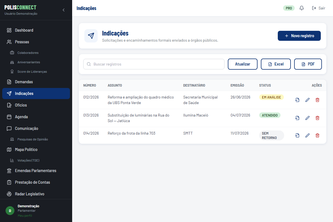
The description states that PolisConnect is an all-in-one management platform for Brazilian political offices and campaigns, with modules covering CRM (Pessoas), legislative requests (Demandas & Indicações), budget amendments (Emendas), calendar and communication (Agenda & Comunicação), territorial political mapping (Mapa Político), and campaign management (Campanha). It is described as a SaaS product with multi-tenant architecture, where each politician's office is an isolated tenant. The platform admin layer handles provisioning across tenants.
Evidence:
- The author describes the modules and their functions.
- The system uses Supabase with Postgres, RLS for tenant isolation, and service-role API routes.
- It is deployed via Vercel and built using React, TypeScript, Tailwind, Zustand, and React Query.
Inference:
- The product is a custom-built SaaS solution tailored to Brazilian political processes.
Positioning & Claim Evolution
The author claims that off-the-shelf CRMs do not understand Brazilian political terminology like emendas parlamentares, indicações, electoral zones, or TSE campaign-finance rules. PolisConnect was built to address this gap, aiming to be a single platform for both governing and campaigning.
Evidence:
- The inspiration section explicitly states that existing CRMs fail to support these specific political processes.
- The product is positioned as solving a problem unique to Brazilian politics.
Inference:
- The positioning reflects an attempt to create a niche solution within the broader CRM market, tailored for political mandates and campaigns in Brazil.
Target Customer & ICP
The description states that PolisConnect targets Brazilian elected officials — approximately 60,000 of them — who manage constituent requests, legislative activity, and campaign operations. Each office is treated as a separate tenant within the SaaS platform.
Evidence:
- The author mentions “every one of Brazil's ~60,000 elected officials has the same problem.”
- The platform supports both governing (demandas, emendas, indicações) and campaigning functions.
Inference:
- The ICP is likely small to mid-sized political offices or campaigns in Brazil with limited digital infrastructure.
Business Model & Pricing Evidence
The description states that PolisConnect operates as a SaaS product with a platform admin layer for provisioning. It is described as a licensable SaaS, but no pricing details, customer acquisition cost (CAC), or monetization strategy are provided.
Evidence:
- The author mentions “a platform admin layer above all tenants handles provisioning, so the product runs as a licensable SaaS.”
- No mention of pricing tiers, subscription models, or revenue streams.
Inference:
- The business model is likely based on per-tenant licensing, but there is no evidence of actual pricing or monetization.
Technical & Delivery Signals
The platform is built using modern web technologies including React 19, TypeScript, Tailwind, Zustand, Vite, Supabase (PostgreSQL with RLS), and deployed via Vercel. The system enforces multi-tenancy at the database level using Row Level Security (RLS) policies.
Evidence:
- The author describes the tech stack: React, TypeScript, Supabase, Vercel.
- Multi-tenancy is enforced at the database layer with RLS and tenant_id fields.
- Deployment process is described as continuous deploy straight from main to production.
Inference:
- The technical architecture shows a deliberate focus on security and scalability through database-level isolation.
Traction & Maturity Signals
The author states that PolisConnect is live in production at www.polisconnect.com.br, with true multi-tenant SaaS functionality. It has been used by real offices, but no data on actual users, revenue, or adoption is provided.
Evidence:
- The product is live and in production.
- The team includes only one member (Carlos Guido).
- No mention of paying customers, usage metrics, or revenue.
Inference:
- The platform has reached a minimum viable product (MVP) stage but lacks evidence of traction or monetization.
Competitive Context
The author claims that no off-the-shelf CRM in Brazil supports emendas parlamentares, indicações, electoral zones, or TSE campaign-finance rules. This suggests a lack of direct competitors in the specific domain.
Evidence:
- The inspiration section explicitly states that existing CRMs do not understand Brazilian political processes.
- No mention of competitors or market analysis.
Inference:
- The competitive landscape is unclear due to lack of evidence, but the niche may be underserved.
Open Questions & Risks
- Single-founder team: The project is built by one person (Carlos Guido), which raises concerns about scalability and execution.
- No revenue or customer data: Despite being live in production, there is no evidence of monetization or real-world usage beyond the author’s own experience.
- No staging environment: Deploys go straight to production, increasing risk of live errors and lack of QA.
- Lack of pricing or monetization strategy: The business model remains undefined.
Inference:
- The project may be in early-stage development with limited commercial viability.
Questions the description leaves open
- What is the current status of real customer onboarding and adoption?
- How many political offices are currently using PolisConnect, if any?
- Is there a defined pricing model or monetization strategy?
- Are there plans to expand beyond Brazil or into other political domains?
- What is the roadmap for user feedback integration and product evolution?
- How do you plan to scale from one developer to a full team?
Overall Assessment
The description indicates that PolisConnect is a live, production-ready SaaS platform with database-level multi-tenancy and a clear domain-specific focus on Brazilian political processes. However, there is no evidence of revenue, customers, or traction beyond the author’s own use case.
Confidence level: Low — based on self-reported information only, with no external validation or commercial data.
Assessment:
PolisConnect appears to be an early-stage product with a strong technical foundation and a niche market fit. However, due to lack of evidence for traction, revenue, or customer adoption, it is not ready for investment or partnership consideration without further due diligence into real-world usage and monetization.
User Stories BotA demo video on every pull request
Get a demo video on every new feature
GitHub App that watches your pull requests and records a narrated, captioned demo.
Save time on demo prep and make informed decisions faster with a video walkthrough of every new feature.
Source
Submitted to the OpenAI 2026 hackathon on Devpost. Project home on Devpost. Back to the full gallery on Devpost.
This competitive analysis was produced by top-founders.com (opens in a new tab)
Generated by a language model from this project's public Devpost page — its tagline, the author's own write-up and any built-with tags listed there — as captured in August 2026. Short quotations are the author's words. It is an opinion on the idea as a business, not on the people behind it, and it reflects the description as published then. If the project has moved on, request a correction below. The analysis is not independent research and contains no verified traction, revenue or customer data.
An independent guide by KFG International LLC — not affiliated with, endorsed by, or connected to Devpost or OpenAI.