

Archive position — measured, not model output
4 likes on Devpost
89 of the 7,850 archived projects have more likes, and 39 share exactly 4 — so this project's #125 place in the like-ranked listing is a tie-break inside that group, not a ranking.
Projects (log scale)
Likes on Devpost. ▲ marks this project's group.
Show the figures
| Likes | Projects | Share of archive |
|---|---|---|
| 0 | 5,587 | 71.2% |
| 1 | 1,758 | 22.4% |
| 2 | 284 | 3.6% |
| 3–4 | 132 | 1.7% |
| 5–9 | 75 | 1.0% |
| 10+ | 14 | 0.2% |
 User Stories BotA demo video on every pull request
Get a demo video on every new feature
GitHub App that watches your pull requests and records a narrated, captioned demo.
Save time on demo prep and make informed decisions faster with a video walkthrough of every new feature.
Executive Summary
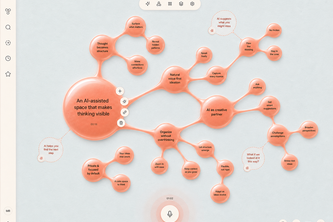
What the company appears to be: ThoughtForm is a voice-first brainstorming tool that uses AI to convert spoken ideas into a visual, interactive map. The product is described as a prototype built for the OpenAI 2026 hackathon.
What changed: The project description indicates this is an early-stage prototype, likely developed in a short timeframe (a hackathon), with no evidence of prior traction or commercial deployment.
Single most important open question: Is there any evidence that ThoughtForm has moved beyond a proof-of-concept stage, or whether it has begun to attract users or customers?
What The Product Actually Is
The description states:
- ThoughtForm is a voice-first canvas for brainstorming and refining ideas.
- It uses GPT-5.6 Sol, Realtime 2.1, and Codex to process spoken input into a visual map.
- The system captures speech, interprets it via GPT-5.6 Sol, and updates the UI in real time.
- It supports traceable maps, provenance tracking, undo/redo, and proactive idea expansion.
Inference: The product is described as a visual thinking tool that integrates voice input with AI-generated content to help users explore ideas visually and conversationally. However, it is not evidenced to be in production or used by anyone beyond the developers.
Positioning & Claim Evolution
The description states:
- The product was built to address a personal problem: "implementation used to be the bottleneck" for the founders (who have ADHD).
- It aims to bridge the gap between chat-based tools, which produce text walls, and mind maps, which lack depth.
- The positioning is that it helps users get to clarity faster by enabling visual and conversational exploration of ideas.
Inference: The product is positioned as a tool for idea refinement and visual thinking, especially for individuals with ADHD or those who struggle with traditional note-taking or brainstorming methods. It is not evidenced to have evolved beyond its initial hackathon concept.
Target Customer & ICP
The description states:
- The founders are people with ADHD.
- The tool was built to help them overcome the constraint of clearly defining what they want, which they see as a bottleneck in implementation.
Inference: The target customer appears to be individuals with ADHD or those who struggle with idea definition and visualization, but there is no evidence of broader market targeting, user segmentation, or customer validation beyond the founders’ personal experience.
Business Model & Pricing Evidence
Not evidenced.
The description does not mention any pricing model, monetization strategy, or business model. There is no indication that ThoughtForm has begun to generate revenue or has a defined path to monetization.
Technical & Delivery Signals
The description states:
- The system uses GPT-5.6 Sol, Realtime 2.1, and Codex.
- It was built using Codex as an implementation and debugging partner.
- The team used Codex to convert concept images into a UI, and to debug and test the app.
- Challenges included managing real-time API response, AI reasoning delay, and UI fluidity.
- The architecture separates transcript handling, semantic graph, and undo/redo logic on the server side, while the browser handles physics and animation.
Inference: The product is technically ambitious, with a hybrid approach to voice processing, AI interpretation, and UI rendering. However, it is not evidenced to be in production or have been tested at scale.
Traction & Maturity Signals
Not evidenced.
The project was submitted as a hackathon entry, and there is no evidence of:
- Customers, users, or adoption
- Revenue or monetization
- Product iteration beyond the prototype
- Any form of market validation or traction
Competitive Context
Not evidenced.
There is no mention of competitors, existing tools in the space, or how ThoughtForm compares to other brainstorming or visual thinking tools.
Open Questions & Risks
- Prototype-only: The product is described as a hackathon prototype with no evidence of production use or user adoption.
- Unverified AI claims: The description references GPT-5.6 Sol, which may not exist in the real world; this is a self-reported claim without external verification.
- No commercialization path: There is no indication of how ThoughtForm intends to monetize or scale beyond its initial concept.
- Founder-centric positioning: The product appears to be built for the founders’ personal needs rather than a broader market, raising questions about scalability and generalizability.
Questions the description leaves open
- Has ThoughtForm been tested with users outside of the founding team?
- What is the plan to move from prototype to production or commercial use?
- Are there any early adopters or pilot customers?
- How does the product intend to monetize or generate revenue?
- What are the technical challenges that remain unresolved for scaling?
- Is there a roadmap beyond the current hackathon version?
Overall Assessment
Not evidenced.
There is no evidence of traction, revenue, customers, or commercial viability. The project is described as a hackathon prototype with no indication of progress toward product-market fit or commercialization. It is not evident that ThoughtForm has moved beyond the idea stage.
The description states: “This project was submitted to the OpenAI 2026 hackathon on Devpost.” This is the only confirmed context for the project, and it does not suggest any commercial or growth trajectory.
User Stories BotA demo video on every pull request
Get a demo video on every new feature
GitHub App that watches your pull requests and records a narrated, captioned demo.
Save time on demo prep and make informed decisions faster with a video walkthrough of every new feature.
Source
Submitted to the OpenAI 2026 hackathon on Devpost. Project home on Devpost. Back to the full gallery on Devpost.
This competitive analysis was produced by top-founders.com (opens in a new tab)
Generated by a language model from this project's public Devpost page — its tagline, the author's own write-up and any built-with tags listed there — as captured in August 2026. Short quotations are the author's words. It is an opinion on the idea as a business, not on the people behind it, and it reflects the description as published then. If the project has moved on, request a correction below. The analysis is not independent research and contains no verified traction, revenue or customer data.
An independent guide by KFG International LLC — not affiliated with, endorsed by, or connected to Devpost or OpenAI.