

Archive position — measured, not model output
0 likes on Devpost
2,263 of the 7,850 archived projects have more likes, and 5,587 share exactly 0 — so this project's #5,947 place in the like-ranked listing is a tie-break inside that group, not a ranking.
Projects (log scale)
Likes on Devpost. ▲ marks this project's group.
Show the figures
| Likes | Projects | Share of archive |
|---|---|---|
| 0 | 5,587 | 71.2% |
| 1 | 1,758 | 22.4% |
| 2 | 284 | 3.6% |
| 3–4 | 132 | 1.7% |
| 5–9 | 75 | 1.0% |
| 10+ | 14 | 0.2% |
 User Stories BotA demo video on every pull request
Get a demo video on every new feature
GitHub App that watches your pull requests and records a narrated, captioned demo.
Save time on demo prep and make informed decisions faster with a video walkthrough of every new feature.
Executive Summary
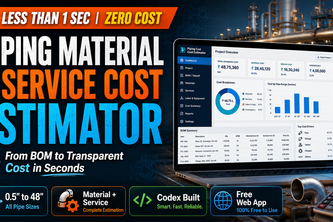
The description states that "Piping Material & Service Cost Estimator" is a browser-based web application built using Codex-assisted development. The author, Medini Kumar Bora, describes it as a tool to convert piping Bills of Materials (BOMs) into transparent, auditable material and service cost estimates for faster project decisions.
The product appears to be a focused estimation platform targeting refinery and petrochemical industries, aiming to solve the problem of delayed cost estimation due to lack of readily available pricing data. It is described as having zero software and hosting cost, and being deployable publicly.
Key commercial signals:
- The author claims it solves a high-frequency problem in engineering estimation
- It targets a specific industrial use case (piping cost estimation)
- It uses Codex for development, suggesting a low-cost build approach
- It is positioned as an alternative to expensive enterprise platforms
The single most important open question: Is there any evidence of actual usage or adoption by target customers? The description contains no traction data, revenue figures, customer names, or user feedback.
What The Product Actually Is
The description states that the product is:
- A browser-based engineering decision-support application
- Built with Codex-assisted development
- Designed to convert manual inputs or piping BOM files into preliminary (AACE Class 3) material and service cost estimates
- Capable of importing Excel, XLS, and CSV BOM files
- Able to recognize various piping components including pipes, fittings, flanges, valves, bolts, gaskets, strainers, and others
- Designed to work with different BOM column names and layouts
The application is described as having two connected cost views:
- Part A: Piping Material Cost - calculates material costs based on component weight, geometry, material category, and conversion factors
- Part B: Piping Service Cost - estimates service costs for activities like pipe erection, welding, flange welding, valve installation, etc.
The description states this is a "static" web application built with HTML5, CSS3, JavaScript, and vanilla technologies.
Positioning & Claim Evolution
The description states the product's positioning as:
- A Codex-built web app that transforms piping BOMs into transparent, auditable material and service cost estimates
- "Less Than 1 Second | Zero Cost" - emphasizing speed and zero software cost
- A solution for "fast, transparent, and auditable estimates for piping materials and services"
- An alternative to expensive enterprise platforms like Cleopatra Enterprise and Aspen Capital Cost Estimator
The claim evolution shows:
- Initial problem: "reliable piping prices are often unavailable when an estimate is urgently required"
- Solution approach: "combine internal engineering knowledge with Codex-assisted software development"
- Value proposition: "speed + consistency + auditability" in cost estimation
- Broader vision: "Piping Cost 360: Any size. Multiple materials. Material and service cost. One transparent estimation platform"
The description also states the objective is not to reproduce every capability of enterprise platforms, but to solve a specific, high-frequency problem.
Target Customer & ICP
The description states that the application is intended for:
- Refinery owners
- Petrochemical companies
- Consultants
- EPC contractors
- Construction contractors
- Procurement teams
- Freelance estimators
- Students
- Engineers
The description indicates this targets industrial engineering professionals working in process industries, particularly those dealing with piping systems in refineries and petrochemical plants. The author identifies the target market as "refinery and petrochemical projects" and mentions that similar challenges exist across "refineries, petrochemical plants, EPC organizations, consultants, contractors, and process industries globally."
Business Model & Pricing Evidence
Not evidenced.
The description does not contain any information about:
- Revenue streams
- Pricing models
- Customer acquisition costs
- Unit economics
- Monetization strategy
- Subscription or licensing fees
- Commercial arrangements with users
Technical & Delivery Signals
The description states that the application is:
- Browser-based and client-side only
- Built using HTML5, CSS3, JavaScript, vanilla technologies
- Uses Codex for development
- Static web application
- Can import Excel, XLS, and CSV BOM files
- Recognizes different BOM column names and layouts
- Converts nominal pipe size and schedule into actual dimensions
- Calculates pipe weight using outside diameter, wall thickness, density, and length
- Estimates weight of fittings, flanges, valves, and other components
- Classifies materials into carbon steel, alloy steel, stainless steel, and review categories
- Applies material-specific and component-specific estimation factors
- Generates printable and exportable calculation reports
The author notes that the application does not depend on a fixed price list for every individual piping item, but uses engineering geometry, component weight, material category, and conversion factors to develop indicative finished prices.
Traction & Maturity Signals
Not evidenced.
The description contains no information about:
- Actual users or customers
- Revenue or monetization
- Customer adoption rates
- Usage metrics
- Product iteration history
- Market feedback
- User testimonials
- Customer retention
- Geographic reach
- Product maturity indicators
Competitive Context
The description states that the author reviewed established commercial cost-estimation platforms including:
- Cleopatra Enterprise (approximately ₹70 lakh per year for up to 5 users)
- Aspen Capital Cost Estimator (approximately ₹4 crore per year for up to 5 users)
The author notes these platforms would need configuration and calibration using historical purchase orders, rate data, estimation practices, and project experience. The build-versus-buy decision was made based on the high licensing costs and dependency on external configuration support.
The description states that the objective was not to reproduce every capability of enterprise platforms but to solve a specific, high-frequency problem in piping estimation.
Open Questions & Risks
Inferences:
- The product is described as built by a single individual (team size: 1) with no evidence of additional team members or development resources
- The application is described as "static" and client-side only, which may limit scalability and data persistence capabilities
- The author states that the application does not depend on fixed price lists but uses engineering formulas and conversion factors - this raises questions about accuracy and consistency of estimates without real-time pricing data
- The product appears to be a prototype or proof-of-concept rather than a mature commercial offering, as evidenced by lack of traction data and no mention of production deployment
- The use of Codex for development suggests potential limitations in terms of reproducibility and scalability of the development approach
Questions the description leaves open
- What specific engineering formulas and conversion factors are used to calculate material and service costs?
- How is the accuracy of cost estimates validated or tested against actual purchase orders?
- Has there been any independent validation of the estimation methodology by other engineers or industry professionals?
- What is the actual process for updating cost libraries with new pricing data?
- Are there any plans to expand beyond piping cost estimation to include other project components?
- How does the application handle different regional pricing variations and currency fluctuations?
- What are the limitations of the current approach in terms of accuracy for complex or unusual piping configurations?
- Is there any mechanism for users to contribute or validate pricing data back into the system?
- What is the long-term vision for maintaining and updating the cost libraries?
- How would the application handle integration with existing enterprise systems or ERP platforms?
Overall Assessment
Not evidenced.
The description contains no information about:
- Financial performance
- Market opportunity size
- Competitive advantages
- Go-to-market strategy
- Scalability potential
- Team experience beyond the single individual mentioned
- Strategic fit for potential partners or investors
- Valuation considerations
- Commercial traction metrics
- Risk mitigation strategies
The author states that this is a project submitted to the OpenAI 2026 hackathon, suggesting it may be in early development or prototype stage rather than a mature commercial venture.
User Stories BotA demo video on every pull request
Get a demo video on every new feature
GitHub App that watches your pull requests and records a narrated, captioned demo.
Save time on demo prep and make informed decisions faster with a video walkthrough of every new feature.
Source
Submitted to the OpenAI 2026 hackathon on Devpost. Project home on Devpost. Back to the full gallery on Devpost.
This competitive analysis was produced by top-founders.com (opens in a new tab)
Generated by a language model from this project's public Devpost page — its tagline, the author's own write-up and any built-with tags listed there — as captured in August 2026. Short quotations are the author's words. It is an opinion on the idea as a business, not on the people behind it, and it reflects the description as published then. If the project has moved on, request a correction below. The analysis is not independent research and contains no verified traction, revenue or customer data.
An independent guide by KFG International LLC — not affiliated with, endorsed by, or connected to Devpost or OpenAI.