

Archive position — measured, not model output
2 likes on Devpost
221 of the 7,850 archived projects have more likes, and 284 share exactly 2 — so this project's #417 place in the like-ranked listing is a tie-break inside that group, not a ranking.
Projects (log scale)
Likes on Devpost. ▲ marks this project's group.
Show the figures
| Likes | Projects | Share of archive |
|---|---|---|
| 0 | 5,587 | 71.2% |
| 1 | 1,758 | 22.4% |
| 2 | 284 | 3.6% |
| 3–4 | 132 | 1.7% |
| 5–9 | 75 | 1.0% |
| 10+ | 14 | 0.2% |
 User Stories BotA demo video on every pull request
Get a demo video on every new feature
GitHub App that watches your pull requests and records a narrated, captioned demo.
Save time on demo prep and make informed decisions faster with a video walkthrough of every new feature.
Executive Summary
PillAI is a self-reported mobile application designed to help users manage medication intake in the context of their health, food, and pregnancy status. The app uses AI to log doses, answer questions about drug interactions, and route emergency phrases locally. It was built as a hackathon submission for the OpenAI 2026 hackathon by two founders (Omar Althbite and Abdullah ALSHAMRANI). The description states that PillAI is not a clinical database but rather an interface that classifies user intent using a fixed JSON schema and server-owned templates, with no verified medical data or clinical claims. It does not report revenue, customers, or traction.
The single most important open question is: What level of clinical accuracy and trust can be achieved without a verified clinical database?
This analysis is based entirely on the self-reported project description provided by the authors — there is no independent verification or historical data available.
What The Product Actually Is
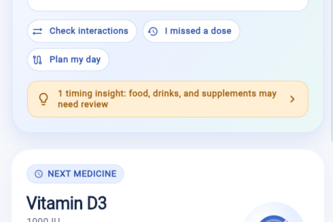
The description states that PillAI is a mobile app built with Flutter and Node.js, using GPT-5.6 through the Responses API. It allows users to log medication doses (Taken, Missed, Snooze) in one tap, answers questions via voice or text, and routes emergency phrases in English and Arabic locally.
It keeps structured medical records including active ingredients, allergies, pregnancy status, kidney/liver function, foods, and supplements.
The app uses a strict JSON schema for intent classification and avoids generating medical wording. All user-facing sentences come from server-owned templates. Emergency detection runs deterministically before any network call, and API keys are stored only on the server.
Inference: The product is described as an AI-powered medication tracker with a focus on usability and safety through deterministic fallbacks, not as a clinical decision support system.
Positioning & Claim Evolution
The description positions PillAI as a tool that helps users "track medicines with food and health context" and warns them of potential conflicts. It emphasizes ease-of-use ("one tap") and contextual awareness ("pregnancy changes what's safe").
It claims to be a chatbot alternative that avoids the limitations of forgetting past sessions or requiring re-typing conditions.
The authors also state that PillAI does not claim to be a clinical database, nor does it make up dosing intervals or prove combinations safe. Instead, it says so explicitly when unable to provide verified information.
Inference: The positioning has evolved from a general health assistant to a structured, cautious interface for medication logging and basic interaction — not a substitute for medical advice or clinical tools.
Target Customer & ICP
The description does not clearly define the target customer segment beyond an individual managing multiple medications. It mentions that the app was inspired by someone taking eight medications daily due to illness.
It includes two layouts: one standard and one with large-type fonts for older users, suggesting a potential demographic focus on aging or visually impaired individuals.
There is no evidence of segmentation by disease type, age group, or socioeconomic status.
Inference: The ICP appears to be a person managing complex medication regimens, possibly including chronic conditions or post-illness recovery, with some concern for drug interactions and ease-of-use.
Business Model & Pricing Evidence
There is no evidence of pricing, monetization strategy, or business model in the description. No mention of subscriptions, freemium tiers, enterprise licensing, or partnerships.
The project was submitted as a hackathon entry, indicating it is not yet commercialized.
Inference: The business model remains undefined; this is an early-stage concept with no revenue or pricing data.
Technical & Delivery Signals
- Built with Flutter (client), Node.js (backend)
- Uses GPT-5.6 via Responses API
- Core design rule: AI never writes medical wording; uses fixed enums and server-owned templates
- Emergency detection runs deterministically before any network call
- API key lives only on the server, not in the app build
- No verified clinical database used
- Graceful degradation built-in (e.g., fallback to deterministic guidance when quota is exhausted)
Inference: The technical approach prioritizes safety and control over generative AI outputs. It avoids risks associated with unverified medical claims by limiting AI-generated content.
Traction & Maturity Signals
The project was submitted to the OpenAI 2026 hackathon, indicating it is a prototype or proof-of-concept.
No evidence of user adoption, retention, or usage metrics exists.
There is no mention of funding, partnerships, or product launches beyond the hackathon submission.
Inference: The product has not yet reached market traction. It is in an early development stage with no demonstrated user base or commercial viability.
Competitive Context
The description does not reference competitors or existing solutions in the medication tracking space.
It implies a niche for apps that avoid the limitations of chatbots (forgetting, re-typing) and offer structured logging.
No evidence of market analysis, competitive differentiation, or positioning against other tools is provided.
Inference: The competitive landscape is unknown. The app may aim to address gaps in current medication tracking tools but lacks clarity on how it compares or differentiates.
Open Questions & Risks
- No verified clinical database: The app explicitly states it does not use one, which raises concerns about accuracy and liability.
- Limited scope of AI use: AI is constrained to intent classification and fixed templates — this limits its utility beyond basic interaction.
- No monetization or business model: No evidence of how the product will generate revenue or scale.
- Early-stage prototype: Submitted as a hackathon project, suggesting it has not been tested in real-world conditions.
- Dependency on API quota: Graceful degradation works only when quotas are not exceeded — this could be a failure point.
Inference: The app is technically cautious but commercially unproven. Its lack of clinical backing and unclear path to monetization are major risks.
Questions the description leaves open
- How does the app handle edge cases where user input doesn’t match known patterns?
- What are the legal and liability implications of not using a verified clinical database?
- Are there plans to integrate with existing health systems or EHRs?
- How is the team planning to validate the safety and accuracy of the app without clinical data?
- Is there any plan for user testing, feedback loops, or iterative improvements beyond the hackathon?
- What are the long-term goals for scaling or monetizing this product?
Overall Assessment
The description indicates that PillAI is a concept in early development, submitted as a hackathon project. It has no evidence of traction, revenue, or customer base.
It shows technical discipline and an awareness of safety concerns but lacks commercial viability or scalability indicators.
Assessment: Not ready for investment or partnership at this stage. The product may have potential if it evolves into a more robust system with clinical integration and user validation — but currently, it is a prototype without clear path to market or monetization.
User Stories BotA demo video on every pull request
Get a demo video on every new feature
GitHub App that watches your pull requests and records a narrated, captioned demo.
Save time on demo prep and make informed decisions faster with a video walkthrough of every new feature.
Source
Submitted to the OpenAI 2026 hackathon on Devpost. Project home on Devpost. Back to the full gallery on Devpost.
This competitive analysis was produced by top-founders.com (opens in a new tab)
Generated by a language model from this project's public Devpost page — its tagline, the author's own write-up and any built-with tags listed there — as captured in August 2026. Short quotations are the author's words. It is an opinion on the idea as a business, not on the people behind it, and it reflects the description as published then. If the project has moved on, request a correction below. The analysis is not independent research and contains no verified traction, revenue or customer data.
An independent guide by KFG International LLC — not affiliated with, endorsed by, or connected to Devpost or OpenAI.