

Archive position — measured, not model output
2 likes on Devpost
221 of the 7,850 archived projects have more likes, and 284 share exactly 2 — so this project's #415 place in the like-ranked listing is a tie-break inside that group, not a ranking.
Projects (log scale)
Likes on Devpost. ▲ marks this project's group.
Show the figures
| Likes | Projects | Share of archive |
|---|---|---|
| 0 | 5,587 | 71.2% |
| 1 | 1,758 | 22.4% |
| 2 | 284 | 3.6% |
| 3–4 | 132 | 1.7% |
| 5–9 | 75 | 1.0% |
| 10+ | 14 | 0.2% |
 User Stories BotA demo video on every pull request
Get a demo video on every new feature
GitHub App that watches your pull requests and records a narrated, captioned demo.
Save time on demo prep and make informed decisions faster with a video walkthrough of every new feature.
Executive Summary
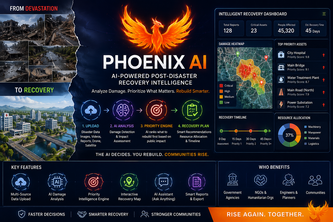
Phoenix AI is an AI-powered post-disaster recovery intelligence platform, self-described as a tool that analyzes disaster damage, prioritizes critical reconstruction, and generates intelligent recovery plans to help communities rebuild faster and smarter. The project was built as a hackathon submission for the OpenAI 2026 hackathon by one team member (Poranki Gokulesh varma). It is described as an AI-first web application using Next.js, TypeScript, Supabase, and OpenAI models.
The platform is positioned to support decision-makers in prioritizing infrastructure rebuilding based on public impact, rather than just detecting damage. It allows users to upload images, videos, and reports; analyze damaged infrastructure; visualize recovery insights; ask an AI assistant questions; and generate structured recovery reports.
The single most important open question
Is there any evidence of real-world adoption or pilot use by humanitarian organizations or governments? The description states no such traction exists beyond the hackathon context.
What The Product Actually Is
- The description states that Phoenix AI is an AI-powered post-disaster recovery intelligence platform.
- It enables users to:
- Upload disaster images, videos, and reports
- Analyze damaged infrastructure
- Prioritize reconstruction using an AI-powered Priority Intelligence Engine
- Visualize recovery insights through an interactive dashboard
- Ask an AI assistant questions about recovery planning
- Generate structured recovery reports for decision-makers
- The platform is built as a modern web application using:
- Frontend: Next.js, TypeScript, Tailwind CSS, shadcn/ui
- Backend: Supabase (authentication, database, file storage)
- AI models: OpenAI (for reasoning, damage interpretation, report generation, recovery recommendations)
- The system is described as AI-first, with Codex used to accelerate implementation.
Inference The product appears to be a prototype or proof-of-concept built for a hackathon, not yet deployed in production. No evidence of actual deployment or usage beyond the development phase.
Positioning & Claim Evolution
- The description states that Phoenix AI is “named after the mythical phoenix that rises from the ashes”, symbolizing resilience, recovery, and hope.
- It positions itself as a tool that helps communities recover by intelligently prioritizing reconstruction based on public impact.
- The platform shifts focus from damage detection to reconstruction planning, answering “What should we rebuild first to maximize public benefit?” instead of just “What was damaged?”
Inference The positioning reflects an attempt to differentiate from existing disaster management tools that focus on prediction or damage assessment, by emphasizing decision support in the recovery phase.
Target Customer & ICP
- The description states that Phoenix AI is designed for governments, NGOs, and international humanitarian organizations.
- It targets decision-makers who need to prioritize infrastructure rebuilding after natural disasters.
- The platform is intended to be used by larger-scale actors, not individual users.
Inference The ICP appears to be large-scale humanitarian or government entities involved in post-disaster recovery, but there is no evidence of actual customer engagement or use cases beyond the hackathon.
Business Model & Pricing Evidence
- No information is provided about pricing, monetization, or business model.
- The description does not mention any revenue streams, licensing models, or paid features.
- It is unclear whether the platform is intended for free public use, subscription-based access, or other commercial arrangements.
Not evidenced.
Technical & Delivery Signals
- Built with Next.js, TypeScript, Tailwind CSS, shadcn/ui
- Backend uses Supabase for authentication, database, and file storage
- AI models used include OpenAI, including GPT-5.6 (as per tags)
- Tools like Codex were used to accelerate development
- The system includes interactive dashboards and visualizations
- Features include damage analysis, priority engine, AI assistant, report generation
Inference The tech stack suggests a modern, scalable web application with AI integration. However, the project is described as a hackathon prototype, not a production-ready product.
Traction & Maturity Signals
- The platform was built for the OpenAI 2026 hackathon, indicating it is a prototype or proof-of-concept.
- No evidence of real-world deployment, customer adoption, or usage beyond the development phase.
- There is no mention of pilot programs, partnerships, or user feedback.
Not evidenced.
Competitive Context
- The description does not name specific competitors.
- It distinguishes itself from systems that focus on disaster prediction or damage detection, by focusing instead on post-disaster recovery planning.
- It implies a niche in AI-driven decision support for humanitarian recovery, which may overlap with GIS-based tools, emergency response platforms, and disaster management software.
Inference The competitive landscape includes existing disaster management systems, but Phoenix AI’s positioning is to offer a new angle — prioritization based on public benefit rather than just damage mapping.
Open Questions & Risks
- No real-world traction or adoption: The platform was built for a hackathon and has no evidence of being used in practice.
- Unverified claims: All descriptions are self-reported, with no independent verification of functionality or impact.
- Unclear commercial viability: No pricing, monetization, or business model is described.
- Prototype nature: The system is described as a hackathon project, not a mature product.
- AI dependency without clarity on explainability or trustworthiness in high-stakes environments.
Questions the description leaves open
- What specific post-disaster recovery scenarios have you tested the platform with?
- Have any humanitarian organizations or government agencies expressed interest in piloting this tool?
- How does the system handle uncertainty or incomplete data in real-world disaster situations?
- What is the current maturity of the AI models used, and how are they validated for reliability?
- Are there plans to integrate satellite or drone imagery in real-time, and what infrastructure would be needed?
- Is there any plan to scale beyond the hackathon prototype, and if so, what are the key milestones?
Overall Assessment
- Not evidenced as a viable investment or partnership opportunity at this stage.
- The project is described as a hackathon prototype, with no evidence of traction, revenue, or customer engagement.
- It may be a promising concept for future development, but currently lacks the commercial due-diligence signals required to assess its viability or potential for scaling.
Confidence Level: Low.
User Stories BotA demo video on every pull request
Get a demo video on every new feature
GitHub App that watches your pull requests and records a narrated, captioned demo.
Save time on demo prep and make informed decisions faster with a video walkthrough of every new feature.
Source
Submitted to the OpenAI 2026 hackathon on Devpost. Project home on Devpost. Back to the full gallery on Devpost.
This competitive analysis was produced by top-founders.com (opens in a new tab)
Generated by a language model from this project's public Devpost page — its tagline, the author's own write-up and any built-with tags listed there — as captured in August 2026. Short quotations are the author's words. It is an opinion on the idea as a business, not on the people behind it, and it reflects the description as published then. If the project has moved on, request a correction below. The analysis is not independent research and contains no verified traction, revenue or customer data.
An independent guide by KFG International LLC — not affiliated with, endorsed by, or connected to Devpost or OpenAI.