

Archive position — measured, not model output
0 likes on Devpost
2,263 of the 7,850 archived projects have more likes, and 5,587 share exactly 0 — so this project's #5,911 place in the like-ranked listing is a tie-break inside that group, not a ranking.
Projects (log scale)
Likes on Devpost. ▲ marks this project's group.
Show the figures
| Likes | Projects | Share of archive |
|---|---|---|
| 0 | 5,587 | 71.2% |
| 1 | 1,758 | 22.4% |
| 2 | 284 | 3.6% |
| 3–4 | 132 | 1.7% |
| 5–9 | 75 | 1.0% |
| 10+ | 14 | 0.2% |
 User Stories BotA demo video on every pull request
Get a demo video on every new feature
GitHub App that watches your pull requests and records a narrated, captioned demo.
Save time on demo prep and make informed decisions faster with a video walkthrough of every new feature.
Executive Summary
What the company appears to be
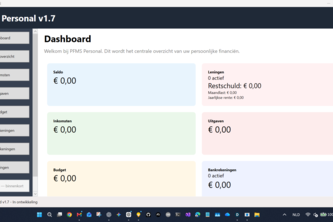
PFMS Personal — Private Finance, Made Simple is a self-reported Windows desktop application built as a hackathon submission. The author describes it as a privacy-first, offline financial management tool that aggregates income, spending, budgets, bank accounts and savings into one secure command center.
What changed
No evidence of prior version or evolution; this is the first public manifestation of the project as described by the author.
The single most important open question
Is there any evidence of user adoption, revenue, or traction beyond the hackathon submission?
What The Product Actually Is
The description states that PFMS Personal is a privacy-first offline Windows app. It is built using .NET 10, C#, WPF, SQLite, and integrates with tools like Codex, CommunityToolkit.MVVM, EntityFrameworkCore, and GPT-5.6.
It claims to help users manage income, spending, budgets, bank accounts, and savings in one secure financial command center.
Evidence
- The author describes the product as a Windows app.
- It uses .NET 10, C#, WPF, SQLite.
- It integrates with GPT-5.6 and other developer tools.
- It is described as offline and privacy-first.
Inference The app appears to be a desktop application built for personal finance management, likely using a MVVM architecture and local data storage (SQLite).
Positioning & Claim Evolution
The author states that PFMS Personal is a privacy-first offline Windows app that helps people take control of income, spending, budgets, bank accounts and savings in one secure financial command center.
There is no evidence of prior positioning or claim evolution. The project description is limited to the tagline and basic technical details.
Evidence
- Tagline: “A privacy-first offline Windows app that helps people take control of income, spending, budgets, bank accounts and savings in one secure financial command center.”
- No mention of prior versions or changes in positioning.
- No evidence of marketing materials or public claims beyond the self-description.
Inference The product is positioned as a personal finance tool with strong privacy and offline capabilities. It appears to be a first-time product, not an evolved version of something else.
Target Customer & ICP
The description states that PFMS Personal helps people take control of income, spending, budgets, bank accounts and savings in one secure financial command center.
It is described as a Windows app, suggesting it targets users on Windows desktops. The privacy-first approach implies a segment concerned with data security and control.
Evidence
- The app is for personal finance management.
- It is built for Windows.
- It emphasizes privacy and offline use.
Inference The target customer appears to be individuals who manage their own finances, value privacy, and prefer offline tools. The ICP is likely self-employed individuals or those with a strong preference for local data storage and control.
Business Model & Pricing Evidence
There is no evidence of pricing, monetization, or business model in the description.
Evidence
- No mention of pricing.
- No indication of monetization strategy.
- No evidence of revenue streams.
Inference The project was submitted to a hackathon and has no commercial traction. It is unclear if it will be monetized or how.
Technical & Delivery Signals
The author reports that the app is built with:
- .NET 10
- C#
- WPF
- SQLite
- Codex
- CommunityToolkit.MVVM
- EntityFrameworkCore
- GPT-5.6
- Git
- Visual Studio
- xUnit
Evidence
- The app uses a modern .NET stack.
- It integrates with AI tools like GPT-5.6.
- It is built using MVVM architecture and local data storage.
Inference The technical stack suggests a modern, well-structured desktop application with AI integration. However, no evidence of delivery or deployment beyond the hackathon submission.
Traction & Maturity Signals
There is no evidence of traction, adoption, or maturity beyond the hackathon submission.
Evidence
- The project was submitted to a hackathon.
- No mention of users, downloads, or usage.
- No evidence of revenue or customer base.
Inference The product is in early development and has not yet reached a market-ready stage. It lacks any signs of traction or user engagement.
Competitive Context
There is no evidence of competitive analysis or positioning within the financial management space.
Evidence
- No mention of competitors.
- No indication of how it compares to existing tools.
- No reference to market size or segment.
Inference The project does not appear to have a clear understanding of its competitive landscape. It is not evident whether it addresses an unmet need or competes with existing solutions.
Open Questions & Risks
- No traction or revenue: The product has no evidence of adoption or monetization.
- Single founder: Only one team member (d kerey) is listed, which may limit execution capacity.
- Hackathon origin: The project was submitted to a hackathon, suggesting it’s early-stage and unproven.
- No pricing or business model: No evidence of how the product will be monetized.
- AI integration without clarity: GPT-5.6 is mentioned but not explained in context.
Evidence
- No users, revenue, or adoption.
- Only one team member.
- Submitted to a hackathon.
- No pricing or business model.
Questions the description leaves open
- What is the intended user base and how do you plan to reach them?
- How does this product differ from existing personal finance tools?
- Is there a plan for monetization or revenue generation?
- What are the technical challenges in scaling this application?
- How will you ensure data privacy and security in an offline environment?
- Are there any plans for future development beyond the current version?
Overall Assessment
Not evidenced.
There is no evidence of traction, revenue, or business model to support a commercial due-diligence read. The project is described as a hackathon submission with no indication of market readiness or user adoption.
The author states that this is a privacy-first offline Windows app for personal finance management, but there is no evidence of any real-world use, customer feedback, or monetization strategy.
Confidence Low — based entirely on self-reported information, with no external validation.
User Stories BotA demo video on every pull request
Get a demo video on every new feature
GitHub App that watches your pull requests and records a narrated, captioned demo.
Save time on demo prep and make informed decisions faster with a video walkthrough of every new feature.
Source
Submitted to the OpenAI 2026 hackathon on Devpost. Project home on Devpost. Back to the full gallery on Devpost.
This competitive analysis was produced by top-founders.com (opens in a new tab)
Generated by a language model from this project's public Devpost page — its tagline and any built-with tags listed there, since the author published no write-up — as captured in August 2026. Short quotations are the author's words. It is an opinion on the idea as a business, not on the people behind it, and it reflects the description as published then. If the project has moved on, request a correction below. The analysis is not independent research and contains no verified traction, revenue or customer data.
An independent guide by KFG International LLC — not affiliated with, endorsed by, or connected to Devpost or OpenAI.