

Archive position — measured, not model output
8 likes on Devpost
19 of the 7,850 archived projects have more likes, and 7 share exactly 8 — so this project's #24 place in the like-ranked listing is a tie-break inside that group, not a ranking.
Projects (log scale)
Likes on Devpost. ▲ marks this project's group.
Show the figures
| Likes | Projects | Share of archive |
|---|---|---|
| 0 | 5,587 | 71.2% |
| 1 | 1,758 | 22.4% |
| 2 | 284 | 3.6% |
| 3–4 | 132 | 1.7% |
| 5–9 | 75 | 1.0% |
| 10+ | 14 | 0.2% |
 User Stories BotA demo video on every pull request
Get a demo video on every new feature
GitHub App that watches your pull requests and records a narrated, captioned demo.
Save time on demo prep and make informed decisions faster with a video walkthrough of every new feature.
Executive Summary
What the company appears to be
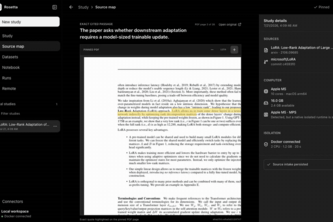
Rosetta is a self-reported desktop application designed as a learning workbench for AI engineers. It enables users to reproduce machine learning research papers by adapting experiments to local hardware while maintaining visibility into adaptations and provenance.
What changed
The project description shows an author-built tool that claims to bridge the gap between reading academic papers and running practical implementations, using AI agents (specifically GPT-5.6) to automate parts of the process but keeping human oversight in key areas like execution approval and evidence grounding.
Single most important open question
Is there any evidence of traction, revenue, or customer adoption beyond the author's own development? The description contains no data on users, usage, or monetization — only claims about functionality and design decisions.
What The Product Actually Is
The description states that Rosetta is a TypeScript/React/Electron desktop application with a local Node.js API and a pinned Python/PyTorch Docker runtime. It consists of five connected layers:
- Source and evidence layer
- Learning and planning layer
- Agent and model layer (using GPT-5.6)
- Execution layer
- Proof and provenance layer
It is described as a tool that allows learners to:
- Start with a paper and its implementation repository
- Pin sources, connect claims to PDF passages and code
- Turn them into an editable lesson
- Plan experiments for local hardware or Modal GPU plans
- Run isolated experiments in Docker environments
- Retain provenance of all steps
The system uses Codex and GPT-5.6 for automation but emphasizes human-led product decisions, particularly around execution approval and evidence grounding.
Claim
Rosetta is a desktop application built with Electron, React, TypeScript, Node.js, Python, PyTorch, Docker, and GPT-5.6.
Evidence Author's own write-up
Positioning & Claim Evolution
The description positions Rosetta as a learning workbench for AI engineers that aims to make research reproduction more approachable without simplifying away science.
It claims:
- To turn passive reading into active understanding
- To help learners trace evidence, adapt experiments responsibly, and run ideas on their own hardware
- To preserve mechanisms being taught while clearly showing what was changed
- To maintain honesty in reproduction by distinguishing reported results from adaptations and actual runs
The project evolved from a simple question: What if a learner could understand a difficult paper by tracing its evidence, adapting the experiment responsibly, and running the central idea on the hardware they already have?
Claim
Rosetta helps learners move from understanding a paper to executing it on their own hardware.
Evidence Author's own write-up
Target Customer & ICP
The description states that Rosetta targets AI engineers who want to learn by reproducing machine learning research papers.
It does not specify further细分 (e.g., whether it targets students, researchers, practitioners, or educators), nor does it define a specific ideal customer profile beyond the general category of "AI engineers."
Claim
Rosetta is aimed at AI engineers.
Evidence Author's own write-up
Business Model & Pricing Evidence
There is no evidence in the description of any business model or pricing structure. The project is described as a hackathon submission and does not mention monetization, subscriptions, licensing, or any revenue-generating mechanisms.
Claim
No business model or pricing information provided.
Evidence Author's own write-up
Technical & Delivery Signals
Rosetta is built with:
- Electron (desktop app)
- React + TypeScript
- Node.js API
- Python/PyTorch Docker runtime
- GPT-5.6 and Codex for automation
- Playwright, Vite, GitHub, Modal, etc.
It uses a layered architecture with five distinct components:
- Source and evidence layer
- Learning and planning layer
- Agent and model layer (with GPT-5.6 routing policy)
- Execution layer (Docker + Modal GPU plans)
- Proof and provenance layer
The system is designed to:
- Pin sources and repositories
- Adapt experiments to local hardware
- Run isolated Docker environments
- Allow approval before remote execution
- Retain full provenance of runs
Claim
Rosetta uses a layered architecture with GPT-5.6, Docker, and Modal.
Evidence Author's own write-up
Traction & Maturity Signals
There is no evidence of traction or maturity beyond the author’s development effort. The project is described as a hackathon submission (OpenAI 2026) with:
- One team member
- No revenue, customers, or adoption data
- No mention of user feedback, usage metrics, or product iteration history
Claim
No traction or maturity signals.
Evidence Author's own write-up
Competitive Context
The description does not provide any information about competitors or competitive positioning. It does not name similar tools or platforms in the space of AI research reproduction or educational tooling.
Claim
No competitive context provided.
Evidence Author's own write-up
Open Questions & Risks
- Unverified claims: All statements are self-reported and unverified.
- No traction or revenue: The project is described as a hackathon submission with no evidence of adoption or monetization.
- Single-person team: The entire development effort was done by one person, raising questions about scalability or long-term viability.
- GPT-5.6 dependency: Reliance on an unverified model version (GPT-5.6) raises concerns about availability and consistency.
- Lack of user feedback: No mention of testing with users or iterative improvement.
Inference The lack of traction, revenue, or customer data suggests this is a prototype or proof-of-concept rather than a mature product.
Evidence Author's own write-up
Questions the description leaves open
- What specific problems are you solving for AI engineers trying to reproduce research?
- How do you plan to scale beyond one person building the tool?
- Have you tested this with actual users or educators?
- Is there any plan for monetization or commercialization?
- What is your long-term vision for Rosetta beyond the hackathon?
- How do you ensure reproducibility without sacrificing scientific rigor?
- Can you explain how the GPT-5.6 routing policy works in practice?
Note
These are direct questions based on the self-reported description and should be asked to validate assumptions.
Overall Assessment
There is no evidence of revenue, customers, or traction to support an investment or partnership decision. The project appears to be a proof-of-concept or prototype built during a hackathon by one individual. It describes a compelling idea and technical approach but lacks any indication of real-world usage or commercial viability.
Inference This is likely a pre-product stage concept with potential, but not ready for investment or partnership.
Evidence Author's own write-up
Customer Segments
evidenced
The description states: "Rosetta is a learning workbench for AI engineers."
Value Propositions
evidenced
The description states: "Rosetta is a learning workbench for AI engineers. A learner starts with a machine-learning paper and its implementation repository. Rosetta pins those sources, connects claims to the relevant PDF passages and code, and turns them into an editable lesson rather than a one-shot summary."
It also states: "The goal is to preserve the mechanism being taught while clearly showing what was changed." and "Rosetta keeps the evidence with the result. It records the pinned sources, selected dataset, notebook version, code and runtime details, model route, generated figures, outputs, annotations, and any deviation from the original experiment."
Channels
inferred
The description does not explicitly state how Rosetta reaches its users. However, it mentions that the project was submitted to the OpenAI 2026 hackathon on Devpost, which implies an online platform or event-based distribution channel.
Customer Relationships
inferred
The description does not explicitly describe how Rosetta interacts with its customers. However, since it is described as a desktop application and provides interactive learning features such as annotation and question-answering capabilities, one might infer that the relationship involves direct user interaction through the software interface.
Revenue Streams
not evidenced
There is no information in the description about how Rosetta generates revenue or monetizes its service.
Key Resources
evidenced
The description states: "Rosetta is a TypeScript, React, and Electron desktop application with a local Node.js API and a pinned Python/PyTorch Docker runtime."
It also mentions: "We built it as five connected layers, each with a specific responsibility." and "Codex also accelerated the development of these layers."
Key Activities
evidenced
The description states: "Rosetta pins those sources, connects claims to the relevant PDF passages and code, and turns them into an editable lesson rather than a one-shot summary."
It also mentions: "Rosetta then plans an experiment for the learner's machine. It checks the available CPU, memory, disk, accelerators, dependencies, and execution budget."
Additionally: "Rosetta extracts datasets mentioned by the paper, verifies candidate metadata and licenses, compares size with local hardware, and lets the learner approve a bounded local sample."
And: "When a learner is confused, they can drag a paper passage, equation, code selection, or generated figure into an annotation and ask the research agent about that exact context."
Key Partnerships
inferred
The description does not explicitly mention any partnerships. However, given that it uses Codex and GPT-5.6, one might infer that there are technological partnerships involved in the development of these components.
Cost Structure
not evidenced
There is no information in the description about the cost structure or expenses associated with operating Rosetta.
Evidence & Gaps
- Customer Segments: evidenced - "Rosetta is a learning workbench for AI engineers."
- Value Propositions: evidenced - "Rosetta is a learning workbench for AI engineers... It records the pinned sources, selected dataset, notebook version, code and runtime details, model route, generated figures, outputs, annotations, and any deviation from the original experiment."
- Channels: inferred - Based on submission to Devpost, likely online platform or event-based.
- Customer Relationships: inferred - Direct interaction through software interface.
- Revenue Streams: not evidenced - No mention of monetization strategy.
- Key Resources: evidenced - "Rosetta is a TypeScript, React, and Electron desktop application with a local Node.js API and a pinned Python/PyTorch Docker runtime."
- Key Activities: evidenced - "Rosetta pins those sources... Rosetta then plans an experiment... Rosetta extracts datasets mentioned by the paper..."
- Key Partnerships: inferred - Likely involves Codex and GPT-5.6.
- Cost Structure: not evidenced - No information on operational costs.
Questions that would convert inferred blocks into evidenced ones:
- Channels: What specific channels does Rosetta use to reach its users?
- Customer Relationships: How does Rosetta interact with its customers beyond the software interface?
- Revenue Streams: How does Rosetta generate revenue?
- Key Partnerships: Who are Rosetta's key partners in development or operation?
- Cost Structure: What are the main cost drivers for operating Rosetta?
User Stories BotA demo video on every pull request
Get a demo video on every new feature
GitHub App that watches your pull requests and records a narrated, captioned demo.
Save time on demo prep and make informed decisions faster with a video walkthrough of every new feature.
Source
Submitted to the OpenAI 2026 hackathon on Devpost. Project home on Devpost. Back to the full gallery on Devpost.
This competitive analysis was produced by top-founders.com (opens in a new tab)
Generated by a language model from this project's public Devpost page — its tagline, the author's own write-up and any built-with tags listed there — as captured in August 2026. Short quotations are the author's words. It is an opinion on the idea as a business, not on the people behind it, and it reflects the description as published then. If the project has moved on, request a correction below. The analysis is not independent research and contains no verified traction, revenue or customer data.
An independent guide by KFG International LLC — not affiliated with, endorsed by, or connected to Devpost or OpenAI.