

Archive position — measured, not model output
2 likes on Devpost
221 of the 7,850 archived projects have more likes, and 284 share exactly 2 — so this project's #412 place in the like-ranked listing is a tie-break inside that group, not a ranking.
Projects (log scale)
Likes on Devpost. ▲ marks this project's group.
Show the figures
| Likes | Projects | Share of archive |
|---|---|---|
| 0 | 5,587 | 71.2% |
| 1 | 1,758 | 22.4% |
| 2 | 284 | 3.6% |
| 3–4 | 132 | 1.7% |
| 5–9 | 75 | 1.0% |
| 10+ | 14 | 0.2% |
 User Stories BotA demo video on every pull request
Get a demo video on every new feature
GitHub App that watches your pull requests and records a narrated, captioned demo.
Save time on demo prep and make informed decisions faster with a video walkthrough of every new feature.
Executive Summary
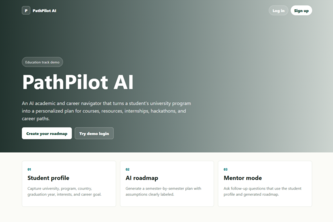
The company appears to be a self-reported AI-powered academic and career navigation tool for students, built as a hackathon project by two founders. The product generates personalized degree roadmaps, recommends learning resources, and connects students with internships and career opportunities.
What changed: The project is described as a hackathon submission, not yet a commercial product or service in the market. It has no evidence of revenue, customers, or traction beyond its own self-description.
The single most important open question: Is there sufficient evidence that this idea can scale into a viable business model with real user adoption and monetization?
What The Product Actually Is
- The description states that PathPilot AI is an AI-powered academic and career navigator.
- It allows students to input their university, country, degree program, interests, graduation year, and career goal.
- It generates a semester-by-semester academic roadmap, recommends learning resources, suggests career pathways, explains internship preparation steps, proposes hackathon project ideas, and offers an AI Mentor Mode for follow-up questions.
- The product is built using HTML, CSS, JavaScript, with optional Next.js API routes, OpenAI Responses API, and browser localStorage for demo purposes.
Inference: The tool appears to be a prototype or MVP built in a short timeframe, likely for demonstration at a hackathon. It does not yet appear to have real backend infrastructure or data sources beyond what was described.
Positioning & Claim Evolution
- The description states that PathPilot AI is an "AI-powered academic and career navigator".
- It positions itself as a tool that helps students understand what their next four years actually demand, by consolidating scattered information into a single personalized starting point.
- The project claims to offer a “wow” moment: turning a student’s profile into a useful roadmap in under a minute while clearly labeling assumptions.
Inference: This is a self-reported positioning statement. There is no evidence of market testing or customer feedback that would validate whether this is a compelling value proposition for students or universities.
Target Customer & ICP
- The description states that PathPilot AI targets university students.
- It aims to help students who know their degree title but not what the next four years actually demand.
- It also mentions targeting students with interests, graduation year, and career goals in mind.
Inference: The target customer is a student segment, but no evidence of market segmentation or specific user personas is provided. No indication of whether this is for undergrads, grads, or international students.
Business Model & Pricing Evidence
- Not evidenced.
- The description does not mention any pricing model, monetization strategy, or business model.
Inference: There is no evidence that the project has moved beyond a prototype or demo stage to consider how it might be monetized.
Technical & Delivery Signals
- Built with HTML5, CSS3, JavaScript, React, Next.js, TypeScript, Vercel, OpenAI API (Responses), GitHub, and localStorage.
- The frontend is described as simple and editable, built in plain HTML/CSS/JavaScript to allow team members to personalize UI without deep framework knowledge.
- Backend uses optional Next.js API routes and OpenAI Responses API for roadmap generation and mentor mode.
- Uses browser localStorage for demo accounts, profiles, saved roadmaps, and mentor messages.
- Includes a fallback demo mode if backend or API key is unavailable.
Inference: The technical stack suggests a lightweight MVP. No evidence of production-grade infrastructure, scalability, or cloud services beyond Vercel and localStorage.
Traction & Maturity Signals
- Not evidenced.
- The project is described as a hackathon submission.
- There is no mention of users, adoption, revenue, or any traction metrics.
Inference: No evidence of real-world usage or product-market fit. The project appears to be in early-stage development.
Competitive Context
- Not evidenced.
- The description does not mention competitors or market landscape.
Inference: No information is provided about existing tools or platforms that address similar needs in academic and career navigation.
Open Questions & Risks
- The product is described as a hackathon submission with no evidence of real traction or commercial viability.
- It uses localStorage for demo purposes, suggesting no persistent backend or user data infrastructure.
- The team size is two, which may limit development speed or scalability.
- No mention of monetization, pricing, or business model.
- The MVP focuses on core "wow" features but does not include real curriculum databases or internship listings.
Inference: The project lacks commercial readiness and has no evidence of a sustainable path to market adoption or revenue generation.
Questions the description leaves open
- What is the actual user acquisition strategy for this product?
- How do you plan to scale beyond the current hackathon-level prototype?
- Are there any partnerships with universities or educational institutions already in place?
- What is your long-term vision for monetization and pricing?
- How do you intend to validate that students actually use and value the roadmap features?
- What are the technical limitations of using localStorage for user data storage at scale?
Overall Assessment
- Not evidenced.
- The project is described as a hackathon submission with no evidence of traction, revenue, or commercial viability.
Inference: Based on the self-reported description alone, there is insufficient evidence to support an investment or partnership decision. This appears to be an early-stage idea that has not yet demonstrated product-market fit or a clear path to monetization.
User Stories BotA demo video on every pull request
Get a demo video on every new feature
GitHub App that watches your pull requests and records a narrated, captioned demo.
Save time on demo prep and make informed decisions faster with a video walkthrough of every new feature.
Source
Submitted to the OpenAI 2026 hackathon on Devpost. Project home on Devpost. Back to the full gallery on Devpost.
This competitive analysis was produced by top-founders.com (opens in a new tab)
Generated by a language model from this project's public Devpost page — its tagline, the author's own write-up and any built-with tags listed there — as captured in August 2026. Short quotations are the author's words. It is an opinion on the idea as a business, not on the people behind it, and it reflects the description as published then. If the project has moved on, request a correction below. The analysis is not independent research and contains no verified traction, revenue or customer data.
An independent guide by KFG International LLC — not affiliated with, endorsed by, or connected to Devpost or OpenAI.