

Archive position — measured, not model output
0 likes on Devpost
2,263 of the 7,850 archived projects have more likes, and 5,587 share exactly 0 — so this project's #2,375 place in the like-ranked listing is a tie-break inside that group, not a ranking.
Projects (log scale)
Likes on Devpost. ▲ marks this project's group.
Show the figures
| Likes | Projects | Share of archive |
|---|---|---|
| 0 | 5,587 | 71.2% |
| 1 | 1,758 | 22.4% |
| 2 | 284 | 3.6% |
| 3–4 | 132 | 1.7% |
| 5–9 | 75 | 1.0% |
| 10+ | 14 | 0.2% |
 User Stories BotA demo video on every pull request
Get a demo video on every new feature
GitHub App that watches your pull requests and records a narrated, captioned demo.
Save time on demo prep and make informed decisions faster with a video walkthrough of every new feature.
Executive Summary
What the company appears to be
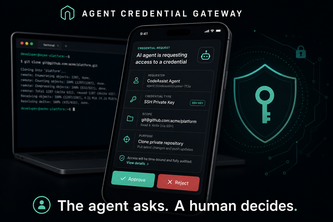
Agent Credential Gateway is a self-reported project submitted to the OpenAI 2026 hackathon. The description states it enables AI agents to request user credentials while ensuring human approval via passkeys, with no action taken unless a human approves on their phone.
What changed
No evidence of prior version or change history is provided. This appears to be a new submission, likely a prototype or proof-of-concept.
Single most important open question
Is there any evidence of actual user testing, adoption, or integration with real AI agents or credential systems?
What The Product Actually Is
The description states: “AI agents can ask for your credentials, but a human always decides: approve once on your phone with a passkey, or nothing happens.” This implies a system where:
- AI agents request access to user credentials.
- A human must approve such requests via a mobile passkey.
- If not approved, no action occurs.
The author declares the following technologies were used in development:
- 1Password
- AI agents
- Cloudflare Durable Objects and Workers
- ed25519, extism, Go, GPT-5.6, OpenAI Codex, OpenWRT, passkeys, PWA, React, SQLite, TailwindCSS, TanStack, TypeScript, Vite, WASM, Web Push, WebAuthn
However, no functional specification or architecture is provided beyond this self-reported list.
Confidence Low — the description does not define how the system works technically beyond a high-level narrative and tooling tags.
Positioning & Claim Evolution
The tagline states: “AI agents can ask for your credentials, but a human always decides: approve once on your phone with a passkey, or nothing happens.”
This is a self-reported claim about:
- A security-focused approach to credential sharing.
- Human-in-the-loop decision-making in AI agent workflows.
- Passkey-based authentication.
There is no evidence of prior positioning, evolution of claims, or marketing history. The project appears to be a new submission with no prior version or narrative development.
Confidence Very low — the only claim is from the author’s own description.
Target Customer & ICP
The description does not state who the target customer is or what the ideal customer profile (ICP) might be. It implies a general audience of users who interact with AI agents and manage credentials, but no segmentation or persona details are provided.
Confidence Not evidenced — no indication of target user type or market focus.
Business Model & Pricing Evidence
There is no evidence of pricing, monetization strategy, or business model in the description. The author does not state how the product would be sold, licensed, or funded.
Confidence Not evidenced — no commercial details provided.
Technical & Delivery Signals
The author declares the following technologies were used:
- 1Password
- AI agents
- Cloudflare Durable Objects and Workers
- ed25519, extism, Go, GPT-5.6, OpenAI Codex, OpenWRT, passkeys, PWA, React, SQLite, TailwindCSS, TanStack, TypeScript, Vite, WASM, Web Push, WebAuthn
This suggests a technical stack focused on:
- Passkey-based authentication (WebAuthn)
- AI agent integration
- Lightweight, secure credential handling
- Mobile-first delivery via PWA and passkeys
However, no evidence of actual implementation, deployment, or performance is provided.
Confidence Low — the list of technologies is self-reported and not validated.
Traction & Maturity Signals
There is no evidence of traction, adoption, or maturity. The project was submitted to a hackathon (Devpost), which implies it may be a prototype or proof-of-concept. No users, customers, or usage data are mentioned.
Confidence Not evidenced — no signs of product-market fit or real-world use.
Competitive Context
The description does not mention any competitors or existing solutions in the space. It is unclear whether this project addresses an existing market gap or overlaps with known tools for credential management or AI agent security.
Confidence Not evidenced — no competitive analysis or positioning against other tools.
Open Questions & Risks
- No evidence of real-world use or testing: The product appears to be a hackathon submission, not a tested solution.
- Unverified claims: All descriptions are self-reported and unverified.
- Lack of commercial clarity: No pricing, business model, or target customer is defined.
- Technical depth unknown: While technologies are listed, no implementation details or performance data are provided.
Confidence Low — risks stem from lack of evidence rather than explicit claims.
Questions the description leaves open
- What specific AI agents does this system interact with?
- How is the passkey approval process implemented and secured?
- Has this been tested with real users or in a live environment?
- What is the intended business model or monetization strategy?
- Are there any existing partnerships, integrations, or early adopters?
Overall Assessment
Not evidenced — no information on traction, revenue, customer base, or commercial viability exists in the description.
Confidence Very low — this is a self-reported hackathon submission with no signs of product-market fit or business development.
User Stories BotA demo video on every pull request
Get a demo video on every new feature
GitHub App that watches your pull requests and records a narrated, captioned demo.
Save time on demo prep and make informed decisions faster with a video walkthrough of every new feature.
Source
Submitted to the OpenAI 2026 hackathon on Devpost. Project home on Devpost. Back to the full gallery on Devpost.
This competitive analysis was produced by top-founders.com (opens in a new tab)
Generated by a language model from this project's public Devpost page — its tagline and any built-with tags listed there, since the author published no write-up — as captured in August 2026. Short quotations are the author's words. It is an opinion on the idea as a business, not on the people behind it, and it reflects the description as published then. If the project has moved on, request a correction below. The analysis is not independent research and contains no verified traction, revenue or customer data.
An independent guide by KFG International LLC — not affiliated with, endorsed by, or connected to Devpost or OpenAI.