

Archive position — measured, not model output
0 likes on Devpost
2,263 of the 7,850 archived projects have more likes, and 5,587 share exactly 0 — so this project's #2,376 place in the like-ranked listing is a tie-break inside that group, not a ranking.
Projects (log scale)
Likes on Devpost. ▲ marks this project's group.
Show the figures
| Likes | Projects | Share of archive |
|---|---|---|
| 0 | 5,587 | 71.2% |
| 1 | 1,758 | 22.4% |
| 2 | 284 | 3.6% |
| 3–4 | 132 | 1.7% |
| 5–9 | 75 | 1.0% |
| 10+ | 14 | 0.2% |
 User Stories BotA demo video on every pull request
Get a demo video on every new feature
GitHub App that watches your pull requests and records a narrated, captioned demo.
Save time on demo prep and make informed decisions faster with a video walkthrough of every new feature.
Executive Summary
What the company appears to be
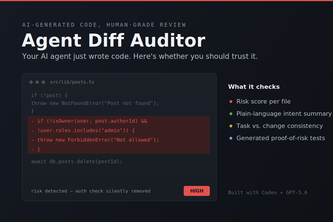
Agent Diff Auditor is a self-reported tool that claims to audit AI-generated code changes (diffs) by checking whether those changes align with the task they were intended to fulfill. It uses GPT-5.6 and structured outputs to analyze diffs, flag inconsistencies between stated tasks and actual code changes, score risk per file, generate tests for high-risk files, and provide line-cited explanations.
What changed
The project was built over one week by a single developer (Lamine Gaye) using Codex, GPT-5.6, Next.js, React, Tailwind CSS, TypeScript, Vitest, Zod, and OpenAI API. It is presented as a solution to a perceived gap in AI code review tools — specifically, that most tools check for code quality but not whether the code does what it was asked to do.
Single most important open question
Is there any evidence of real-world usage or adoption beyond the author’s own development and demo? The description states no revenue, customers, or traction data are available. If this tool is being used in practice, how is it integrated into workflows?
What The Product Actually Is
The description states that Agent Diff Auditor:
- Takes a unified git diff and an optional task description
- Runs parallel analyses powered by GPT-5.6
- Performs consistency checks between the stated task and real diff
- Scores risk per file (low/medium/high/unknown)
- Provides plain-language intent summaries with exact line citations
- Generates runnable test code (Vitest) for high-risk files
- Offers “explain this” functionality for any line in the diff
It is described as a tool that evaluates whether AI-generated code changes match their intended purpose, rather than just checking code quality.
Evidence
- The author describes all five core features.
- The architecture uses Zod schema validation and OpenAI structured outputs.
- It includes a demo scenario where a diff removing an authorization check while claiming to "improve performance" is flagged as high risk, with generated tests.
Inference The tool appears designed for use in CI/CD pipelines or code review workflows involving AI agents. However, no evidence of integration into such systems exists in the description.
Positioning & Claim Evolution
The author states:
- Most AI code review tools check if code is clean, not whether it does what was asked.
- Agent Diff Auditor focuses on consistency between task and diff — a gap that existing tools don’t address.
- It’s built to catch silent failures where code looks correct but behaves incorrectly due to misalignment with the original task.
Evidence
- The inspiration section explicitly contrasts this tool with general-purpose review tools.
- The “Why not just paste the diff into a chat window?” paragraph highlights the need for schema-constrained responses over open-ended LLM answers.
Inference The positioning is that of a specialized auditing layer for AI-generated code, aimed at reducing risks from misaligned outputs. It positions itself as a complement to existing quality-focused tools rather than a replacement.
Target Customer & ICP
The description does not name specific customers or personas.
Evidence
- No mention of target industries, roles, or organizations.
- The tool is framed as useful for teams using AI agents in development workflows.
Inference
Based on the context (CI/CD, GitHub Actions, agent-written code), likely targets:
- Development teams working with AI-assisted coding tools
- Organizations integrating LLMs into software development pipelines
- Engineering leads or security-focused developers concerned about misaligned outputs
Business Model & Pricing Evidence
There is no evidence of pricing, monetization strategy, or business model.
Evidence
- No mention of subscriptions, usage fees, or licensing.
- The project was submitted to a hackathon and deployed as a demo.
- No indication of commercial intent beyond the author’s own use case.
Inference If this tool is intended for commercial deployment, it likely would follow a SaaS model (e.g., API access, CI/CD integration), but no such details are provided.
Technical & Delivery Signals
The description provides technical details:
- Built with Codex, GPT-5.6, Next.js, React, Tailwind CSS, TypeScript, Vitest, Zod, OpenAI API
- Uses structured outputs and schema validation (Zod) for defense-in-depth
- Implements a swappable provider architecture to manage costs during development
- Includes unit tests and handles edge cases like new files or deletions
Evidence
- The author describes prompt design challenges around anti-hallucination techniques.
- A script that exited silently due to CommonJS/top-level-await incompatibility was traced down with Codex.
Inference The tool is built with a focus on reliability and correctness, especially in handling LLM outputs. It suggests the author prioritized robustness over speed or scalability.
Traction & Maturity Signals
There is no evidence of traction, customers, revenue, or adoption beyond the author’s own development.
Evidence
- The project was built by one person (Lamine Gaye).
- Submitted to a hackathon.
- Deployed as a demo with no indication of ongoing usage.
- No mention of users, feedback loops, or product iterations.
Inference This is an early-stage prototype or proof-of-concept. There is no evidence of product-market fit or real-world deployment.
Competitive Context
The description does not name competitors or reference existing tools in the space.
Evidence
- No list of competing products or platforms.
- The author contrasts this tool with “general-purpose code review tools” but doesn’t specify which ones.
Inference It likely competes with AI-assisted code review tools like GitHub Copilot, Tabnine, SonarQube, or other LLM-based linting and analysis platforms. However, no direct comparison is made.
Open Questions & Risks
Several risks are implied by the self-reported nature of the project:
- No independent verification — all claims are unverified.
- Single-person development — raises questions about scalability or long-term maintenance.
- Limited real-world testing — no evidence of usage beyond author’s own experiments.
- Dependency on GPT-5.6 — not a publicly available model, limiting transparency and reproducibility.
- Demo-only deployment — public demo runs on a development provider, suggesting no production-ready infrastructure yet.
Inference The tool may be too early to assess for commercial viability or market readiness without further evidence of traction, integration, or user feedback.
Questions the description leaves open
- What is the actual workflow in which this tool would be used? Is it integrated into CI/CD?
- Have you tested this with real teams or organizations using AI agents for code generation?
- How do you plan to scale beyond a single developer’s prototype?
- Are there any known limitations or edge cases that haven’t been addressed yet?
- What is the roadmap for multi-file cross-referencing and repository history tracking?
- Do you have plans to monetize this tool, and if so, what model are you considering?
Overall Assessment
There is insufficient evidence to assess commercial viability or strategic fit.
Evidence
- No revenue, customers, or traction data.
- The project was built as a hackathon submission with no indication of commercial intent.
- The tool appears to be a prototype or early-stage idea.
Inference This represents a concept with potential — particularly in an emerging area where AI-generated code is becoming more common and misalignment risks are increasing. However, without evidence of real-world usage, adoption, or product-market fit, it cannot be evaluated as a viable investment or partnership opportunity at this time.
User Stories BotA demo video on every pull request
Get a demo video on every new feature
GitHub App that watches your pull requests and records a narrated, captioned demo.
Save time on demo prep and make informed decisions faster with a video walkthrough of every new feature.
Source
Submitted to the OpenAI 2026 hackathon on Devpost. Project home on Devpost. Back to the full gallery on Devpost.
This competitive analysis was produced by top-founders.com (opens in a new tab)
Generated by a language model from this project's public Devpost page — its tagline, the author's own write-up and any built-with tags listed there — as captured in August 2026. Short quotations are the author's words. It is an opinion on the idea as a business, not on the people behind it, and it reflects the description as published then. If the project has moved on, request a correction below. The analysis is not independent research and contains no verified traction, revenue or customer data.
An independent guide by KFG International LLC — not affiliated with, endorsed by, or connected to Devpost or OpenAI.