

Archive position — measured, not model output
0 likes on Devpost
2,263 of the 7,850 archived projects have more likes, and 5,587 share exactly 0 — so this project's #5,795 place in the like-ranked listing is a tie-break inside that group, not a ranking.
Projects (log scale)
Likes on Devpost. ▲ marks this project's group.
Show the figures
| Likes | Projects | Share of archive |
|---|---|---|
| 0 | 5,587 | 71.2% |
| 1 | 1,758 | 22.4% |
| 2 | 284 | 3.6% |
| 3–4 | 132 | 1.7% |
| 5–9 | 75 | 1.0% |
| 10+ | 14 | 0.2% |
 User Stories BotA demo video on every pull request
Get a demo video on every new feature
GitHub App that watches your pull requests and records a narrated, captioned demo.
Save time on demo prep and make informed decisions faster with a video walkthrough of every new feature.
Executive Summary
What the company appears to be
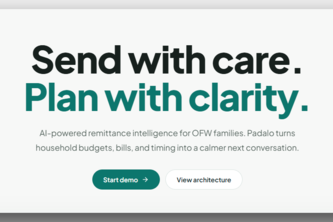
Padalo is an AI-powered remittance intelligence platform for overseas Filipino workers (OFWs) and their families. The product presents itself as a shared household finance workspace that includes a ledger, conversational AI agent, and forecasting tool (FXPilot) to help manage financial coordination across distance.
What changed
This is a self-reported hackathon project submitted to the OpenAI 2026 hackathon. It describes an early-stage prototype with a demo mode and synthetic data, but no live integrations or production use.
Single most important open question
Is there evidence of traction, revenue, or customer adoption beyond the author's own demonstration?
Note: This analysis is based solely on the self-reported project description provided by the caller. All claims are unverified and should be treated as such. No third-party data, financials, or user feedback were used.
What The Product Actually Is
The description states that Padalo is:
- A shared household finance workspace for OFW families.
- A platform with a ledger, conversational AI agent (called "the agent"), and a forecasting tool called FXPilot.
- Not intended to replace remittance providers but to act as a neutral layer between the sender and receiver.
It includes:
- A shared ledger for envelopes, transactions, remittances, and bills.
- An AI agent that can check budgets, look up bills, search transactions, log expenses, and create remittances — with a visible tool-progress timeline.
- FXPilot, which forecasts provider-behavior patterns using Prophet, trained on synthetic data.
The system is built using:
- Next.js (App Router) + TypeScript
- FastAPI as API boundary
- PostgreSQL for data storage
- OpenAI Responses API for agent routing
- Prophet for forecasting
- React-based frontend stack including TanStack Query, Zod, Tailwind CSS, etc.
Inference: The product is described as a prototype or demo, not a production-ready solution. It uses synthetic data and lacks live integrations.
Positioning & Claim Evolution
The author states that Padalo:
- Treats remittances as a shared household concern rather than a one-way transaction.
- Aims to make financial coordination between OFWs and their families more transparent and collaborative.
- Is honest about what it can and cannot predict, especially in forecasting.
It positions itself not as a replacement for remittance providers but as a complementary tool that improves communication and planning around money transfers.
Claim: Padalo is positioned as a neutral layer between OFWs and remittance providers.
Inference: The positioning reflects an intent to build trust through transparency, especially in AI behavior and forecasting accuracy.
Target Customer & ICP
The description identifies:
- Overseas Filipino workers (OFWs) and their families.
- Specifically, those who coordinate finances across distance and want clarity on what arrived, what was spent, and what’s left.
Claim: The target customer is OFW families.
Inference: There is no evidence of segmentation beyond this group or any indication of how many such users exist or have been reached.
Business Model & Pricing Evidence
There is no mention in the description of:
- Revenue streams
- Pricing models
- Monetization strategy
- Customer acquisition costs
- Any commercial arrangements
Not evidenced: No evidence of business model or pricing structure.
Technical & Delivery Signals
The project uses:
- Next.js + TypeScript for frontend
- FastAPI + SQLAlchemy for backend services
- PostgreSQL for data persistence
- OpenAI Responses API with Pydantic-validated tools
- Prophet for forecasting
- Synthetic data with clear disclaimers
- Demo mode with deterministic reseeding
Key technical features include:
- Typed agent architecture
- Tool-progress timeline visible to users
- Disclaimers on forecasts
- No direct database access by AI model
Inference: The architecture shows attention to trust and safety in AI interactions, but no evidence of scalability or production deployment.
Traction & Maturity Signals
The description states:
- It was built for a hackathon.
- It includes a deterministic demo mode.
- It uses synthetic data instead of live provider integrations.
- No mention of real users, customers, or usage metrics.
Not evidenced: No evidence of traction, adoption, or user engagement beyond the author’s own demonstration.
Competitive Context
The description does not reference:
- Competitors
- Market size
- Existing solutions in the remittance or financial coordination space
Not evidenced: No competitive analysis or positioning relative to other tools.
Open Questions & Risks
Key risks and open questions based on the self-reported description:
- The product is described as a hackathon prototype with synthetic data.
- No live integrations, no real remittance provider connections.
- No evidence of user feedback, market validation, or commercial viability.
- AI agent architecture relies heavily on tool schemas and validation — but this is not yet proven at scale.
- Forecasting uses synthetic data only; lack of real-world performance metrics.
Inference: The project may be a proof-of-concept rather than a scalable product. Lack of traction or revenue makes it hard to assess commercial potential.
Questions the description leaves open
- What is the actual source of remittance data used in FXPilot? Is there any plan to integrate with live providers?
- How does the team intend to validate the accuracy of forecasts when transitioning from synthetic to real data?
- Are there any early adopters or pilot users beyond the demo?
- What are the key assumptions about user behavior and willingness to pay for this type of service?
- Has the team considered regulatory compliance in financial coordination tools?
- How will authentication, identity verification, and security be handled at scale?
Overall Assessment
This is a self-reported hackathon project with no evidence of traction, revenue, or customer adoption.
Assessment: Not ready for investment or partnership consideration at this stage. The product shows early technical sophistication but lacks commercial validation or real-world usage. It may be a promising idea in need of further development and market testing before it can be evaluated as a viable business opportunity.
User Stories BotA demo video on every pull request
Get a demo video on every new feature
GitHub App that watches your pull requests and records a narrated, captioned demo.
Save time on demo prep and make informed decisions faster with a video walkthrough of every new feature.
Source
Submitted to the OpenAI 2026 hackathon on Devpost. Project home on Devpost. Back to the full gallery on Devpost.
This competitive analysis was produced by top-founders.com (opens in a new tab)
Generated by a language model from this project's public Devpost page — its tagline, the author's own write-up and any built-with tags listed there — as captured in August 2026. Short quotations are the author's words. It is an opinion on the idea as a business, not on the people behind it, and it reflects the description as published then. If the project has moved on, request a correction below. The analysis is not independent research and contains no verified traction, revenue or customer data.
An independent guide by KFG International LLC — not affiliated with, endorsed by, or connected to Devpost or OpenAI.