

Archive position — measured, not model output
5 likes on Devpost
54 of the 7,850 archived projects have more likes, and 35 share exactly 5 — so this project's #81 place in the like-ranked listing is a tie-break inside that group, not a ranking.
Projects (log scale)
Likes on Devpost. ▲ marks this project's group.
Show the figures
| Likes | Projects | Share of archive |
|---|---|---|
| 0 | 5,587 | 71.2% |
| 1 | 1,758 | 22.4% |
| 2 | 284 | 3.6% |
| 3–4 | 132 | 1.7% |
| 5–9 | 75 | 1.0% |
| 10+ | 14 | 0.2% |
 User Stories BotA demo video on every pull request
Get a demo video on every new feature
GitHub App that watches your pull requests and records a narrated, captioned demo.
Save time on demo prep and make informed decisions faster with a video walkthrough of every new feature.
Executive Summary
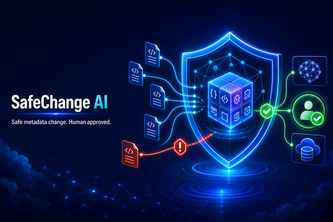
What the company appears to be: SafeChange AI is a self-reported Salesforce metadata deletion assistant designed to make destructive operations safe and reviewable. It is built as a Lightning Web Component embedded in Salesforce, with a backend service using Node.js and Express that leverages OpenAI APIs for intent interpretation and Salesforce APIs for dependency mapping and execution control.
What changed: The project description indicates this was built for the OpenAI 2026 hackathon. No evidence of prior development or commercial traction is provided beyond its submission to Devpost.
Single most important open question: Is there any evidence of actual use, adoption or revenue generation from SafeChange AI beyond its hackathon submission?
What The Product Actually Is
The description states that SafeChange AI is a review-first Salesforce metadata deletion assistant embedded in Lightning. It allows administrators to type or dictate commands such as "Delete Legacy_Field__c from Account".
It uses:
- Structured OpenAI output for interpreting requests
- Salesforce Tooling API for dependency mapping
- Salesforce REST and Metadata APIs for validation, deployment, and rollback
- A Node.js/Express backend coordinating the safety pipeline
The system is described as performing:
- Dependency mapping through Salesforce APIs
- Backup retrieval before changes
- Generation of fixes and diffs
- Requirement for human approval and one-time token
- Validation and deployment of dependency fixes
- Execution via a separate post-destructive deployment
- Synchronization of generated changes to source control
Not evidenced: No details on pricing, customer base, or actual deployment in production environments.
Positioning & Claim Evolution
The author claims that SafeChange AI makes destructive Salesforce metadata changes:
- Understandable
- Reviewable
- Recoverable
It positions itself as a tool that:
- Interprets commands
- Maps dependencies
- Generates fixes
- Creates backups
- Requires approval before execution
Inferred claim: The product is positioned to reduce risk in Salesforce deployments by introducing an AI-assisted, deterministic workflow.
Not evidenced: No evidence of prior positioning or claims about market fit, competitive differentiation, or customer feedback on the product's value proposition.
Target Customer & ICP
The description states that SafeChange AI targets Salesforce administrators who perform metadata deletion operations. These users are likely:
- System administrators
- Salesforce developers
- DevOps engineers managing Salesforce orgs
It is embedded in Lightning, suggesting it’s intended for use within Salesforce environments.
Not evidenced: No evidence of specific customer segments, personas, or user roles beyond "administrators". No data on how many such users exist or their adoption behavior.
Business Model & Pricing Evidence
The description does not contain any information about:
- Revenue model
- Pricing structure
- Monetization strategy
- Customer acquisition costs
Not evidenced: There is no indication of whether this is a freemium, subscription, or one-time purchase model. No pricing data or sales process described.
Technical & Delivery Signals
The system is built using:
- Frontend: Salesforce Lightning Web Component with browser-native speech recognition
- Backend: Node.js + Express service
- AI: OpenAI Responses API with structured output
- Salesforce APIs: REST, Tooling, Metadata, CLI
- Other tools: XML parsing, SOQL queries, source control integration
Key technical features include:
- Isolated run per request
- Backup and rollback capability
- Dependency detection across multiple metadata types
- Diff generation for review
- Approval token system
- Separation of planning from execution
Inferred signal: The architecture suggests a focus on safety, auditability, and deterministic control over destructive operations.
Not evidenced: No evidence of scalability, performance metrics, or production deployment details beyond the hackathon context.
Traction & Maturity Signals
The project was submitted to the OpenAI 2026 hackathon, indicating it is a prototype or proof-of-concept. There is no evidence of:
- Revenue
- Customers
- User adoption
- Product-market fit
- Iteration beyond the hackathon phase
Not evidenced: No data on usage, retention, or growth metrics.
Competitive Context
The description does not mention any competitors or direct market comparisons. It implies a niche within Salesforce admin tooling but provides no information about:
- Existing tools in this space
- Market size or competitive landscape
- Differentiation from current offerings
Not evidenced: No evidence of competitive positioning, market analysis, or prior product development.
Open Questions & Risks
- Unverified claims: All descriptions are self-reported and unverified.
- No traction: The product is only described as a hackathon submission with no evidence of real-world usage.
- Single founder: Only one team member (Syed Ashraf) is mentioned, raising questions about scalability or long-term viability.
- Limited scope: Focuses solely on metadata deletion; no indication of broader functionality or roadmap.
- AI dependency: Relies heavily on OpenAI APIs and structured outputs — potential risk if API availability or accuracy changes.
Inferred risk: Without real-world testing, adoption, or feedback, the product may not meet actual needs in production environments.
Questions the description leaves open
- What specific Salesforce orgs or teams are currently using this tool?
- How many destructive operations have been performed through SafeChange AI?
- Are there any known issues with dependency resolution or metadata mapping?
- Has the product been tested in multi-org environments?
- What is your plan for expanding beyond deletion to full lifecycle management?
- Have you considered integrating with CI/CD pipelines or pull request workflows?
- How do you intend to monetize this tool?
- Do you have any feedback from Salesforce administrators who tried it?
Overall Assessment
Not evidenced: No information is provided on financials, traction, scalability, or strategic fit for investment or partnership.
This project appears to be a hackathon prototype, not a commercial product with demonstrated market demand. It lacks evidence of revenue, customers, or adoption beyond its submission to Devpost.
Confidence level: Low — based entirely on self-reported claims and no external validation.
User Stories BotA demo video on every pull request
Get a demo video on every new feature
GitHub App that watches your pull requests and records a narrated, captioned demo.
Save time on demo prep and make informed decisions faster with a video walkthrough of every new feature.
Source
Submitted to the OpenAI 2026 hackathon on Devpost. Project home on Devpost. Back to the full gallery on Devpost.
This competitive analysis was produced by top-founders.com (opens in a new tab)
Generated by a language model from this project's public Devpost page — its tagline, the author's own write-up and any built-with tags listed there — as captured in August 2026. Short quotations are the author's words. It is an opinion on the idea as a business, not on the people behind it, and it reflects the description as published then. If the project has moved on, request a correction below. The analysis is not independent research and contains no verified traction, revenue or customer data.
An independent guide by KFG International LLC — not affiliated with, endorsed by, or connected to Devpost or OpenAI.