

Archive position — measured, not model output
0 likes on Devpost
2,263 of the 7,850 archived projects have more likes, and 5,587 share exactly 0 — so this project's #5,832 place in the like-ranked listing is a tie-break inside that group, not a ranking.
Projects (log scale)
Likes on Devpost. ▲ marks this project's group.
Show the figures
| Likes | Projects | Share of archive |
|---|---|---|
| 0 | 5,587 | 71.2% |
| 1 | 1,758 | 22.4% |
| 2 | 284 | 3.6% |
| 3–4 | 132 | 1.7% |
| 5–9 | 75 | 1.0% |
| 10+ | 14 | 0.2% |
 User Stories BotA demo video on every pull request
Get a demo video on every new feature
GitHub App that watches your pull requests and records a narrated, captioned demo.
Save time on demo prep and make informed decisions faster with a video walkthrough of every new feature.
Executive Summary
What the company appears to be
Patch the Web is a browser extension and associated toolchain that allows users to apply safe, shareable fixes to websites they do not own — such as government forms, university portals, or healthcare directories. The system uses a constrained transformation language (DSL), AI-assisted authoring via Codex, and a public registry of patches. It aims to make web accessibility and usability improvements possible without requiring site owners to act.
What changed
The project is presented as a self-contained hackathon submission with a functional prototype. It includes a manifest V3 browser extension, a DSL for safe transformations, an authoring workflow using GPT-5.6 and Codex, and two demo patches (MetroCare and CivicApply). The description indicates the team built it in a short timeframe, likely for a hackathon.
The single most important open question
Is there any evidence of real-world usage or adoption beyond the demos? The project is described as a prototype with no verified revenue, customers, or traction data — only self-reported claims about functionality and testing.
Note: This analysis is based entirely on the author’s own description. No third-party verification, archived history, or independent sources are available. All findings are drawn from the self-reported evidence provided.
What The Product Actually Is
- The description states that Patch the Web is a public feature layer for the web.
- It consists of:
- A manifest V3 browser extension
- A constrained transformation language (DSL)
- A Codex patch-authoring skill and plugin
- A machine-readable community registry
- The system allows users to describe missing capabilities to GPT-5.6 through Codex, which then generates a patch using:
- DOM inspection
- Screenshots
- Acceptance criteria
- Safe built-in operations
- Patches are declarative data, scoped to exact hosts and paths.
- They cannot contain arbitrary JavaScript, HTML, callbacks, fetches, cookies, templates, or page-text extraction.
- The extension discovers matching registry patches, validates the DSL and scope again, verifies SHA-256 receipts, checks the current DOM, and installs only declared Chrome domains.
Inference: The product is a browser-based toolchain for applying safe, community-driven fixes to websites. It is not a general-purpose automation or scripting platform.
Positioning & Claim Evolution
- The description states that Patch the Web is designed to address situations where people are forced to use websites they did not choose and cannot change.
- It positions itself as an alternative to waiting for site owners to fix issues, offering a way to patch the web directly.
- The author claims:
- “The usual solution is to wait for the owner but patch the web gives users another answer.”
- It’s a public repair layer, not a theme editor or userscript marketplace.
- It uses deterministic distribution without model calls.
Inference: The positioning has evolved from a hackathon idea into a concept of a public, safe, and shareable repair system for the web. The claim is that it enables community-driven accessibility and usability improvements.
Target Customer & ICP
- The description does not name specific customer segments or personas.
- It implies the target is users of inaccessible or poorly designed websites — such as:
- Government forms
- University portals
- Healthcare directories
- Legacy work tools
Inference: The ICP likely includes individuals or organizations seeking to improve access to public or shared digital services, especially those with accessibility needs. However, no explicit segmentation or user research is provided.
Business Model & Pricing Evidence
- No pricing information, revenue model, or monetization strategy is described.
- The extension and registry are MIT-licensed, and the project includes a prebuilt Chrome extension and installation steps.
- There is no mention of paid features, subscriptions, or API access.
Inference: The business model is not evident. It appears to be open-source or community-driven with no clear commercial path.
Technical & Delivery Signals
- Built with:
- TypeScript
- Manifest V3 browser extension
- DSL with nine bounded capabilities
- Playwright, Vitest, JSDOM, axe accessibility tests
- GitHub Actions CI
- Vercel deployment
- The system includes:
- Automatic registry discovery
- Manual import
- SHA-256 verification
- Live selector preflight
- Compatibility Sentinel (checks every six hours)
- No login or test account required for demo
Inference: The technical stack is modern and focused on safety, testing, and browser compatibility. It emphasizes deterministic distribution and security.
Traction & Maturity Signals
- The project includes:
- Two demo patches (MetroCare and CivicApply)
- 44 unit, policy, registry, compatibility, preflight, runtime, and privacy tests
- 20 desktop/mobile browser journeys
- 6 packaged Manifest V3 integration tests
- 70 checks in the full release gate
- Eight additional post-deploy axe scans
- The author states:
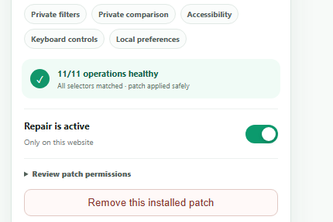
- “11/11 MetroCare operations and 10/10 publication assertions healthy”
- “19/19 CivicApply operations and 10/10 publication assertions healthy”
Inference: The project is a functional prototype with extensive internal testing. However, there is no evidence of external adoption or user feedback.
Competitive Context
- No mention of direct competitors.
- The description does not reference existing tools for web accessibility or patching.
- It positions itself as a public repair layer, distinct from userscript managers or theme editors.
Inference: There is no clear competitive landscape described. The project appears to be in a niche space with limited prior art, but this cannot be confirmed without external data.
Open Questions & Risks
- The system is self-reported and unverified.
- No evidence of real-world usage or adoption beyond demos.
- The project is presented as a hackathon submission — no indication of long-term viability or scalability.
- The use of AI (GPT-5.6) for authoring raises questions about reproducibility, cost, and control.
- The DSL is constrained, which may limit its usefulness in complex scenarios.
Inference: Risks include lack of traction, unproven adoption, and potential over-reliance on AI for development without clear commercial or operational sustainability.
Questions the description leaves open
- What is the actual user base or community behind the patches?
- How do you plan to scale beyond the two demo patches?
- Are there any real-world pilots or partnerships with civic, education, or accessibility organizations?
- How will you handle patch drift and maintain compatibility over time?
- Is there a plan for monetization or long-term sustainability?
- What are the limitations of the constrained DSL in practice?
- How do you intend to manage moderation, reputation, or rollback controls?
Overall Assessment
- The project is a functional prototype with strong technical execution and clear intent.
- It addresses a real problem: inaccessible or poorly designed websites.
- However, there is no evidence of traction, revenue, or adoption beyond the demos.
- It is presented as a hackathon submission — no commercial or operational history is evident.
Assessment: Not suitable for investment or partnership at this stage. The project shows promise but lacks demonstrated market demand or user engagement. Further due diligence would require evidence of real-world usage, customer feedback, and scalability plans.
User Stories BotA demo video on every pull request
Get a demo video on every new feature
GitHub App that watches your pull requests and records a narrated, captioned demo.
Save time on demo prep and make informed decisions faster with a video walkthrough of every new feature.
Source
Submitted to the OpenAI 2026 hackathon on Devpost. Project home on Devpost. Back to the full gallery on Devpost.
This competitive analysis was produced by top-founders.com (opens in a new tab)
Generated by a language model from this project's public Devpost page — its tagline, the author's own write-up and any built-with tags listed there — as captured in August 2026. Short quotations are the author's words. It is an opinion on the idea as a business, not on the people behind it, and it reflects the description as published then. If the project has moved on, request a correction below. The analysis is not independent research and contains no verified traction, revenue or customer data.
An independent guide by KFG International LLC — not affiliated with, endorsed by, or connected to Devpost or OpenAI.