

Archive position — measured, not model output
0 likes on Devpost
2,263 of the 7,850 archived projects have more likes, and 5,587 share exactly 0 — so this project's #5,631 place in the like-ranked listing is a tie-break inside that group, not a ranking.
Projects (log scale)
Likes on Devpost. ▲ marks this project's group.
Show the figures
| Likes | Projects | Share of archive |
|---|---|---|
| 0 | 5,587 | 71.2% |
| 1 | 1,758 | 22.4% |
| 2 | 284 | 3.6% |
| 3–4 | 132 | 1.7% |
| 5–9 | 75 | 1.0% |
| 10+ | 14 | 0.2% |
 User Stories BotA demo video on every pull request
Get a demo video on every new feature
GitHub App that watches your pull requests and records a narrated, captioned demo.
Save time on demo prep and make informed decisions faster with a video walkthrough of every new feature.
Executive Summary
Company: oceanskill
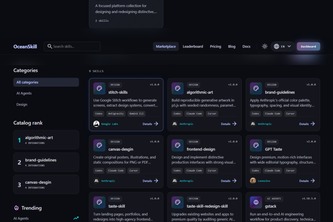
Tagline: Curated AI skills, organized into collections, connected to your AI agent through a single MCP connection.
Self-reported basis: The analysis is based entirely on the author's own description of the project, submitted as part of a Devpost hackathon entry. No external verification or historical data are available.
What it appears to be: A platform for curating and distributing vetted AI skills for use in AI agents, with a focus on security and ease-of-use through an MCP connection.
What changed: The author describes building a system that allows developers to connect their AI assistants to a curated catalog of skills via a single MCP connection, while also enabling upload and moderation of private skills.
Most important open question: Does the platform have sufficient traction or user validation to justify further development or investment?
What The Product Actually Is
The description states that oceanskill is a platform for providing vetted AI skills for use in AI agents. It allows developers to:
- Search and discover a catalog of hand-curated, quality-controlled skills.
- Upload their own private skills, which still go through the same moderation process.
- Organize skills into collections (public or private) to share setups with teammates or the community.
- Connect to the platform's MCP via an MCP key, enabling their agent to call skills on demand.
The system is built using Next.js, Supabase, and TypeScript, deployed on Vercel. The MCP server is implemented as a Supabase Edge Function, exposing JSON-RPC 2.0 tools for search, fetch, and collection management.
Inference: The platform appears to be a tool for developers to manage and share AI skills in a secure, curated way, with an emphasis on trust and usability.
Positioning & Claim Evolution
The author states that the inspiration behind oceanskill was to solve the problem of finding trustworthy, well-written skills in AI agents. The platform is positioned as a single trusted source for skills that are content-moderated and security-reviewed.
It claims to offer:
- A catalog of hand-curated skills.
- A security pipeline that applies to all skills, whether uploaded or sourced from GitHub.
- An MCP connection that allows AI agents to call skills on demand.
The platform is described as a better solution than manually downloading and inspecting skill files from scattered repos or app marketplaces.
Inference: The positioning evolved from solving a developer pain point (lack of trust in skill sources) to offering a curated, secure, and easily integrable solution for AI agents.
Target Customer & ICP
The description states that oceanskill is intended for developers who use AI assistants like Claude Code, Codex, Cursor, or Antigravity. These developers are said to need skills that are:
- Trustworthy.
- Well-written.
- Easily integrated into their AI agents.
It also mentions that the platform allows users to upload and organize private skills, suggesting a potential team-based or enterprise use case.
Inference: The primary customer is likely developer teams or individuals working with AI agents, who want to integrate vetted skills without manual effort or risk.
Business Model & Pricing Evidence
The description does not provide any information about the business model or pricing. It mentions that the team is focused on validating the beta with real paying users and plans to polish the collections feature for public sharing, but no details are given about monetization, pricing tiers, or revenue streams.
Inference: The business model is not evidenced. The platform may be in a pre-revenue stage, possibly relying on early adopters or beta testing for validation.
Technical & Delivery Signals
The platform is built using:
- Next.js (App Router)
- Supabase for database management, storage, and authentication
- TypeScript
- Deployed on Vercel
The MCP server is implemented as a Supabase Edge Function, exposing JSON-RPC 2.0 tools.
Security pipeline includes:
- Size limits
- Zip-bomb detection
- Structure validation
- Extension whitelisting
- Path-traversal checks
- Malware scanning
- AI-based content scanning
The system treats all skills the same way, regardless of origin (uploaded zip or GitHub).
Inference: The technical stack is modern and focused on security. The platform appears to be built with scalability and trust in mind.
Traction & Maturity Signals
The description states that the project was submitted to the OpenAI 2026 hackathon, and that the team is focused on validating the beta with real paying users. It also mentions plans to:
- Polish the collections feature
- Integrate a lightweight rating system based on usage data
- Expand the skill catalog based on developer feedback
There is no evidence of revenue, customer base, or adoption metrics.
Inference: The platform is in an early stage, likely a beta or prototype. No traction or maturity signals are evident beyond the hackathon submission and stated future plans.
Competitive Context
The author mentions AI agents like Claude Code, Codex, Cursor, and Antigravity as existing tools that benefit from curated skills. The platform is positioned to improve upon the lack of trustworthy skill sources in these systems.
No direct competitors are named, but the concept of a skill marketplace or curation platform for AI agents is implied to exist or be emerging.
Inference: The competitive landscape includes AI agent platforms and potentially future skill marketplaces. oceanskill positions itself as a solution to a gap in trust and usability.
Open Questions & Risks
- No revenue or customer data: The platform is described as being in beta, with no evidence of monetization or paying users.
- Single-person team: The project is built by one person (thanh thanh), which may limit scalability or speed of development.
- Unproven market demand: While the idea is presented as solving a problem, there is no evidence that developers are actively seeking such a solution.
- Limited technical depth: The platform is described as a prototype with a security pipeline built from scratch — this raises questions about robustness and scalability.
Inference: The platform is at a very early stage. Risks include lack of traction, limited team capacity, and unvalidated market demand.
Questions the description leaves open
- What specific feedback have you received from beta users?
- How are you planning to monetize the platform?
- What is your roadmap for expanding the skill catalog?
- Are there any existing partnerships or integrations with AI agents or platforms?
- How do you plan to scale beyond a single developer team?
- What are the key metrics you're tracking for user engagement and retention?
Overall Assessment
The description states that oceanskill is a self-contained platform for curating and distributing vetted AI skills, built with security and ease-of-use in mind.
It is described as being in an early stage (beta), with no revenue or customer data. The team size is one person, and the project was submitted to a hackathon.
Inference: The platform has potential but lacks evidence of traction, scalability, or commercial viability. It may be worth exploring further if there is interest in validating the concept or building out the product with additional resources. However, no clear investment or partnership case is evident from this description alone.
User Stories BotA demo video on every pull request
Get a demo video on every new feature
GitHub App that watches your pull requests and records a narrated, captioned demo.
Save time on demo prep and make informed decisions faster with a video walkthrough of every new feature.
Source
Submitted to the OpenAI 2026 hackathon on Devpost. Project home on Devpost. Back to the full gallery on Devpost.
This competitive analysis was produced by top-founders.com (opens in a new tab)
Generated by a language model from this project's public Devpost page — its tagline, the author's own write-up and any built-with tags listed there — as captured in August 2026. Short quotations are the author's words. It is an opinion on the idea as a business, not on the people behind it, and it reflects the description as published then. If the project has moved on, request a correction below. The analysis is not independent research and contains no verified traction, revenue or customer data.
An independent guide by KFG International LLC — not affiliated with, endorsed by, or connected to Devpost or OpenAI.