

Archive position — measured, not model output
0 likes on Devpost
2,263 of the 7,850 archived projects have more likes, and 5,587 share exactly 0 — so this project's #5,608 place in the like-ranked listing is a tie-break inside that group, not a ranking.
Projects (log scale)
Likes on Devpost. ▲ marks this project's group.
Show the figures
| Likes | Projects | Share of archive |
|---|---|---|
| 0 | 5,587 | 71.2% |
| 1 | 1,758 | 22.4% |
| 2 | 284 | 3.6% |
| 3–4 | 132 | 1.7% |
| 5–9 | 75 | 1.0% |
| 10+ | 14 | 0.2% |
 User Stories BotA demo video on every pull request
Get a demo video on every new feature
GitHub App that watches your pull requests and records a narrated, captioned demo.
Save time on demo prep and make informed decisions faster with a video walkthrough of every new feature.
Executive Summary
What the company appears to be
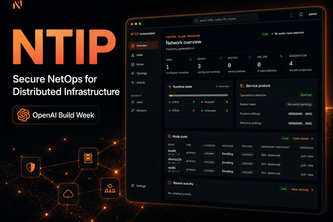
NTIP is a self-reported secure network operations platform for connecting, managing, observing, and troubleshooting distributed infrastructure nodes—especially those behind NAT. It includes a protocol layer implemented in Zig, an integrated control plane with persistent state (using SQLite), and a web-based dashboard built with Next.js/React.
What changed
The author states that NTIP evolved from a working command-line protocol implementation into a more complete product during OpenAI Build Week. This included adding a centralized control plane, authentication, a polished dashboard, automated verification, and an AI-assisted diagnostic feature.
Single most important open question — the commercial due-diligence read
Is there evidence of real-world usage or traction beyond the author’s own experimental infrastructure? The description does not indicate any customers, revenue, or adoption data. Without this, NTIP remains a self-reported prototype with no demonstrated market need or commercial viability.
What The Product Actually Is
The description states that NTIP is a secure network operations platform for connecting, managing, observing, and troubleshooting distributed infrastructure nodes—especially those behind NAT. It includes:
- A Zig-based networking core implementing protocol behavior such as node identity, virtual network ranges (VNRs), address allocation, route management, and connectivity.
- An integrated control plane with persistent state stored in SQLite, handling:
- VNRs
- Nodes
- Addresses
- Routes
- Users
- Authentication
- Sessions
- Operational events
- A web dashboard built using Next.js, React, TypeScript, and Tailwind CSS.
- An optional AI-assisted diagnostic capability, which analyzes structured operational data to explain likely causes or recommend steps but does not replace deterministic protocol logic.
The system treats connectivity and operations as one coherent problem. It distinguishes between desired configuration and observed runtime state.
Positioning & Claim Evolution
The description states that NTIP was originally inspired by the author’s need to manage distributed systems across VPSs, VMs, local servers, and edge nodes—many of which are behind NAT or use changing network environments.
It evolved from a practical infrastructure tool into a secure network operations platform, with a focus on:
- Treating connectivity and operations as one problem
- Providing a unified interface for managing distributed nodes
- Supporting secure logical networks across complex infrastructures
The author emphasizes that the goal was not to build another generic AI dashboard, but rather to use AI as a bounded operational assistant where it can provide meaningful value.
This positioning suggests NTIP is aimed at operators and engineers who manage distributed systems, particularly in environments with NAT or dynamic IPs.
Target Customer & ICP
The description states that NTIP targets operators managing distributed infrastructure—especially those working with:
- VPSs
- Virtual machines
- Local servers
- Edge nodes
- Systems behind NAT or using changing network environments
These users are likely network engineers, DevOps practitioners, or system administrators who need to connect and manage nodes across complex infrastructures.
The author does not specify a clear customer segment beyond this general category. No evidence of specific personas, buyer roles, or use cases beyond personal experimentation is provided.
Business Model & Pricing Evidence
Not evidenced.
The description does not contain any information about pricing models, monetization strategies, licensing terms, or business model assumptions. There is no indication whether NTIP will be offered as open-source, SaaS, or a self-hosted solution with optional support or premium features.
Technical & Delivery Signals
The description states that NTIP is implemented as a multi-language monorepo with clearly separated systems:
- Zig networking core: Implements protocol behavior including identity, addresses, routes, and configuration validation.
- Control plane: Integrated directly into the Zig server; uses SQLite for persistent storage.
- Web dashboard: Built with Next.js, React, TypeScript, Bun, shadcn/ui, Tailwind CSS.
- Testing & CI/CD: GitHub Actions orchestrates formatting, compilation, tests, frontend validation, and build verification.
Key technical signals include:
- Use of Zig for systems-level networking
- Embedded SQLite database for control-plane state
- Explicit separation between protocol logic and presentation layer
- API contracts to isolate components across languages
- Automated testing covering protocol behavior, configuration validation, authentication, authorization, and integration
Traction & Maturity Signals
Not evidenced.
There is no mention of:
- Customers or users
- Revenue or monetization
- Adoption metrics
- Product usage data
- Market feedback or pilot programs
The project is described as a prototype built during a hackathon (OpenAI Build Week), with no indication of post-hackathon traction or commercial deployment.
Competitive Context
Not evidenced.
The description does not reference existing competitors, similar tools, or market positioning relative to other network management or distributed infrastructure platforms. No competitive analysis or differentiation strategy is provided.
Open Questions & Risks
Inferences based on self-reported information:
- Prototype risk: NTIP appears to be a hackathon prototype with no evidence of real-world usage or customer feedback.
- Limited team size: The project has only one member, which may limit scalability and long-term development capacity.
- Unproven market demand: No evidence of actual users or commercial interest beyond the author’s own use case.
- AI boundary risk: While AI is described as bounded, there is no clarity on how it will be scaled or validated in production environments.
- Self-hosted focus: The emphasis on self-hosting and embedded persistence may limit appeal to enterprises preferring managed services.
Questions the description leaves open
- What specific infrastructure challenges are you solving for real users? Can you provide examples of how NTIP would be used in practice?
- Are there any early adopters or pilot customers currently using NTIP?
- How do you plan to monetize NTIP, and what is your go-to-market strategy?
- What are the key technical challenges that remain unresolved before production deployment?
- How does NTIP compare to existing tools like WireGuard, OpenVPN, or other network management platforms in terms of functionality and ease-of-use?
- What is the roadmap for expanding beyond the current monorepo architecture and supporting multi-tenant environments?
- How do you intend to ensure security and compliance as the platform scales?
Overall Assessment
Not evidenced.
There is no evidence of revenue, customers, or traction that would support an investment or partnership decision. The project is described as a self-reported prototype built during a hackathon with no indication of commercial viability or market readiness.
Given the lack of external validation, user feedback, or business model clarity, any investment or partnership consideration should be contingent on further due diligence confirming real-world demand and technical feasibility.
User Stories BotA demo video on every pull request
Get a demo video on every new feature
GitHub App that watches your pull requests and records a narrated, captioned demo.
Save time on demo prep and make informed decisions faster with a video walkthrough of every new feature.
Source
Submitted to the OpenAI 2026 hackathon on Devpost. Project home on Devpost. Back to the full gallery on Devpost.
This competitive analysis was produced by top-founders.com (opens in a new tab)
Generated by a language model from this project's public Devpost page — its tagline, the author's own write-up and any built-with tags listed there — as captured in August 2026. Short quotations are the author's words. It is an opinion on the idea as a business, not on the people behind it, and it reflects the description as published then. If the project has moved on, request a correction below. The analysis is not independent research and contains no verified traction, revenue or customer data.
An independent guide by KFG International LLC — not affiliated with, endorsed by, or connected to Devpost or OpenAI.