

Archive position — measured, not model output
0 likes on Devpost
2,263 of the 7,850 archived projects have more likes, and 5,587 share exactly 0 — so this project's #5,609 place in the like-ranked listing is a tie-break inside that group, not a ranking.
Projects (log scale)
Likes on Devpost. ▲ marks this project's group.
Show the figures
| Likes | Projects | Share of archive |
|---|---|---|
| 0 | 5,587 | 71.2% |
| 1 | 1,758 | 22.4% |
| 2 | 284 | 3.6% |
| 3–4 | 132 | 1.7% |
| 5–9 | 75 | 1.0% |
| 10+ | 14 | 0.2% |
 User Stories BotA demo video on every pull request
Get a demo video on every new feature
GitHub App that watches your pull requests and records a narrated, captioned demo.
Save time on demo prep and make informed decisions faster with a video walkthrough of every new feature.
Executive Summary
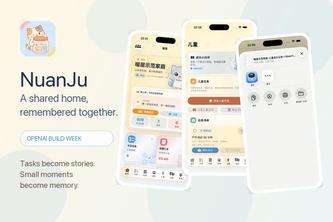
What the company appears to be: NuanJu is a self-reported iOS app for families and caregivers that coordinates household tasks, child-care check-ins, and daily growth moments into a shared, chronological record. The project was built during a hackathon (OpenAI 2026) by one founder, Alvin A.
What changed: During Build Week, the team extended the baseline app with features like child-task check-ins, a growth diary, photo-aware entries, multi-page PDF exports, and an offline demo mode. These additions were supported by AI tools (Codex, GPT-5.6) for engineering and product review.
The single most important open question: Is there any evidence of user adoption or traction beyond the hackathon submission? The description states no revenue, customers, or usage data exist outside of the self-reported project history.
What The Product Actually Is
The description states that NuanJu is a native iOS app for families and caregivers. It allows coordination of tasks, requests, receipts, schedules, reminders, pets, child care, and messages within a role-aware space.
Key features include:
- Child-task check-ins with author, role, date, note, and optional photo
- A chronological growth diary for learning, school, exercise, daily life, and milestones
- Photo-aware handling of tasks, check-ins, and diary entries
- Export of the complete record as a structured multi-page A4 PDF
The app is built using Swift and SwiftUI for iOS 17 and later. It uses Vision for OCR-assisted receipt entry, UIKit's PDF renderer for document generation, and StoreKit 2 for optional subscription handling.
Not evidenced: The actual functionality beyond the described features, or whether these are fully implemented in a production-ready state.
Positioning & Claim Evolution
The description states that NuanJu aims to turn household tasks, child-care check-ins, and everyday growth into a calm shared family record instead of another disappearing chat thread. This positioning suggests an emphasis on continuity, documentation, and emotional resonance over ephemeral communication tools.
It also claims that the app preserves context without making home life feel like project management — implying a balance between structure and flexibility.
The evolution from baseline to Build Week shows:
- Expansion from basic household coordination to growth-focused record keeping
- Introduction of visual design elements (cat companion, gentler UI)
- Addition of offline demo mode for evaluation purposes
Not evidenced: How this positioning compares with other family tools or whether it reflects a market need beyond the author's own experience.
Target Customer & ICP
The description states that NuanJu is designed for families and people who help care for them. It supports role-aware coordination among household members, including owners and helpers.
It also mentions support for child-care check-ins, which implies targeting parents or guardians of young children.
Not evidenced: Specific customer segments beyond "families" and "caregivers", or any evidence of market segmentation or persona development.
Business Model & Pricing Evidence
The description states that the app uses StoreKit 2 to handle optional receipt subscription surfaces. This suggests a freemium or tiered model where some features may be behind a paywall.
However, there is no mention of pricing tiers, monetization strategy, or revenue streams beyond the optional subscription surface.
Not evidenced: Any concrete business model details, pricing structure, or financial viability indicators.
Technical & Delivery Signals
The app is built with Swift and SwiftUI for iOS 17 and later. It uses:
- Observable household store for role-aware state coordination
- Vision for OCR-assisted receipt entry
- UIKit's PDF renderer for A4 document generation
- StoreKit 2 for subscription handling
The team used Codex and GPT-5.6 to assist with engineering and product review, particularly in tracing large SwiftUI models, connecting new records to backward-compatible payloads, reviewing image and PDF paths, and implementing the offline demo.
Not evidenced: Whether these technical choices reflect scalability or long-term maintainability, or if there are any production deployments beyond the demo mode.
Traction & Maturity Signals
The description states that NuanJu existed before Build Week with household invitations, owner/helper roles, shared tasks, receipts, requests, and basic communication. During Build Week, it was extended with new features.
It also mentions a pre-build-week-baseline tag from a July 3 handoff snapshot, imported on July 19 for comparison purposes. The repository includes setup documentation and a fresh unsigned Debug simulator build completed with Xcode 26.5.
Not evidenced: Any evidence of user adoption, retention, or usage metrics beyond the hackathon submission. No mention of customer acquisition, revenue, or product-market fit indicators.
Competitive Context
The description does not provide any information about competitors or how NuanJu differentiates from existing family coordination tools or journaling apps.
Not evidenced: Any competitive landscape analysis, differentiation strategy, or market positioning relative to other solutions in the space.
Open Questions & Risks
Key risks and open questions based on the self-reported description:
- The app is described as a hackathon project with no evidence of traction or commercial viability.
- There is no mention of any funding rounds, revenue, or customer base.
- The offline demo mode suggests that full functionality requires login/account access — raising questions about how users will engage with core features outside of this limited environment.
- AI tools were used for assistance but not for decision-making on privacy or product values — indicating potential risks in AI integration without clear governance.
Not evidenced: Any risk mitigation strategies, scalability plans, or long-term roadmap beyond the hackathon scope.
Questions the description leaves open
- What is the actual user base or traction beyond the hackathon?
- How does the app plan to monetize its features beyond optional subscriptions?
- Are there any plans for expanding beyond iOS or adding cross-platform support?
- How do you intend to ensure data privacy and security, especially with photo and diary entries?
- What are your long-term goals for product development and market expansion?
- Can you explain how the offline demo mode translates into a full user experience?
Overall Assessment
The description states that NuanJu is a self-reported iOS app built during a hackathon by one founder, Alvin A. There is no evidence of revenue, customers, or traction beyond the project submission.
While the concept appears thoughtful and aligned with current trends in family care and digital documentation, there is insufficient evidence to assess commercial viability or market readiness.
Assessment: Not evidenced. The project lacks any demonstrated traction, financials, or customer validation beyond its own self-reporting. Any investment or partnership decision should be contingent upon further due diligence into actual usage, monetization strategy, and competitive positioning.
User Stories BotA demo video on every pull request
Get a demo video on every new feature
GitHub App that watches your pull requests and records a narrated, captioned demo.
Save time on demo prep and make informed decisions faster with a video walkthrough of every new feature.
Source
Submitted to the OpenAI 2026 hackathon on Devpost. Project home on Devpost. Back to the full gallery on Devpost.
This competitive analysis was produced by top-founders.com (opens in a new tab)
Generated by a language model from this project's public Devpost page — its tagline, the author's own write-up and any built-with tags listed there — as captured in August 2026. Short quotations are the author's words. It is an opinion on the idea as a business, not on the people behind it, and it reflects the description as published then. If the project has moved on, request a correction below. The analysis is not independent research and contains no verified traction, revenue or customer data.
An independent guide by KFG International LLC — not affiliated with, endorsed by, or connected to Devpost or OpenAI.