

Archive position — measured, not model output
1 like on Devpost
505 of the 7,850 archived projects have more likes, and 1,758 share exactly 1 — so this project's #1,554 place in the like-ranked listing is a tie-break inside that group, not a ranking.
Projects (log scale)
Likes on Devpost. ▲ marks this project's group.
Show the figures
| Likes | Projects | Share of archive |
|---|---|---|
| 0 | 5,587 | 71.2% |
| 1 | 1,758 | 22.4% |
| 2 | 284 | 3.6% |
| 3–4 | 132 | 1.7% |
| 5–9 | 75 | 1.0% |
| 10+ | 14 | 0.2% |
 User Stories BotA demo video on every pull request
Get a demo video on every new feature
GitHub App that watches your pull requests and records a narrated, captioned demo.
Save time on demo prep and make informed decisions faster with a video walkthrough of every new feature.
Executive Summary
What the company appears to be
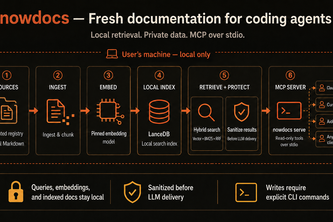
Nowdocs is a self-reported local-first CLI tool and MCP server designed for coding agents. It enables secure, offline search of third-party documentation through hybrid retrieval (vector + BM25) and exposes this functionality via the Model Context Protocol (MCP) over stdio/NDJSON.
What changed
The project was submitted as part of the OpenAI 2026 hackathon. The author describes a focus on local-first design, safety boundaries, and agent integration without reliance on hosted services or open ports.
Single most important open question
Is there evidence that this tool has been adopted by users beyond the author’s own use case, or that it is being used in real-world coding-agent workflows?
What The Product Actually Is
The description states:
- Nowdocs is an open-source, local-first documentation retrieval server for coding agents.
- It supports tools such as Codex CLI, Claude Code, Cursor, and other MCP clients.
- It uses hybrid retrieval (vector + BM25) with Reciprocal Rank Fusion.
- It speaks the Model Context Protocol over standard input/output (stdio/NDJSON), avoiding hosted services or open ports.
- Documentation, embeddings, and indexes stay on the user’s machine.
- Retrieved text is sanitized before reaching an LLM.
- MCP tools are read-only; writes require explicit CLI actions.
- Optional remote reranking is opt-in with local fallback.
Inference The product appears to be a command-line tool built in Rust that indexes documentation locally and allows agents to query it securely without network exposure.
Positioning & Claim Evolution
The description states:
- The goal was to give coding agents current documentation without relying on hosted RAG services.
- It emphasizes keeping documentation retrieval local by default.
- It positions itself as a secure, agent-friendly tool that makes every state-changing action explicit.
Inference This is a self-reported positioning shift from generic documentation tools toward a niche focused on agent integration and local-first principles.
Target Customer & ICP
The description states:
- The target users are developers using coding agents like Codex CLI, Claude Code, Cursor, etc.
- It supports MCP clients generally.
Inference The ICP likely includes developers working with LLM-powered coding tools who value local control and security.
Business Model & Pricing Evidence
Not evidenced.
Technical & Delivery Signals
The description states:
- Built in Rust as a single local binary.
- Uses LanceDB for indexing, pinned models for embeddings, and BM25 full-text search.
- Supports hybrid retrieval with Reciprocal Rank Fusion.
- MCP over stdio/NDJSON.
- Includes setup flows, verification, rollback, and one-shot authorization.
- Prebuilt binaries and checksums are published for major platforms.
Inference The technical approach is consistent with a developer-focused tool that prioritizes safety, portability, and minimal dependencies.
Traction & Maturity Signals
The description states:
- A v0.2.0 release exists.
- Prebuilt binaries, checksums, CI gates, and open-source codebase are available.
- Supports Codex CLI, Claude Code, Cursor, and generic MCP workflows.
Inference There is a basic version released with some operational tooling, but no evidence of adoption or usage beyond the author’s own development.
Competitive Context
Not evidenced.
Open Questions & Risks
- The project is self-reported and unverified; no third-party validation.
- No revenue, customer data, or traction metrics are provided.
- Only one team member (Kaige Gao) is listed.
- The tool targets a narrow niche — developers using coding agents — which may limit its addressable market.
- The lack of any mention of user feedback, community engagement, or production use cases raises questions about real-world viability.
Questions the description leaves open
- What specific coding-agent workflows are you seeing users adopt?
- How many developers are currently using this tool in practice?
- Have you received any feedback from users beyond your own testing?
- What is the plan for scaling beyond a single developer’s use case?
- Are there any known compatibility issues with other MCP clients or LLMs?
- How do you intend to evolve the documentation coverage and retrieval quality?
Overall Assessment
Not evidenced.
User Stories BotA demo video on every pull request
Get a demo video on every new feature
GitHub App that watches your pull requests and records a narrated, captioned demo.
Save time on demo prep and make informed decisions faster with a video walkthrough of every new feature.
Source
Submitted to the OpenAI 2026 hackathon on Devpost. Project home on Devpost. Back to the full gallery on Devpost.
This competitive analysis was produced by top-founders.com (opens in a new tab)
Generated by a language model from this project's public Devpost page — its tagline, the author's own write-up and any built-with tags listed there — as captured in August 2026. Short quotations are the author's words. It is an opinion on the idea as a business, not on the people behind it, and it reflects the description as published then. If the project has moved on, request a correction below. The analysis is not independent research and contains no verified traction, revenue or customer data.
An independent guide by KFG International LLC — not affiliated with, endorsed by, or connected to Devpost or OpenAI.