

Archive position — measured, not model output
0 likes on Devpost
2,263 of the 7,850 archived projects have more likes, and 5,587 share exactly 0 — so this project's #5,602 place in the like-ranked listing is a tie-break inside that group, not a ranking.
Projects (log scale)
Likes on Devpost. ▲ marks this project's group.
Show the figures
| Likes | Projects | Share of archive |
|---|---|---|
| 0 | 5,587 | 71.2% |
| 1 | 1,758 | 22.4% |
| 2 | 284 | 3.6% |
| 3–4 | 132 | 1.7% |
| 5–9 | 75 | 1.0% |
| 10+ | 14 | 0.2% |
 User Stories BotA demo video on every pull request
Get a demo video on every new feature
GitHub App that watches your pull requests and records a narrated, captioned demo.
Save time on demo prep and make informed decisions faster with a video walkthrough of every new feature.
Executive Summary
What the company appears to be
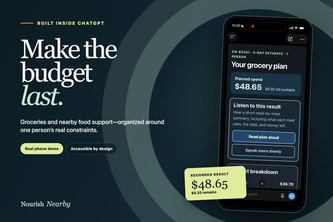
Nourish Nearby is a senior-friendly ChatGPT app that creates practical grocery plans through conversational interaction. The author states it uses Codex (Sol 5.6) as a development partner and is built with TypeScript, React, and AWS. It is designed for users with limited budgets, transportation, or technology confidence, particularly retirees living alone on fixed incomes.
What changed
The project was developed as part of the OpenAI 2026 hackathon. The author describes it as a functional prototype that includes a deterministic planning engine, an accessible interface, and integration with a simulated retailer data source (Fry's). It does not appear to have launched commercially or gained users beyond the development phase.
The single most important open question
Is there any evidence of real-world adoption or customer feedback from the target demographic? The description is entirely self-reported, and no traction, revenue, or user data are provided.
What The Product Actually Is
The description states that Nourish Nearby is a senior-friendly ChatGPT app that creates grocery plans through conversation. It begins with what the user has — such as a budget, household size, and available cooking equipment — rather than what they want to cook. The app uses Codex (Sol 5.6) for conversational flow and a deterministic TypeScript planning engine for calculations.
It includes:
- A planning engine that selects products based on equipment availability and meal patterns.
- A tool-based architecture using Model Context Protocol (MCP), with five read-only tools: intake, planning, food help lookup, transition to assistance results, and rendering the final view.
- A deterministic snapshot of 50 Fry's products, including prices, serving evidence, and compatibility with equipment.
- An accessible interface designed for older adults, using large text, high contrast, and touch-friendly controls.
The app is described as a browser-based experience deployed on AWS, with a public demo available. It does not support native ChatGPT Voice mode but includes a prototype read-aloud guide.
Positioning & Claim Evolution
The author states that Nourish Nearby was inspired by the challenges faced by retirees living alone on fixed incomes. The app is positioned to simplify grocery planning for people who struggle with traditional meal-planning apps, which often start with what someone wants to cook.
Key claims:
- It helps users stretch limited budgets.
- It provides a practical food plan based on real product data and user inputs.
- It offers verified local food support, separating home-delivery programs from others that require confirmation.
- The experience is designed for accessibility, using large text, high contrast, and simple language.
The positioning evolved from an idea to a functional prototype within a hackathon timeframe. No indication of prior versions or market testing exists in the description.
Target Customer & ICP
The author states that Nourish Nearby was designed with older adults in mind, particularly retirees living alone on fixed incomes. The pilot is targeted at Sun City, Arizona (ZIP code 85351), a retirement community with a large older-adult population.
Key customer characteristics:
- Limited budget
- Limited transportation
- Limited confidence with technology
- Living alone
- Food insecure or struggling to find affordable food
The description does not identify any other segments beyond this core group, nor does it describe how the app might be adapted for broader use.
Business Model & Pricing Evidence
Not evidenced. The author does not state anything about pricing, monetization, or a business model beyond the prototype's development and demo deployment.
Technical & Delivery Signals
The description states that:
- The app was built with Codex (Sol 5.6) as a development partner.
- It uses TypeScript, React, Model Context Protocol (MCP), Zod, Vitest, Playwright.
- A deterministic planning engine handles sensitive calculations and ensures accuracy in budgeting and meal coverage.
- The system includes five read-only tools exposed via an MCP server.
- The app is deployed on AWS, using CloudFront, S3, Lambda, and Bedrock AgentCore Gateway.
- It supports accessibility features such as WCAG AA compliance, keyboard navigation, and touch targets.
It also mentions:
- A snapshot of 50 Fry's products used for the pilot.
- A CatalogProvider boundary to allow future replacement with real retailer APIs.
- Automated testing covering unit, contract, integration, and widget tests.
- A browser-based read-aloud guide for accessibility.
Traction & Maturity Signals
Not evidenced. The description does not include any data on:
- Users or customer base
- Revenue or monetization
- Adoption metrics
- Product usage or retention
- Any form of production deployment beyond the hackathon demo
The project is described as a prototype and a hackathon submission, with no indication of commercial traction.
Competitive Context
Not evidenced. The description does not mention any competitors, nor does it describe how Nourish Nearby compares to existing meal-planning or grocery apps in the market.
Open Questions & Risks
- No real-world testing or user feedback — all evidence is self-reported and from a hackathon prototype.
- Limited scope — the pilot uses only one store (Fry's) and 50 products, with no indication of scalability or API integration beyond the demo.
- Unverified data sources — product information is based on snapshots, not live retailer APIs.
- No commercial model — no evidence of pricing, monetization, or business strategy beyond prototype development.
- Prototype limitations — voice support is described as a prototype and not functional in production; accessibility testing was done manually and may not reflect full deployment.
Questions the description leaves open
- What is the plan for integrating with real retailer APIs (e.g., Kroger)?
- How will the app scale beyond the single ZIP code pilot?
- Are there any plans to expand beyond the senior demographic or geographic scope?
- Has the app been tested with actual users from the target demographic?
- What are the long-term sustainability and scalability plans for the product?
- Is there a roadmap for monetization or commercial deployment?
Overall Assessment
Not evidenced. The description does not provide any information on:
- Revenue or financial performance
- Customer traction or adoption
- Market opportunity size
- Team experience or track record
- Any investment or partnership interest from third parties
The project is described as a hackathon prototype with no indication of commercial viability, traction, or strategic value beyond its development phase. It is not evident whether the team intends to pursue further development or launch commercially.
User Stories BotA demo video on every pull request
Get a demo video on every new feature
GitHub App that watches your pull requests and records a narrated, captioned demo.
Save time on demo prep and make informed decisions faster with a video walkthrough of every new feature.
Source
Submitted to the OpenAI 2026 hackathon on Devpost. Project home on Devpost. Back to the full gallery on Devpost.
This competitive analysis was produced by top-founders.com (opens in a new tab)
Generated by a language model from this project's public Devpost page — its tagline, the author's own write-up and any built-with tags listed there — as captured in August 2026. Short quotations are the author's words. It is an opinion on the idea as a business, not on the people behind it, and it reflects the description as published then. If the project has moved on, request a correction below. The analysis is not independent research and contains no verified traction, revenue or customer data.
An independent guide by KFG International LLC — not affiliated with, endorsed by, or connected to Devpost or OpenAI.