

Archive position — measured, not model output
0 likes on Devpost
2,263 of the 7,850 archived projects have more likes, and 5,587 share exactly 0 — so this project's #5,603 place in the like-ranked listing is a tie-break inside that group, not a ranking.
Projects (log scale)
Likes on Devpost. ▲ marks this project's group.
Show the figures
| Likes | Projects | Share of archive |
|---|---|---|
| 0 | 5,587 | 71.2% |
| 1 | 1,758 | 22.4% |
| 2 | 284 | 3.6% |
| 3–4 | 132 | 1.7% |
| 5–9 | 75 | 1.0% |
| 10+ | 14 | 0.2% |
 User Stories BotA demo video on every pull request
Get a demo video on every new feature
GitHub App that watches your pull requests and records a narrated, captioned demo.
Save time on demo prep and make informed decisions faster with a video walkthrough of every new feature.
Executive Summary
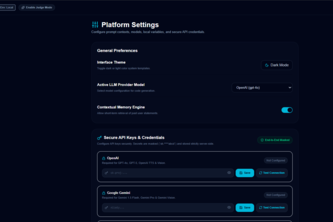
Nova-AI is described as an advanced AI assistant that combines multiple LLMs, autonomous agents, RAG, voice, vision, and automation into one workspace. The author states this is a self-contained platform built for intelligent work, aiming to reduce fragmentation in current AI tool usage by offering a single interface for chat, document analysis, automation, coding assistance, voice interaction, and image understanding.
The project was submitted to the OpenAI 2026 hackathon and is presented as a modular system with separate frontend (React/Vite) and backend (FastAPI/Python) components. It includes support for multi-provider LLMs, RAG pipelines, vision and voice modules, autonomous agents, and automation workflows.
Key commercial due-diligence question
Does the author’s self-reported platform have any evidence of traction, revenue, or customer adoption beyond the hackathon submission?
What The Product Actually Is
The description states that Nova-AI is an intelligent AI workspace designed to combine:
- Multi-provider LLM support
- Intelligent routing and planning
- Retrieval-Augmented Generation (RAG)
- Voice interaction
- Vision and image understanding
- Autonomous AI agents
- Tool execution framework
- Automation workflows
- Secure API key management
- Real-time streaming responses
It is described as a modular architecture with separate frontend and backend services, built using React/Vite for the frontend and FastAPI/Python for the backend. The system includes components such as an agent runtime, RAG pipeline, vision module, voice module, automation engine, and MCP integration.
The author claims it enables users to perform complex multi-step tasks from a single interface.
Inference Based on the architecture described, Nova-AI appears to be a platform that integrates various AI capabilities into one cohesive workspace. However, no evidence of actual deployment or usage is provided.
Positioning & Claim Evolution
The author positions Nova-AI as an AI operating system for intelligent work, aiming to replace fragmented workflows across multiple applications. It is described as a tool that brings together chat, document analysis, automation, coding assistance, voice interaction, and image understanding into one interface.
It claims to be a unified workspace where users can interact with multiple AI models, automate tasks, analyze documents, understand images, use voice commands, and access knowledge through RAG.
The project also mentions future plans including team collaboration features, enterprise integrations, local AI execution, and mobile/desktop support — suggesting an evolution toward broader commercial adoption.
Inference The positioning reflects a vision of a comprehensive AI platform that could evolve into a productivity tool for individuals or teams. However, this is based on self-reported claims without evidence of market traction or user feedback.
Target Customer & ICP
The description does not explicitly define the target customer or ideal customer profile (ICP). The author focuses on describing what the product does rather than who uses it.
Inference Based on the features described, Nova-AI may appeal to users seeking a centralized AI workspace for productivity, including developers, researchers, content creators, and professionals working with documents, automation, and multi-modal inputs. However, no specific customer segment is identified in the description.
Business Model & Pricing Evidence
There is no evidence of any business model or pricing structure in the provided description.
The author does not mention monetization strategies, subscription tiers, licensing models, or sales channels.
Inference The project appears to be a prototype or hackathon submission with no indication of how it would generate revenue or sustain itself commercially.
Technical & Delivery Signals
The platform is built using:
- Frontend: React, TypeScript, Vite
- Backend: FastAPI, Python
- AI Components:
- Multi-provider LLM manager
- Agent runtime
- RAG pipeline
- Vision module
- Voice module
- Automation engine
- MCP integration
- Planner and execution pipeline
The architecture is described as modular, with each AI capability working independently while sharing a common execution framework.
Challenges mentioned include building a provider-independent architecture, managing secure API keys, integrating RAG, voice, vision, and automation into one workflow, handling real-time streaming responses, and maintaining clean architecture.
Inference The technical stack suggests a scalable and modular approach to AI system design. However, there is no evidence of production deployment or performance metrics.
Traction & Maturity Signals
The project was submitted to the OpenAI 2026 hackathon, indicating it is likely a prototype or early-stage development effort.
There is no evidence of:
- Revenue
- Customers
- User adoption
- Product-market fit
- Market traction
- Any form of monetization or business growth
The author notes that the project was built over time and includes lessons learned, but no data on usage or impact.
Inference The product is in an early stage of development and lacks any measurable traction or maturity indicators.
Competitive Context
The description does not provide information about existing competitors or how Nova-AI differentiates from them.
It does not reference other AI workspaces, productivity platforms, or LLM-based tools that might compete with or complement this offering.
Inference Without competitive analysis or differentiation details, it's unclear where Nova-AI stands in the market. The author’s claims are self-reported and unverified.
Open Questions & Risks
- No traction or revenue: The project is presented as a hackathon submission with no evidence of real-world usage.
- Unproven commercial viability: No pricing, business model, or monetization strategy is described.
- Self-reported only: All claims are based on the author’s own account; no external validation exists.
- Early-stage prototype: The system appears to be a proof-of-concept rather than a mature product.
- Lack of customer insights: No mention of user feedback, personas, or use cases beyond general functionality.
Inference This is a high-risk investment or partnership opportunity due to lack of evidence for commercial viability or traction.
Questions the description leaves open
- What specific problems are users trying to solve with Nova-AI?
- How does the platform handle multi-model orchestration in practice?
- Has there been any user testing or feedback on the current version?
- Are there plans for monetization or revenue generation beyond the hackathon?
- What is the roadmap for scaling beyond a single developer’s effort?
- How does Nova-AI manage data privacy and security, especially with API key handling?
- What are the technical limitations of the current architecture?
- Is there any internal testing or benchmarking done on performance or accuracy?
Overall Assessment
The description presents Nova-AI as a conceptual platform built during a hackathon, combining multiple AI technologies into one workspace. It is described as modular and extensible but lacks evidence of traction, revenue, customers, or commercial viability.
There are no signs of product-market fit, user adoption, or monetization strategy in the provided information.
Assessment: Not evidenced for investment or partnership purposes. The project is at a very early stage with no measurable impact or business outcomes. Any potential value lies in its conceptual framework and future development path — not in current performance or market readiness.
User Stories BotA demo video on every pull request
Get a demo video on every new feature
GitHub App that watches your pull requests and records a narrated, captioned demo.
Save time on demo prep and make informed decisions faster with a video walkthrough of every new feature.
Source
Submitted to the OpenAI 2026 hackathon on Devpost. Project home on Devpost. Back to the full gallery on Devpost.
This competitive analysis was produced by top-founders.com (opens in a new tab)
Generated by a language model from this project's public Devpost page — its tagline, the author's own write-up and any built-with tags listed there — as captured in August 2026. Short quotations are the author's words. It is an opinion on the idea as a business, not on the people behind it, and it reflects the description as published then. If the project has moved on, request a correction below. The analysis is not independent research and contains no verified traction, revenue or customer data.
An independent guide by KFG International LLC — not affiliated with, endorsed by, or connected to Devpost or OpenAI.