

Archive position — measured, not model output
0 likes on Devpost
2,263 of the 7,850 archived projects have more likes, and 5,587 share exactly 0 — so this project's #5,586 place in the like-ranked listing is a tie-break inside that group, not a ranking.
Projects (log scale)
Likes on Devpost. ▲ marks this project's group.
Show the figures
| Likes | Projects | Share of archive |
|---|---|---|
| 0 | 5,587 | 71.2% |
| 1 | 1,758 | 22.4% |
| 2 | 284 | 3.6% |
| 3–4 | 132 | 1.7% |
| 5–9 | 75 | 1.0% |
| 10+ | 14 | 0.2% |
 User Stories BotA demo video on every pull request
Get a demo video on every new feature
GitHub App that watches your pull requests and records a narrated, captioned demo.
Save time on demo prep and make informed decisions faster with a video walkthrough of every new feature.
Executive Summary
What the company appears to be
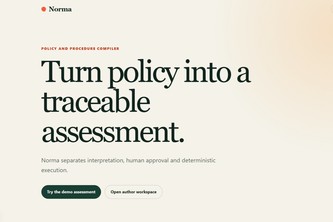
Norma is a self-reported policy and procedure compiler built for regulated environments. It uses AI (specifically GPT-5.6) to interpret PDF documents into structured policy proposals, which are then reviewed by humans before being converted into deterministic rule engines for case evaluation. The system separates AI interpretation from execution, with human approval required before any decision is made.
What changed
The project was built in one week as part of the OpenAI 2026 hackathon. It includes a full-stack TypeScript application using Next.js and React, with features like document ingestion, AI-based interpretation, source traceability, human review workflows, and deterministic evaluation logic.
Single most important open question
Is there evidence that Norma has traction or adoption beyond the hackathon demo? The description does not provide any data on revenue, customers, usage, or market validation — only a self-reported product architecture and use case.
What The Product Actually Is
The description states that Norma is a policy and procedure compiler. It allows users to upload PDF documents (e.g., policies, regulations) and uses GPT-5.6 to interpret them into structured proposals. These proposals are kept separate from executable policy until human review and approval.
After approval:
- A questionnaire is generated for evaluating cases.
- The evaluation is performed by a deterministic rule engine, which ensures consistent outcomes based on inputs.
- Each result includes:
- Overall outcome
- Passed/failed requirements
- Missing information
- Manual review conditions
- Source references supporting findings
The system supports exporting results in JSON and Markdown formats.
Evidence
- “Norma is a policy and procedure compiler.”
- “AI proposes. Humans approve. Deterministic software evaluates.”
- “Norma identifies the variables, questions, rules, open issues, and source references needed to evaluate a case.”
- “The generated proposal is kept separate from executable policy.”
- “Once a policy has been reviewed, its questionnaire can be used to evaluate a case through a deterministic rule engine.”
Inference This implies that Norma functions as both an AI-assisted interpretation tool and a compliance workflow platform — not a chatbot or general-purpose document assistant.
Positioning & Claim Evolution
The description states that Norma was built with the idea of turning policies and procedures into traceable, human-reviewed assessments, aiming to reduce manual effort in compiling regulations into operational workflows.
It positions itself as:
- A compliance compiler — not a chatbot.
- A system where AI proposes, but humans approve.
- Designed around the principle: “AI proposes. Humans approve. Deterministic software evaluates.”
The authors also claim that Norma is built for regulated environments, where auditability and traceability are critical.
Evidence
- “Policies, regulations and administrative procedures are usually written for people to read, not for software to execute.”
- “We wanted to explore a different idea: What if an AI system could compile a regulation into a reviewable and executable decision workflow?”
- “Norma is not a chatbot that simply answers questions about a document. It is a compliance and procedure compiler…”
Inference The positioning suggests Norma targets industries with strict regulatory requirements (e.g., finance, healthcare, public administration), where human oversight and audit trails are essential.
Target Customer & ICP
The description does not explicitly name target customers or define an Ideal Customer Profile (ICP). However, it implies that the product is intended for:
- Organizations managing complex policies or procedures.
- Users who need to convert policy documents into actionable workflows.
- Teams requiring human review and auditability in compliance processes.
It also mentions a fictional student-support scholarship policy as a demo use case, suggesting potential relevance to educational institutions or government agencies.
Evidence
- “Norma is a compliance and procedure compiler.”
- “Each author has a workspace...”
- “The deployed demonstration uses a fictional student-support scholarship policy.”
Inference Based on the context of regulated environments and human review workflows, Norma likely targets enterprise clients in sectors like public administration, legal services, or compliance-focused industries.
Business Model & Pricing Evidence
No information is provided about pricing, monetization strategy, or business model. The description only describes how the product works technically and conceptually.
Evidence
- None.
Inference Since no revenue or customer data is shared, it's unclear whether Norma intends to be sold as a SaaS product, a tool for internal use, or part of a larger platform offering.
Technical & Delivery Signals
The system is described as a full-stack TypeScript application built with Next.js, React, and Tailwind CSS. It uses:
- GPT-5.6 via OpenAI Responses API
- Structured Outputs
- PDF.js for handling documents
- Docker for deployment
- Prisma for database access
- Auth.js for authentication
- Vitest for testing
Key technical features include:
- Document ingestion and text extraction
- Source verification (citations validated against original document)
- Human review workflow
- Deterministic rule engine with three-state logic (true, false, unknown)
- Export capabilities in JSON and Markdown
- Private workspaces and data isolation
- Reproducible deployment via Docker
Evidence
- “Norma is a full-stack TypeScript application built with Next.js, React and Tailwind CSS.”
- “Uses GPT-5.6 interpretation...”
- “Deterministic evaluation uses a closed JSON rule AST and three-state logic: true, false and unknown.”
- “Includes Google authentication for the private author workspace...”
Inference The architecture shows a clear separation of concerns between AI interpretation, human review, and deterministic execution — which may indicate scalability and auditability.
Traction & Maturity Signals
There is no evidence of traction or maturity beyond the hackathon demo. The project was built in one week and deployed publicly as a demonstration. No mention of:
- Revenue
- Customers
- User base
- Product adoption
- Market feedback
- Iteration history
Evidence
- “The deployed demonstration uses a fictional student-support scholarship policy.”
- “We wanted more than a prompt demonstration...”
- “This project was submitted to the OpenAI 2026 hackathon on Devpost.”
Inference Norma is currently at a prototype or proof-of-concept stage. There is no indication of real-world usage or product-market fit.
Competitive Context
No explicit competitors are mentioned in the description. However, based on the functionality described (policy compilation, AI interpretation, human review, deterministic evaluation), Norma could compete with:
- Compliance automation tools
- Workflow management platforms for regulated industries
- Document analysis and rule engine systems
It also overlaps conceptually with:
- AI-powered document processors (e.g., Notion, DocuSign, PandaDoc)
- Regulatory compliance software (e.g., LogicGate, ComplyAdvantage)
But no direct comparison or competitive positioning is made.
Evidence
- None.
Inference Norma’s unique value proposition lies in combining AI interpretation with deterministic execution and traceability — a niche but potentially valuable approach for regulated environments.
Open Questions & Risks
- No traction or commercial validation: The product exists only as a hackathon demo.
- Unproven market demand: No evidence of customer interest, use cases, or feedback.
- Dependency on GPT-5.6: Reliance on a single AI model raises risk if access changes or pricing increases.
- Limited scope in demo: The demo uses a fictional policy; real-world complexity may not be fully addressed.
- No business model disclosed: Unclear how the product will generate revenue or scale.
Evidence
- “No revenue, customer or traction data is available beyond what they state.”
- “The deployed demonstration uses a fictional student-support scholarship policy.”
Inference Without real-world testing or monetization plans, Norma remains unproven in terms of viability and scalability.
Questions the description leaves open
- What specific industries or use cases are you targeting beyond the demo?
- How do you plan to validate demand for this product in regulated environments?
- What is your strategy for scaling beyond a single hackathon project?
- Are there any existing partnerships, pilot programs, or early adopters?
- How will you handle model dependency (e.g., GPT-5.6) long-term?
- What are the key assumptions behind the deterministic evaluation approach?
- Do you have plans to integrate with other compliance tools or platforms?
Overall Assessment
Not evidenced
The description provides no data on financials, customers, traction, or commercial viability. It describes a technical prototype built in one week for a hackathon.
This is a conceptual and architectural demonstration, not a product ready for investment or partnership.
Confidence level Low
Reasoning
The project lacks any evidence of revenue, users, market validation, or business model — all critical signals for due diligence. It is a self-reported idea with no external corroboration.
User Stories BotA demo video on every pull request
Get a demo video on every new feature
GitHub App that watches your pull requests and records a narrated, captioned demo.
Save time on demo prep and make informed decisions faster with a video walkthrough of every new feature.
Source
Submitted to the OpenAI 2026 hackathon on Devpost. Project home on Devpost. Back to the full gallery on Devpost.
This competitive analysis was produced by top-founders.com (opens in a new tab)
Generated by a language model from this project's public Devpost page — its tagline, the author's own write-up and any built-with tags listed there — as captured in August 2026. Short quotations are the author's words. It is an opinion on the idea as a business, not on the people behind it, and it reflects the description as published then. If the project has moved on, request a correction below. The analysis is not independent research and contains no verified traction, revenue or customer data.
An independent guide by KFG International LLC — not affiliated with, endorsed by, or connected to Devpost or OpenAI.