

Archive position — measured, not model output
0 likes on Devpost
2,263 of the 7,850 archived projects have more likes, and 5,587 share exactly 0 — so this project's #5,533 place in the like-ranked listing is a tie-break inside that group, not a ranking.
Projects (log scale)
Likes on Devpost. ▲ marks this project's group.
Show the figures
| Likes | Projects | Share of archive |
|---|---|---|
| 0 | 5,587 | 71.2% |
| 1 | 1,758 | 22.4% |
| 2 | 284 | 3.6% |
| 3–4 | 132 | 1.7% |
| 5–9 | 75 | 1.0% |
| 10+ | 14 | 0.2% |
 User Stories BotA demo video on every pull request
Get a demo video on every new feature
GitHub App that watches your pull requests and records a narrated, captioned demo.
Save time on demo prep and make informed decisions faster with a video walkthrough of every new feature.
Executive Summary
What the company appears to be
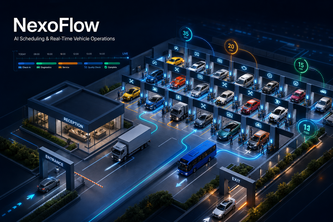
NexoFlow is an AI-powered scheduling and real-time vehicle operations platform designed for automotive dealerships. The author describes it as a system that connects customer conversations, appointments, workshops, and operational workflows in one visual platform. It uses AI agents for communication (voice, WhatsApp, phone) and integrates with tools like Google Calendar, CRM systems, and 3D workshop visualization.
What changed
The project was built as a prototype during the OpenAI 2026 hackathon. The author states that it includes working components such as AI voice agents, scheduling conflict detection, real-time 3D workshop tracking, and WhatsApp-based communication.
Single most important open question — the commercial due-diligence read
Is there evidence of traction or early adoption by automotive dealerships? The description contains no data on revenue, customers, or usage beyond a prototype demonstration.
What The Product Actually Is
The description states that NexoFlow is an AI-powered platform for scheduling and real-time vehicle operations in the automotive industry. It includes:
- AI agents communicating via voice, phone calls, WhatsApp, and audio.
- Identification of customer, vehicle, service requirement, preferred date, and communication consent.
- Workshop availability checks before confirming appointments.
- Integration with Google Calendar.
- WhatsApp confirmations and reminders.
- Real-time 3D visualization of workshop operations showing vehicles, technicians, service bays, and timing.
- Operational intelligence comparing planned vs. actual service times.
The system is described as a connected web platform with three main modules:
- Customer Acquisition and Relationship
- Scheduling
- Real-Time Workshop
It was built using technologies including GPT-5.6, Codex, ElevenLabs, Meta WhatsApp Cloud API, Google Calendar, n8n, and Three.js.
Evidence Self-reported by the author; no independent verification or data on actual deployment or performance.
Positioning & Claim Evolution
The author positions NexoFlow as a future-oriented platform that connects customer communication with real-time operational execution in automotive service environments. The core claim is that it transforms traditional fragmented scheduling into a unified, visual operating system for dealerships.
Key claims:
- AI agents perform real operational work beyond conversation.
- The platform tracks the vehicle journey from first interaction to release.
- It improves scheduling accuracy through operational intelligence.
- Visual design enhances understanding and decision-making.
- It integrates with existing tools like CRM, DMS, and Google Calendar.
The positioning evolved from a hackathon prototype to a vision of becoming "the intelligent operating layer connecting customers, AI agents, vehicles, technicians, and service facilities."
Evidence Self-reported; no external validation or market positioning data provided.
Target Customer & ICP
The description indicates that NexoFlow targets automotive dealerships, particularly those in Brazil where skilled labor shortages are acute. The author notes that the problem of manual, fragmented scheduling is persistent across the industry but especially critical in Brazil due to high employee turnover and limited availability of qualified professionals.
Evidence Self-reported; no explicit segmentation or customer data provided.
Business Model & Pricing Evidence
There is no evidence in the description of a business model or pricing structure. The author does not mention how NexoFlow would generate revenue, whether through subscription fees, per-appointment charges, or other mechanisms.
Evidence Not evidenced.
Technical & Delivery Signals
The system was built using:
- GPT-5.6 for reasoning and conversation orchestration
- Codex for product architecture, implementation, debugging, database design, integrations, testing, documentation, and deployment
- ElevenLabs for voice experiences
- Meta WhatsApp Cloud API for communication
- Google Calendar and n8n for scheduling interoperability
- A persistent operational database connecting customers, vehicles, appointments, communications, work orders, and journey events
- Interactive 3D visualization using Three.js
The architecture supports:
- Real-time voice, phone calls, WhatsApp text/audio
- Consent management
- Conflict prevention
- Automated notifications
- Safety escalation to humans
Codex is described as acting as a continuous engineering partner, helping transform sketches, photographs, and business rules into a working hosted product.
Evidence Self-reported; no independent technical review or delivery metrics provided.
Traction & Maturity Signals
The description states that NexoFlow was developed as a prototype during the OpenAI 2026 hackathon. It includes:
- Working AI voice agents
- Persistent customer and vehicle database
- Consent controls
- Visual scheduling system
- Conflict detection
- Google Calendar sync
- WhatsApp confirmations/reminders
- Safety detection and human handoff
- Real-time 3D workshop visualization
- Automated tests, backups, secure cloud deployment
However, there is no evidence of:
- Revenue or monetization
- Customer base or adoption
- Product-market fit validation
- Operational usage beyond prototype phase
Evidence Prototype-level functionality described; no traction or maturity data provided.
Competitive Context
The description does not provide any information about competitors or competitive landscape. It does not name other platforms, tools, or systems used in automotive scheduling or workshop management.
Evidence Not evidenced.
Open Questions & Risks
- Unproven commercial viability: No evidence of revenue, customers, or market traction.
- Prototype-only development: The system exists only as a hackathon prototype with no indication of production readiness or scalability.
- High technical complexity without validation: Integrating AI agents, real-time 3D visualization, and multiple systems may pose significant engineering challenges.
- Limited team size: Only one founder (Alvaro Lima) is mentioned, which raises questions about execution capacity.
- No pricing or monetization strategy: No indication of how the platform will be monetized.
- Unclear path to market: The author outlines a long-term vision but provides no roadmap for customer acquisition or product development beyond the prototype.
Evidence Inferences based on self-reported description; no external validation.
Questions the description leaves open
- What specific automotive dealerships, if any, have expressed interest in adopting NexoFlow?
- How does NexoFlow plan to scale from a single-user prototype to multi-location operations?
- What is the current status of integration with major dealership management systems (DMS)?
- Are there any pilot programs or beta users currently testing the platform?
- What are the key assumptions underlying the business model, and how do they intend to validate them?
- How does NexoFlow handle compliance issues such as data privacy and consent in different jurisdictions?
- What is the timeline for moving from prototype to full commercial release?
- How will the platform differentiate itself from existing CRM or scheduling tools used by dealerships?
Evidence Inferences based on self-reported description; no independent verification.
Overall Assessment
There is insufficient evidence to assess whether NexoFlow has a viable business case or investment opportunity at this stage. The project is described as a hackathon prototype with working components but lacks any indication of traction, revenue, customer adoption, or clear monetization strategy.
The author's account suggests strong technical capability and alignment with an industry pain point, but without real-world usage or validation, it remains speculative.
Confidence Level Low. The description is self-reported and unverified; no third-party evidence supports the claims made.
Assessment Not evidenced. This is a prototype-level concept with potential but no demonstrated commercial viability or market traction. Further diligence would require proof of early adoption, customer feedback, or product-market fit.
User Stories BotA demo video on every pull request
Get a demo video on every new feature
GitHub App that watches your pull requests and records a narrated, captioned demo.
Save time on demo prep and make informed decisions faster with a video walkthrough of every new feature.
Source
Submitted to the OpenAI 2026 hackathon on Devpost. Project home on Devpost. Back to the full gallery on Devpost.
This competitive analysis was produced by top-founders.com (opens in a new tab)
Generated by a language model from this project's public Devpost page — its tagline, the author's own write-up and any built-with tags listed there — as captured in August 2026. Short quotations are the author's words. It is an opinion on the idea as a business, not on the people behind it, and it reflects the description as published then. If the project has moved on, request a correction below. The analysis is not independent research and contains no verified traction, revenue or customer data.
An independent guide by KFG International LLC — not affiliated with, endorsed by, or connected to Devpost or OpenAI.