

Archive position — measured, not model output
0 likes on Devpost
2,263 of the 7,850 archived projects have more likes, and 5,587 share exactly 0 — so this project's #5,518 place in the like-ranked listing is a tie-break inside that group, not a ranking.
Projects (log scale)
Likes on Devpost. ▲ marks this project's group.
Show the figures
| Likes | Projects | Share of archive |
|---|---|---|
| 0 | 5,587 | 71.2% |
| 1 | 1,758 | 22.4% |
| 2 | 284 | 3.6% |
| 3–4 | 132 | 1.7% |
| 5–9 | 75 | 1.0% |
| 10+ | 14 | 0.2% |
 User Stories BotA demo video on every pull request
Get a demo video on every new feature
GitHub App that watches your pull requests and records a narrated, captioned demo.
Save time on demo prep and make informed decisions faster with a video walkthrough of every new feature.
Executive Summary
What the company appears to be
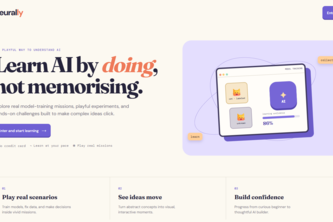
Neurally is a self-reported, static, client-side website built as a learning platform for AI concepts. The author describes it as a playful, hands-on tool that turns abstract AI ideas into interactive missions and visual lessons. It uses HTML, CSS, and vanilla JavaScript with no backend or database.
What changed
The project was submitted to the OpenAI 2026 hackathon by a single founder, Rohini Krishna Mohite. The description indicates this is an experimental prototype built using AI tools (GPT-5.6 and Codex) rather than traditional development methods.
Single most important open question — the commercial due-diligence read
Is there evidence of any traction, revenue, or customer adoption beyond the author's own account? There is no indication of users, usage metrics, monetization, or market validation in the self-reported description.
What The Product Actually Is
The description states that Neurally is:
- A static, client-side website built with HTML, CSS, and vanilla JavaScript.
- A platform for learning core AI concepts through interactive missions and visual lessons.
- Composed of a dashboard, AI missions (2D game scenes), visual lessons, and a progression system called "Neon City".
- Not dependent on any backend services, databases, or authentication.
Inference The product is described as a prototype or proof-of-concept for educational AI learning, not a production-ready SaaS offering.
Positioning & Claim Evolution
The author claims:
- Neurally turns AI concepts into playable missions instead of chapters to memorize.
- The goal is to make AI learning intuitive, addictive, and genuinely fun.
- It aims to shift passive learning (text, diagrams, videos) into active engagement through gameplay.
Inference This positioning reflects a move from traditional academic or instructional content toward gamified experiential learning. However, no evidence of prior positioning or evolution in the description.
Target Customer & ICP
The author states:
- The target is people who want to learn AI concepts in an engaging way.
- It’s designed for learners who prefer hands-on experience over reading definitions.
Inference The ICP appears to be self-directed learners or students interested in AI education, but no specific persona or segment is defined beyond that.
Business Model & Pricing Evidence
Not evidenced.
Explanation
There is no mention of pricing, monetization strategy, or business model in the description. The project is described as a hackathon submission with no indication of commercial intent or revenue streams.
Technical & Delivery Signals
The description states:
- Built entirely using HTML, CSS, and vanilla JavaScript.
- No backend, database, or API calls.
- Developed using GPT-5.6 and Codex for planning and execution.
- All code runs client-side in the browser.
- Features include interactive missions, visual lessons, dashboard navigation, and a progression system.
Inference The technical stack is minimal and self-contained, suggesting a lightweight prototype or proof-of-concept rather than a scalable product. The use of AI tools for development indicates an experimental approach.
Traction & Maturity Signals
Not evidenced.
Explanation
There is no mention of users, downloads, engagement metrics, retention, or any form of traction. The project is described as a hackathon submission with no indication of adoption or growth beyond the author’s own experience.
Competitive Context
Not evidenced.
Explanation
No information is provided about competitors, market positioning, or competitive landscape. The description does not reference existing platforms for AI education or gamified learning tools.
Open Questions & Risks
- Lack of traction or validation: No evidence of users, adoption, or usage beyond the author’s account.
- Prototype nature: Described as a hackathon submission with no indication of product maturity or scalability.
- No monetization strategy: No mention of pricing, revenue model, or business plan.
- Single-founder build: The entire project was built by one person, raising questions about long-term sustainability or team capacity.
- Unverified claims: All assertions are self-reported and unverified.
Questions the description leaves open
- What is the intended user base for Neurally beyond personal experimentation?
- Are there any plans to expand beyond the current scope (e.g., more missions, backend integration)?
- Has the product been tested with real users or educators?
- Is there a roadmap for monetization or commercial viability?
- How does the team plan to scale beyond a single developer?
Overall Assessment
Not evidenced.
Explanation
There is no evidence of revenue, customer traction, or market validation to support an investment or partnership decision. The project is described as a hackathon submission with no indication of commercial readiness or scalability. Any potential for investment or partnership would depend on further development and demonstration of product-market fit.
User Stories BotA demo video on every pull request
Get a demo video on every new feature
GitHub App that watches your pull requests and records a narrated, captioned demo.
Save time on demo prep and make informed decisions faster with a video walkthrough of every new feature.
Source
Submitted to the OpenAI 2026 hackathon on Devpost. Project home on Devpost. Back to the full gallery on Devpost.
This competitive analysis was produced by top-founders.com (opens in a new tab)
Generated by a language model from this project's public Devpost page — its tagline, the author's own write-up and any built-with tags listed there — as captured in August 2026. Short quotations are the author's words. It is an opinion on the idea as a business, not on the people behind it, and it reflects the description as published then. If the project has moved on, request a correction below. The analysis is not independent research and contains no verified traction, revenue or customer data.
An independent guide by KFG International LLC — not affiliated with, endorsed by, or connected to Devpost or OpenAI.