

Archive position — measured, not model output
0 likes on Devpost
2,263 of the 7,850 archived projects have more likes, and 5,587 share exactly 0 — so this project's #5,490 place in the like-ranked listing is a tie-break inside that group, not a ranking.
Projects (log scale)
Likes on Devpost. ▲ marks this project's group.
Show the figures
| Likes | Projects | Share of archive |
|---|---|---|
| 0 | 5,587 | 71.2% |
| 1 | 1,758 | 22.4% |
| 2 | 284 | 3.6% |
| 3–4 | 132 | 1.7% |
| 5–9 | 75 | 1.0% |
| 10+ | 14 | 0.2% |
 User Stories BotA demo video on every pull request
Get a demo video on every new feature
GitHub App that watches your pull requests and records a narrated, captioned demo.
Save time on demo prep and make informed decisions faster with a video walkthrough of every new feature.
Executive Summary
What the company appears to be: Nearwise is a self-reported AI-powered local discovery tool that uses natural language understanding and integrates with Google Places and OpenAI APIs. It was built as a submission to the OpenAI 2026 hackathon.
What changed: The project was submitted to a hackathon, indicating early-stage development or prototype status. No evidence of commercial traction, revenue, or customer adoption is present in the description.
Single most important open question: Is Nearwise intended to be a standalone product or a component of a larger platform, and what is its path to market beyond the hackathon?
Analysis basis: This report is based solely on the self-reported project description provided by the caller. All claims are unverified and should be treated as stated by the author, not proven facts.
What The Product Actually Is
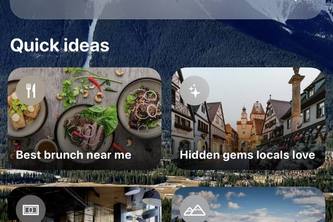
The description states that Nearwise is an “AI-powered local discovery” tool. It integrates with Google Places and OpenAI APIs, and supports iOS development using Swift and SwiftUI.
- Product type: A mobile application or service for discovering nearby places.
- Technology stack: Built with Swift, SwiftUI, Vercel, GitHub, Xcode, and uses GPT-5.6 (as per author-declared tech tags).
- Core functionality: The product is described as understanding natural language and ranking nearby places.
Evidence strength: The description does not define the exact scope or features of the product beyond its integration with APIs and mobile development stack. No evidence of actual user-facing features, UI/UX, or backend architecture is provided.
Positioning & Claim Evolution
The tagline states: “AI-powered local discovery that understands natural language and ranks nearby places with Google Places and OpenAI.”
- Positioning: Nearwise positions itself as a tool for local discovery using AI.
- Key claims:
- It uses natural language processing.
- It integrates with Google Places and OpenAI APIs.
- It ranks nearby places.
Evidence strength: The description does not indicate how the product differentiates from existing tools, nor does it describe any unique value proposition beyond its API integrations. No evidence of prior positioning or evolution in claims is present.
Target Customer & ICP
The description does not state who the target customer is or what the ideal customer profile (ICP) might be.
- Customer type: Not evidenced.
- Use case: Presumably individuals seeking local recommendations, but no explicit use case is described.
- ICP: Not evidenced.
Evidence strength: No evidence of customer segmentation, personas, or target user behavior is present in the description.
Business Model & Pricing Evidence
The description does not include any information about pricing, monetization, or business model.
- Monetization strategy: Not evidenced.
- Pricing model: Not evidenced.
- Revenue streams: Not evidenced.
Evidence strength: No evidence of a business model or pricing structure is present. The project appears to be in early development and not yet commercialized.
Technical & Delivery Signals
The author states that Nearwise was built with the following technologies:
- iOS (Swift, SwiftUI)
- Vercel
- GitHub
- Xcode
- Google Places API
- OpenAI APIs (including GPT-5.6)
- Development approach: Mobile-first, using native iOS development tools and cloud services.
- API usage: Integrates with Google Places and OpenAI APIs.
- Delivery platform: iOS app.
Evidence strength: The technical stack is described but not validated or detailed in terms of architecture, scalability, or delivery mechanisms. No evidence of production deployment or backend infrastructure is present.
Traction & Maturity Signals
The project was submitted to the OpenAI 2026 hackathon.
- Traction: Not evidenced.
- Maturity stage: Prototype or early-stage development.
- Adoption: Not evidenced.
- Customers: Not evidenced.
Evidence strength: The only signal of maturity is that it was entered into a hackathon, which does not indicate commercial traction or product-market fit.
Competitive Context
The description does not mention any competitors or the competitive landscape.
- Competitive landscape: Not evidenced.
- Differentiation from competitors: Not evidenced.
Evidence strength: No evidence of market analysis, competitor identification, or strategic positioning is present.
Open Questions & Risks
- Unproven commercial viability: The project was submitted to a hackathon and has no evidence of traction or monetization.
- Limited team size: Only one team member (Yuanhao Che) is listed.
- No product-market fit evidence: No user feedback, usage data, or adoption metrics are provided.
- Unverified API integration claims: The description does not confirm how the APIs are used or whether they are fully functional.
Evidence strength: Risks are inferred from the lack of evidence for key commercial signals and development maturity.
Questions the description leaves open
- What is the intended user journey and core value proposition?
- How does Nearwise differ from existing local discovery tools like Google Maps or Yelp?
- What is the plan for monetization beyond the hackathon?
- Is this a standalone product or part of a larger platform?
- What are the technical challenges in scaling the AI integration with Google Places and OpenAI?
Note: These questions are based on the lack of clarity in the description and are not derived from any external validation.
Overall Assessment
The project is described as a hackathon submission, indicating early-stage development. There is no evidence of revenue, customers, or product-market fit.
- Investment potential: Not evidenced.
- Partnership opportunity: Not evidenced.
- Readiness for commercialization: Not evidenced.
Confidence level: Low. The description provides no signals of traction, scalability, or business viability beyond a prototype submitted to a hackathon.
User Stories BotA demo video on every pull request
Get a demo video on every new feature
GitHub App that watches your pull requests and records a narrated, captioned demo.
Save time on demo prep and make informed decisions faster with a video walkthrough of every new feature.
Source
Submitted to the OpenAI 2026 hackathon on Devpost. Project home on Devpost. Back to the full gallery on Devpost.
This competitive analysis was produced by top-founders.com (opens in a new tab)
Generated by a language model from this project's public Devpost page — its tagline and any built-with tags listed there, since the author published no write-up — as captured in August 2026. Short quotations are the author's words. It is an opinion on the idea as a business, not on the people behind it, and it reflects the description as published then. If the project has moved on, request a correction below. The analysis is not independent research and contains no verified traction, revenue or customer data.
An independent guide by KFG International LLC — not affiliated with, endorsed by, or connected to Devpost or OpenAI.