

Archive position — measured, not model output
0 likes on Devpost
2,263 of the 7,850 archived projects have more likes, and 5,587 share exactly 0 — so this project's #5,481 place in the like-ranked listing is a tie-break inside that group, not a ranking.
Projects (log scale)
Likes on Devpost. ▲ marks this project's group.
Show the figures
| Likes | Projects | Share of archive |
|---|---|---|
| 0 | 5,587 | 71.2% |
| 1 | 1,758 | 22.4% |
| 2 | 284 | 3.6% |
| 3–4 | 132 | 1.7% |
| 5–9 | 75 | 1.0% |
| 10+ | 14 | 0.2% |
 User Stories BotA demo video on every pull request
Get a demo video on every new feature
GitHub App that watches your pull requests and records a narrated, captioned demo.
Save time on demo prep and make informed decisions faster with a video walkthrough of every new feature.
Executive Summary
What the company appears to be
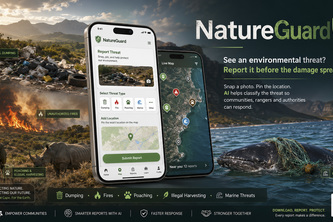
NatureGuard is a self-reported mobile-first web application designed to help citizens document environmental harm through photo uploads and AI-assisted evidence generation. It was built as a submission for the OpenAI 2026 hackathon.
What changed
The project description indicates development of an AI-powered tool that combines image analysis with location data and user input to produce structured environmental reports. It includes claims about using GPT-5.6 for evidence briefs, Firebase for backend, and Next.js for frontend.
Single most important open question
Is there any evidence of real-world usage, traction or revenue generation beyond the hackathon submission? The description contains no data on actual users, customers, monetization, or adoption.
What The Product Actually Is
The description states that NatureGuard is a mobile-first web application that allows users to photograph or upload environmental harm, combine it with location data and observations, then use GPT-5.6 to generate a structured evidence report. It includes:
- Image capture/upload
- Location attachment/confirmation
- User-written eyewitness description
- AI-assisted analysis via GPT-5.6
- Structured report creation
- Guidance on appropriate reporting pathways
The application is described as deliberately not presenting AI analysis as final legal or scientific determination, and the user remains responsible for confirming findings.
Evidence The author's own write-up.
Inference This appears to be a proof-of-concept prototype built for a hackathon, not a production product with users or revenue.
Positioning & Claim Evolution
The description states that NatureGuard was inspired by environmental challenges in South Africa but aims to scale globally. It positions itself as helping people document pollution, illegal dumping, wildlife distress, and other threats by turning photos into AI-assisted evidence reports.
Key claims include:
- Helps citizens navigate fragmented environmental responsibility
- Makes environmental reporting more accessible and actionable
- Uses AI to organize information into clearer reports
- Guides users toward appropriate reporting authorities
The author emphasizes that the AI is used as a decision-support tool, not as an unquestionable authority, and that it does not replace human investigation or enforcement.
Evidence The author's own write-up.
Inference This is a self-described solution to a problem of environmental reporting friction, positioned as a citizen empowerment tool rather than a commercial platform.
Target Customer & ICP
The description states that NatureGuard targets concerned citizens who witness environmental harm and want to report it but face uncertainty about:
- What type of violation they are seeing
- How urgent it is
- What evidence is useful
- Which authority is responsible
It is designed for people in situations where they might take a photo or talk about an incident on social media, but then encounter practical barriers to reporting.
Evidence The author's own write-up.
Inference The target customer is not clearly defined beyond "concerned citizens" and lacks demographic or behavioral segmentation. No evidence of specific personas or buyer journeys.
Business Model & Pricing Evidence
The description does not contain any information about pricing, monetization, or business model. It only describes the technical architecture and functionality.
Evidence Not evidenced.
Inference There is no indication that NatureGuard has a commercial business model or charges for use beyond the hackathon submission.
Technical & Delivery Signals
The application is built with:
- Next.js and TypeScript
- OpenAI GPT-5.6 through the Responses API
- Firebase Authentication, storage
- Geolocation and map-based incident context
- Vercel for deployment
- Codex for AI-assisted development
It includes a public demonstration path using synthetic images to protect privacy.
Evidence The author's own write-up.
Inference This is a prototype built in a short timeframe (hackathon), not a production-grade system with scaling infrastructure or enterprise features.
Traction & Maturity Signals
The description contains no evidence of traction, revenue, customers, or adoption beyond the hackathon submission. It mentions:
- A single developer (Marc Johnston)
- A public demo path
- No mention of real users or usage metrics
Evidence Not evidenced.
Inference The project appears to be a concept prototype with no demonstrated market traction or user base.
Competitive Context
The description does not provide any information about competitors, existing solutions in the environmental reporting space, or how NatureGuard compares to them.
Evidence Not evidenced.
Inference No competitive landscape is described; this is an unproven idea without a known market context.
Open Questions & Risks
- Unverified claims: The description contains no independent verification of any functionality or impact.
- No traction data: There is no evidence of users, customers, revenue, or adoption.
- Prototype nature: Built for a hackathon with no indication of production readiness or scalability.
- AI overstatement risk: While the author claims to keep AI use bounded, this may not be verifiable in practice.
- Privacy concerns: The system handles sensitive environmental evidence and requires careful handling of data privacy.
- Scalability assumptions: The vision includes global expansion but no evidence of planning or execution for such growth.
Evidence Not evidenced.
Inference The project is a concept with no demonstrated viability, traction, or commercial potential.
Questions the description leaves open
- What specific environmental agencies or organizations are you planning to integrate with?
- How do you plan to validate the accuracy of AI-generated evidence reports?
- Have you tested the platform with real users in the field?
- What is your strategy for handling sensitive data and ensuring privacy compliance?
- Are there any existing partnerships or pilot programs with environmental organizations?
- How do you intend to scale beyond the current hackathon prototype?
- What are the key technical challenges that remain unresolved in moving from prototype to production?
Overall Assessment
Not evidenced.
The description provides no information on:
- Revenue or financials
- Customer base or user engagement
- Market traction or adoption
- Commercial viability or business model
- Product-market fit or competitive positioning
This is a self-reported hackathon project with no evidence of real-world usage, monetization, or commercial potential. The author states that the platform was designed to begin locally and eventually scale globally, but there is no indication of progress toward that goal.
Confidence level Low — based entirely on unverified self-reporting without any external validation or performance data.
User Stories BotA demo video on every pull request
Get a demo video on every new feature
GitHub App that watches your pull requests and records a narrated, captioned demo.
Save time on demo prep and make informed decisions faster with a video walkthrough of every new feature.
Source
Submitted to the OpenAI 2026 hackathon on Devpost. Project home on Devpost. Back to the full gallery on Devpost.
This competitive analysis was produced by top-founders.com (opens in a new tab)
Generated by a language model from this project's public Devpost page — its tagline, the author's own write-up and any built-with tags listed there — as captured in August 2026. Short quotations are the author's words. It is an opinion on the idea as a business, not on the people behind it, and it reflects the description as published then. If the project has moved on, request a correction below. The analysis is not independent research and contains no verified traction, revenue or customer data.
An independent guide by KFG International LLC — not affiliated with, endorsed by, or connected to Devpost or OpenAI.