

Archive position — measured, not model output
0 likes on Devpost
2,263 of the 7,850 archived projects have more likes, and 5,587 share exactly 0 — so this project's #5,402 place in the like-ranked listing is a tie-break inside that group, not a ranking.
Projects (log scale)
Likes on Devpost. ▲ marks this project's group.
Show the figures
| Likes | Projects | Share of archive |
|---|---|---|
| 0 | 5,587 | 71.2% |
| 1 | 1,758 | 22.4% |
| 2 | 284 | 3.6% |
| 3–4 | 132 | 1.7% |
| 5–9 | 75 | 1.0% |
| 10+ | 14 | 0.2% |
 User Stories BotA demo video on every pull request
Get a demo video on every new feature
GitHub App that watches your pull requests and records a narrated, captioned demo.
Save time on demo prep and make informed decisions faster with a video walkthrough of every new feature.
Executive Summary
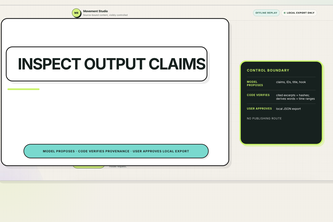
What the company appears to be: Movement Studio is a local, source-bound content-planning workflow tool for expert work, built as a Python 3.11 application with a JavaScript interface. It uses GPT-5.6 (via OpenRouter) for structured output and deterministic code for provenance verification.
What changed: The project was submitted to the OpenAI 2026 hackathon by a single developer, Andrei Turcea. It is described as a prototype that implements a workflow for expert content creation with strict source-boundary enforcement.
The single most important open question: Is there any evidence of traction, revenue or customer adoption beyond the author's own submission?
Analysis basis: This report is based entirely on the self-reported project description provided by the caller. No external verification, archived data, or third-party sources are available. All claims are treated as stated by the author and not independently confirmed.
What The Product Actually Is
- The description states that Movement Studio is a local Python 3.11 application with a JavaScript interface.
- It uses GPT-5.6 (via OpenRouter) for structured output in two steps:
- Creating a source-aware brief.
- Selecting transcript segment IDs for an edit plan.
- The tool enforces deterministic code validation, including checks on:
- Excerpts
- Source hashes
- Segment validity
- Transcript text and time ranges
- It supports both live mode (with model requests) and a credential-free synthetic replay path.
- Final output is a browser-local JSON review bundle, with no publishing or cloud storage.
Inference: The tool appears to be a prototype for expert content planning, focused on maintaining source provenance in AI-assisted workflows. It is not a commercial product but a hackathon submission.
Positioning & Claim Evolution
- The author states that the inspiration was to accelerate expert-content work while avoiding issues of missing or inconsistent provenance.
- The tool aims to reject fluent output detached from its source, and instead derive transcript evidence locally.
- It is positioned as a tool for turning expert guidance into reusable content without losing source context.
Inference: The positioning reflects a niche focus on source-bound AI workflows, likely targeting creators or researchers who need to maintain strict provenance in their outputs. No claims of broader market relevance or scalability are made.
Target Customer & ICP
- The description states that the tool is built for turning expert guidance into reusable content without losing its source context.
- It is described as a source-bound content-planning workflow for expert work, suggesting a target audience of:
- Content creators
- Researchers
- Experts who produce structured, source-heavy outputs
Inference: The ICP appears to be narrow — likely early-stage researchers or content creators who prioritize source integrity. No evidence of customer segments or personas is provided.
Business Model & Pricing Evidence
- The description states that the tool does not publish, post, message, store in cloud, or use social-platform endpoints.
- Final output is a local JSON bundle, with no indication of monetization or pricing.
- There is no mention of revenue streams, subscriptions, or pricing tiers.
Inference: No business model or pricing evidence is provided. The tool appears to be a prototype and not intended for commercial use.
Technical & Delivery Signals
- Built as a local Python 3.11 application with JavaScript interface, using:
- OpenAI GPT-5.6 (via OpenRouter)
- Pydantic contracts
- Vanilla JavaScript
- Allowlisted loopback HTTP server
- Uses structured-output requests for two steps:
- Create a source-aware brief
- Select transcript segment IDs
- Includes 137/137 automated tests and 18/18 offline adversarial cases passing.
- The tool is described as credential-free, with a synthetic replay path that makes no model requests.
Inference: The technical stack suggests a secure, deterministic workflow with strong validation. It is not a SaaS product but a prototype with local execution and offline capabilities.
Traction & Maturity Signals
- The project was submitted to the OpenAI 2026 hackathon, indicating it's a prototype or proof-of-concept.
- No evidence of:
- Revenue
- Customers
- Adoption
- Product-market fit
- User feedback or usage metrics
Inference: There is no evidence of traction, adoption, or maturity beyond the author’s own prototype.
Competitive Context
- The description does not mention any competitors.
- It is not clear whether similar tools exist in the market for:
- Source-bound AI workflows
- Expert content planning
- Transcript-based editing with provenance
Inference: No competitive context is provided. The tool may be unique or niche, but this cannot be confirmed.
Open Questions & Risks
- The project is a single-developer hackathon submission.
- It is described as synthetic and not field-validated, indicating no real-world testing.
- There is no evidence of product-market fit, revenue, or customer traction.
- The tool is local-only, with no cloud or publishing features — limiting its commercial viability.
- No mention of scalability, long-term maintenance, or future development plans.
Inference: The project is a prototype with limited commercial potential. Risks include lack of real-world validation and no clear path to monetization.
Questions the description leaves open
- What is the intended use case for this tool beyond the hackathon?
- Are there any plans to expand beyond local execution or synthetic data?
- How does the tool handle edge cases in transcript parsing or source validation?
- Is there a plan to test with real users or expert content creators?
- What are the long-term goals for this project — is it intended to become a product?
Inference: These questions aim to uncover whether the prototype has evolved into a viable product or remains a proof-of-concept.
Overall Assessment
- The project is described as a single-developer hackathon submission.
- It is not evidenced to have traction, revenue, or customers.
- It is not a commercial product, but a prototype with no monetization strategy.
- No evidence of a scalable business model or market demand.
Inference: Not suitable for investment or partnership at this stage. It may be a promising idea, but lacks the evidence to support a commercial or strategic move.
User Stories BotA demo video on every pull request
Get a demo video on every new feature
GitHub App that watches your pull requests and records a narrated, captioned demo.
Save time on demo prep and make informed decisions faster with a video walkthrough of every new feature.
Source
Submitted to the OpenAI 2026 hackathon on Devpost. Project home on Devpost. Back to the full gallery on Devpost.
This competitive analysis was produced by top-founders.com (opens in a new tab)
Generated by a language model from this project's public Devpost page — its tagline, the author's own write-up and any built-with tags listed there — as captured in August 2026. Short quotations are the author's words. It is an opinion on the idea as a business, not on the people behind it, and it reflects the description as published then. If the project has moved on, request a correction below. The analysis is not independent research and contains no verified traction, revenue or customer data.
An independent guide by KFG International LLC — not affiliated with, endorsed by, or connected to Devpost or OpenAI.