

Archive position — measured, not model output
0 likes on Devpost
2,263 of the 7,850 archived projects have more likes, and 5,587 share exactly 0 — so this project's #5,399 place in the like-ranked listing is a tie-break inside that group, not a ranking.
Projects (log scale)
Likes on Devpost. ▲ marks this project's group.
Show the figures
| Likes | Projects | Share of archive |
|---|---|---|
| 0 | 5,587 | 71.2% |
| 1 | 1,758 | 22.4% |
| 2 | 284 | 3.6% |
| 3–4 | 132 | 1.7% |
| 5–9 | 75 | 1.0% |
| 10+ | 14 | 0.2% |
 User Stories BotA demo video on every pull request
Get a demo video on every new feature
GitHub App that watches your pull requests and records a narrated, captioned demo.
Save time on demo prep and make informed decisions faster with a video walkthrough of every new feature.
Executive Summary
What the company appears to be
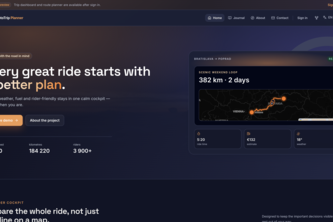
MotoTrip Planner is a self-reported AI-assisted trip planner for motorcycle riders, built as a full-stack web application using Next.js, React, Supabase, and OpenAI APIs. It allows users to define trip parameters (origin, destination, duration, preferences) and receive AI-generated route suggestions that prioritize scenic or memorable roads over fastest arrival times.
What changed
The project was submitted to the OpenAI 2026 hackathon by a solo developer, Michal Smriga. The author describes it as a prototype built with AI tools like Codex and GPT-5.6, and includes a complete end-to-end demo flow from trip creation to GPX export.
Single most important open question
Is there any evidence of actual user adoption or revenue generation beyond the developer’s own use case?
What The Product Actually Is
The description states that MotoTrip Planner is an AI-assisted trip planner built specifically for motorcycle riders. It allows users to define trip parameters and receive AI-generated route suggestions that favor scenic roads over fastest arrival times.
It proposes stops, keeps road style, surface preferences, weather, fuel, and budget visible, lets the rider review and edit every proposed stop before saving it, creates a day-by-day itinerary with practical distance and riding-time estimates, suggests points of interest and overnight stays, displays the route on an interactive map (Leaflet/OpenStreetMap), and exports confirmed routes as GPX files.
The system uses a domain-first architecture with services, thin API routes, and external systems behind provider interfaces. It integrates OpenAI APIs for structured planning suggestions, OpenRouteService for routing, Supabase for authentication and persistence, and Leaflet/OpenStreetMap for mapping.
Not evidenced: The actual product functionality beyond the developer’s own account, including whether it has been tested with real users or deployed in production.
Positioning & Claim Evolution
The author claims MotoTrip Planner is designed to help motorcycle riders avoid the time-consuming process of combining multiple tools for trip planning. It emphasizes that most route planners optimize for arrival time rather than enjoyment — a key differentiator.
It positions itself as an AI-assisted tool where AI proposes but does not overwrite user decisions, maintaining transparency and reversibility in its design.
The author also states that they learned the best experience is not created by one perfect score but through reducing research and proposing coherent options while leaving taste and safety choices to the rider.
Not evidenced: Whether this positioning resonates with a broader audience or if there are competitors who have adopted similar approaches.
Target Customer & ICP
The description states that MotoTrip Planner is built specifically for motorcycle riders. It allows users to define parameters such as origin, destination, duration, daily distance, motorcycle type, riding style, road preferences, interests, and budget.
It targets riders who want to plan trips without relying on multiple tools, focusing on enjoyable routes rather than fastest arrival times.
Not evidenced: Specific customer segments beyond general motorcyclists, or evidence of target market size or segmentation strategy.
Business Model & Pricing Evidence
The description does not provide any information about pricing models, monetization strategies, or business model assumptions. The author mentions future features like booking through the app and collaborative group rides but does not elaborate on how these would be monetized.
Not evidenced: No indication of revenue streams, pricing tiers, or commercial viability beyond the developer’s personal use case.
Technical & Delivery Signals
The application is built using Next.js 16, React 19, TypeScript, Tailwind CSS, Zod, Supabase Postgres, Leaflet/OpenStreetMap, and Vercel. It uses a domain-first architecture with services, thin API routes, and provider interfaces.
It integrates OpenAI APIs for structured planning suggestions, OpenRouteService for routing, Supabase for authentication and persistence, and includes features like request validation, ownership checks, rate limiting, health checks, unit and architecture tests, responsive UI, localization, GPX export, and a Capacitor-based mobile shell.
Codex and GPT-5.6 were used throughout the build process to accelerate domain modeling, provider boundaries, Supabase security migrations, test design, debugging, UI integration, documentation, and end-to-end workflow.
Not evidenced: No evidence of deployment in production, scalability metrics, or performance data beyond the developer’s own account.
Traction & Maturity Signals
The project is described as a hackathon submission to the OpenAI 2026 event. It includes a complete demo flow from trip creation to GPX export and has a substantial automated test suite covering domain rules, APIs, routing, security boundaries, and GPX output.
It also mentions that it remains functional without optional paid API credentials, suggesting some level of robustness or fallback mechanisms.
Not evidenced: No evidence of user adoption, customer feedback, revenue, or usage metrics beyond the developer’s own account.
Competitive Context
The description does not mention any competitors. However, it implies a niche in motorcycle route planning that may overlap with general-purpose trip planners or GPS navigation apps.
It positions itself as an alternative to tools that optimize for fastest arrival time, instead favoring scenic or memorable roads.
Not evidenced: No competitive analysis, market positioning relative to existing players, or differentiation strategy beyond the stated preference for enjoyment over speed.
Open Questions & Risks
- The project is a solo developer effort with no evidence of team expansion or external investment.
- There is no evidence of revenue, customers, or traction beyond the author’s own use case.
- The product is described as a hackathon submission and lacks commercialization signals.
- AI integration relies heavily on OpenAI APIs and Codex, which may introduce dependency risks.
- No mention of data privacy, security compliance, or regulatory considerations.
Not evidenced: No evidence of risk mitigation strategies, scalability concerns, or long-term sustainability plans.
Questions the description leaves open
- What is the actual user base beyond the developer’s own use?
- How does the team plan to scale beyond a solo developer?
- Are there any plans for monetization or revenue generation?
- Has the product been tested with real users outside of the developer’s own experience?
- What are the technical dependencies and how do they plan to manage API availability or cost?
- Is there a roadmap for mobile app development, and what is the timeline?
- How does the team intend to compete with existing GPS and trip planning tools?
Overall Assessment
The project is currently described as a hackathon submission by a single developer, with no evidence of commercial traction or revenue generation. It shows technical maturity in building a full-stack application with AI integration, but lacks any indication of market validation or scalability beyond the developer’s own use case.
Confidence Level Low
Next Steps
If this is a pre-product idea or prototype, further due diligence should focus on whether it has evolved into a viable product with early adopters and clear monetization paths.
User Stories BotA demo video on every pull request
Get a demo video on every new feature
GitHub App that watches your pull requests and records a narrated, captioned demo.
Save time on demo prep and make informed decisions faster with a video walkthrough of every new feature.
Source
Submitted to the OpenAI 2026 hackathon on Devpost. Project home on Devpost. Back to the full gallery on Devpost.
This competitive analysis was produced by top-founders.com (opens in a new tab)
Generated by a language model from this project's public Devpost page — its tagline, the author's own write-up and any built-with tags listed there — as captured in August 2026. Short quotations are the author's words. It is an opinion on the idea as a business, not on the people behind it, and it reflects the description as published then. If the project has moved on, request a correction below. The analysis is not independent research and contains no verified traction, revenue or customer data.
An independent guide by KFG International LLC — not affiliated with, endorsed by, or connected to Devpost or OpenAI.