

Archive position — measured, not model output
1 like on Devpost
505 of the 7,850 archived projects have more likes, and 1,758 share exactly 1 — so this project's #1,475 place in the like-ranked listing is a tie-break inside that group, not a ranking.
Projects (log scale)
Likes on Devpost. ▲ marks this project's group.
Show the figures
| Likes | Projects | Share of archive |
|---|---|---|
| 0 | 5,587 | 71.2% |
| 1 | 1,758 | 22.4% |
| 2 | 284 | 3.6% |
| 3–4 | 132 | 1.7% |
| 5–9 | 75 | 1.0% |
| 10+ | 14 | 0.2% |
 User Stories BotA demo video on every pull request
Get a demo video on every new feature
GitHub App that watches your pull requests and records a narrated, captioned demo.
Save time on demo prep and make informed decisions faster with a video walkthrough of every new feature.
Executive Summary
What the company appears to be
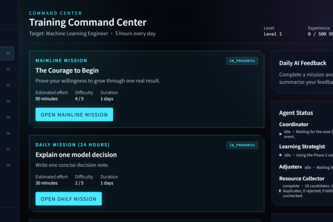
MLevelUp is a self-reported AI-powered progression system for career development, built as a full-stack web application using Next.js, Supabase, and Vercel. It presents users with daily missions designed to be slightly beyond their current skill level, with the goal of turning effort into measurable growth and portfolio-ready evidence.
What changed
The project was submitted as part of the OpenAI 2026 hackathon. The author states that the original vision was broad but was narrowed to machine learning engineering for the first version due to time constraints.
Single most important open question — the commercial due-diligence read
Is there evidence of user engagement, adoption or traction beyond the single developer's prototype? The description does not indicate any revenue, customers, or usage metrics.
Note
This analysis is based exclusively on the self-reported and unverified account provided by the author. No third-party verification or historical data is available.
What The Product Actually Is
- The description states that MLevelUp is an AI-powered progression system for career growth.
- It provides users with daily missions tailored to their target role, current skill level, time availability, and past performance.
- Missions are designed to be slightly beyond the user’s comfort zone, based on real-world problems or Kaggle-style challenges.
- Users submit evidence of work (e.g., GitHub repo, Kaggle notebook) which is reviewed by AI agents for skill growth evaluation.
- Completed missions contribute to a personal profile and portfolio.
- The system includes resource recommendations and feedback from AI agents.
- It uses Next.js, Supabase, Vercel, and GPT-5.6 for agent workflows.
Inference The product is described as a full-stack web application with user authentication, mission delivery, submission handling, and AI-based evaluation. However, no evidence of actual deployment or live users exists in the description.
Positioning & Claim Evolution
- The author claims MLevelUp brings "coaching loops" into career development, contrasting it with traditional course platforms that optimize for content consumption.
- It positions itself as a system that turns hard but achievable challenges into growth opportunities, rather than making learning easy.
- The product is described as starting with machine learning engineering but aims to expand into other life goals such as fitness, finance, language learning, and entrepreneurship.
- A future feature called the "Relic system" intends to foster community support among users pursuing similar goals.
Claim vs Fact
These are self-reported claims about positioning and intent. There is no evidence of market validation or user feedback on these claims.
Target Customer & ICP
- The description states that MLevelUp targets individuals working toward career development, particularly in machine learning engineering.
- It is built for users who want to grow through structured, challenging missions rather than passive consumption.
- Users are expected to be technically capable enough to complete Kaggle-style projects or real-world problem-solving tasks.
Inference The ICP appears to be early-career professionals or self-taught practitioners in tech fields seeking structured growth paths. No evidence of actual customer segmentation, personas, or feedback exists.
Business Model & Pricing Evidence
- Not evidenced.
- The description does not mention any pricing model, monetization strategy, or business model.
- There is no indication of whether the product will be offered as a freemium service, subscription, or one-time purchase.
Absence of evidence
No information on how MLevelUp intends to generate revenue or sustain its operations.
Technical & Delivery Signals
- Built with Next.js (frontend), Supabase (database/authentication), and Vercel (deployment).
- AI agents powered by GPT-5.6 are used for evaluating submissions, recommending resources, and generating missions.
- The system includes a deterministic policy layer to ensure consistency and explainability in progression decisions.
- The author used ChatGPT and Codex during development to refine the idea and implement the product.
- It is described as a full-stack prototype with working components including authentication, command center, mission delivery, submission handling, and portfolio building.
Inference Technical architecture suggests a modern SaaS stack. However, no evidence of scalability, performance metrics, or production-grade infrastructure is provided.
Traction & Maturity Signals
- Not evidenced.
- The description does not include any data on user signups, retention, usage frequency, or engagement.
- No mention of customer feedback, beta testing, or product iteration history.
- The project was submitted to a hackathon and described as a prototype.
Absence of evidence
There is no indication of traction, adoption, or maturity beyond the initial build.
Competitive Context
- Not evidenced.
- The description does not reference competitors, market size, or competitive positioning.
- No mention of existing tools in the career development or gamification space.
Absence of evidence
No competitive landscape or differentiation analysis is provided.
Open Questions & Risks
- Single Developer: The project has only one team member (barrychung1112), raising concerns about scalability, maintenance, and long-term product evolution.
- Unverified AI Capabilities: The use of GPT-5.6 is claimed but not substantiated with performance data or reliability metrics.
- Lack of Traction: No evidence of users, customers, or revenue indicates a high risk of failure to transition from prototype to viable product.
- Broad Vision Narrowed: While the original scope was broad, it was narrowed to machine learning engineering for this version — suggesting potential difficulty in expanding beyond one domain.
- No Monetization Strategy: No indication of how the platform will be monetized or sustained.
Inference The lack of traction and limited team size suggest a high risk of product failure if not validated by users or expanded with additional resources.
Questions the description leaves open
- What specific user feedback have you gathered so far, if any?
- How do you plan to scale beyond one developer?
- Can you describe the AI agent workflow in more detail? Is there a way to verify its effectiveness or accuracy?
- Are there any early adopters or users currently testing the system?
- What is your long-term vision for monetization and user acquisition?
- How do you intend to expand from machine learning engineering into other domains like fitness or finance?
Note
These questions are intended to probe beyond the self-reported claims in the description.
Overall Assessment
- Not evidenced.
- There is no evidence of revenue, customers, or traction that would support an investment or partnership decision.
- The product remains a prototype built by one developer with no indication of commercial viability or market validation.
Confidence Level Low — based on thin self-reported evidence and absence of any measurable outcomes.
User Stories BotA demo video on every pull request
Get a demo video on every new feature
GitHub App that watches your pull requests and records a narrated, captioned demo.
Save time on demo prep and make informed decisions faster with a video walkthrough of every new feature.
Source
Submitted to the OpenAI 2026 hackathon on Devpost. Project home on Devpost. Back to the full gallery on Devpost.
This competitive analysis was produced by top-founders.com (opens in a new tab)
Generated by a language model from this project's public Devpost page — its tagline, the author's own write-up and any built-with tags listed there — as captured in August 2026. Short quotations are the author's words. It is an opinion on the idea as a business, not on the people behind it, and it reflects the description as published then. If the project has moved on, request a correction below. The analysis is not independent research and contains no verified traction, revenue or customer data.
An independent guide by KFG International LLC — not affiliated with, endorsed by, or connected to Devpost or OpenAI.