

Archive position — measured, not model output
0 likes on Devpost
2,263 of the 7,850 archived projects have more likes, and 5,587 share exactly 0 — so this project's #5,371 place in the like-ranked listing is a tie-break inside that group, not a ranking.
Projects (log scale)
Likes on Devpost. ▲ marks this project's group.
Show the figures
| Likes | Projects | Share of archive |
|---|---|---|
| 0 | 5,587 | 71.2% |
| 1 | 1,758 | 22.4% |
| 2 | 284 | 3.6% |
| 3–4 | 132 | 1.7% |
| 5–9 | 75 | 1.0% |
| 10+ | 14 | 0.2% |
 User Stories BotA demo video on every pull request
Get a demo video on every new feature
GitHub App that watches your pull requests and records a narrated, captioned demo.
Save time on demo prep and make informed decisions faster with a video walkthrough of every new feature.
Executive Summary
Company: Monbra
Self-reported basis: The analysis is based entirely on the author's own description of the project, submitted as part of a Devpost hackathon entry. No external verification or independent sources are available.
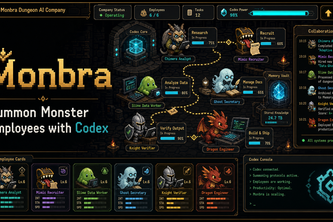
What it appears to be: A local-first prototype that presents AI agents as monster employees within a dungeon-themed company framework. It allows users to summon AI workers, assign tasks, observe workflows, and store outputs as reusable memory.
What changed: The project is described as a learning-focused prototype built during a hackathon, with no evidence of prior development or commercial traction.
Most important open question: Is there any indication that this concept will evolve into a product with real user adoption or commercial viability beyond the prototype stage?
What The Product Actually Is
The description states that Monbra is a local-first AI company builder where users can summon monster employees, assign jobs, and observe agent workflows. It includes:
- A UI for choosing monster employees from an AI employee library
- Work request handling
- Agent collaboration through agency-style workflows
- Visualization of participation, handoffs, and communication logs
- Storage of outputs as reusable memory
It is described as a prototype focused on learning how to build and operate an AI company, not a polished SaaS product.
Evidence: The author's own write-up.
Confidence: Low — no independent verification or demonstration of functionality beyond the self-reported description.
Positioning & Claim Evolution
The project claims to reframe AI agents as understandable monster employees within a dungeon-themed company. It positions itself as an alternative to abstract AI automation, aiming for clarity and trustworthiness in agent workflows.
It is explicitly framed as a learning tool rather than a commercial product, with no mention of monetization or customer acquisition strategies.
Evidence: The author's own write-up and tagline.
Confidence: Low — the positioning is self-reported and lacks evidence of traction or market validation.
Target Customer & ICP
The description does not identify a specific target customer or ideal customer profile (ICP). It is described as a local-first prototype for understanding AI company construction, not aimed at end-users or businesses.
Evidence: The author's own write-up.
Confidence: Very low — no evidence of defined personas or use cases beyond the prototype’s educational intent.
Business Model & Pricing Evidence
There is no evidence of a business model or pricing strategy in the description. It is described as a local prototype, not a commercial offering.
Evidence: The author's own write-up.
Confidence: Not evidenced — no mention of revenue, monetization, or pricing.
Technical & Delivery Signals
The project was built using React and Codex. It includes:
- A local web UI
- Agent orchestration
- Work logs
- Memory-style output for traceability
It is described as a prototype with no commercial delivery or scalability features.
Evidence: The author's own write-up.
Confidence: Low — the technical details are self-reported and unverified.
Traction & Maturity Signals
There is no evidence of traction, customers, or adoption beyond the prototype stage. It is described as a hackathon submission with no prior development history.
Evidence: The author's own write-up.
Confidence: Not evidenced — no data on usage, users, or product maturity.
Competitive Context
The description does not mention any competitors or competitive landscape. It is positioned as a novel approach to agent workflows but lacks context in the broader AI tooling or SaaS space.
Evidence: The author's own write-up.
Confidence: Not evidenced — no mention of existing tools or market positioning.
Open Questions & Risks
- Unproven commercial viability: No evidence of product-market fit, revenue, or customer traction.
- Prototype-only: The project is described as a learning prototype with no indication of future development or scalability.
- No monetization strategy: No mention of business model or pricing.
- Limited scope: Focused on local-first experience and educational goals, not enterprise or commercial use.
Evidence: The author's own write-up.
Confidence: Low — risks are inferred from lack of evidence rather than stated facts.
Questions the description leaves open
- What is the intended evolution from this prototype to a product with real users?
- Are there any plans for commercialization or monetization beyond the prototype?
- How does the dungeon-themed metaphor translate into usability for non-hobbyist users?
- What are the technical limitations of the local-first approach, and how would they be addressed at scale?
- Is there any evidence of user feedback or testing beyond the hackathon?
Overall Assessment
Not evidenced — There is no indication that this project has progressed beyond a prototype stage or has demonstrated commercial viability, traction, or scalability. It is described as a learning-focused hackathon submission with no evidence of market validation or business development.
Confidence: Very low — the description provides no basis for assessing investment or partnership potential.
User Stories BotA demo video on every pull request
Get a demo video on every new feature
GitHub App that watches your pull requests and records a narrated, captioned demo.
Save time on demo prep and make informed decisions faster with a video walkthrough of every new feature.
Source
Submitted to the OpenAI 2026 hackathon on Devpost. Project home on Devpost. Back to the full gallery on Devpost.
This competitive analysis was produced by top-founders.com (opens in a new tab)
Generated by a language model from this project's public Devpost page — its tagline, the author's own write-up and any built-with tags listed there — as captured in August 2026. Short quotations are the author's words. It is an opinion on the idea as a business, not on the people behind it, and it reflects the description as published then. If the project has moved on, request a correction below. The analysis is not independent research and contains no verified traction, revenue or customer data.
An independent guide by KFG International LLC — not affiliated with, endorsed by, or connected to Devpost or OpenAI.