

Archive position — measured, not model output
0 likes on Devpost
2,263 of the 7,850 archived projects have more likes, and 5,587 share exactly 0 — so this project's #5,306 place in the like-ranked listing is a tie-break inside that group, not a ranking.
Projects (log scale)
Likes on Devpost. ▲ marks this project's group.
Show the figures
| Likes | Projects | Share of archive |
|---|---|---|
| 0 | 5,587 | 71.2% |
| 1 | 1,758 | 22.4% |
| 2 | 284 | 3.6% |
| 3–4 | 132 | 1.7% |
| 5–9 | 75 | 1.0% |
| 10+ | 14 | 0.2% |
 User Stories BotA demo video on every pull request
Get a demo video on every new feature
GitHub App that watches your pull requests and records a narrated, captioned demo.
Save time on demo prep and make informed decisions faster with a video walkthrough of every new feature.
Executive Summary
What the company appears to be
Mindland is a self-reported personal development app that uses AI to help users track progress toward life goals through gamified 3D island visualization. The product is built using GPT-5.6 models, with an onboarding chat experience and automated island growth or degradation based on user input.
What changed
The project was submitted as a hackathon entry for the OpenAI 2026 hackathon. It represents a proof-of-concept prototype built by a single developer using AI-assisted development tools.
Single most important open question — the commercial due-diligence read
Is there evidence of any traction, revenue, or user engagement beyond the author’s own account? The description states no such data exists.
What The Product Actually Is
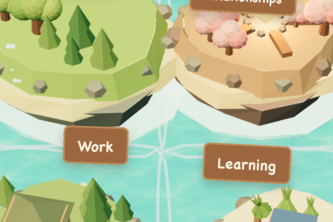
The description states that Mindland is a personal development app where users sign up and begin an onboarding chat with GPT 5.6 Luna. This AI agent attempts to understand aspects of the user's life (e.g., Fitness, Sleep, Work) and creates personalized 3D islands for each topic. Users can check in daily via chat or by completing questionnaires. If users meet their goals, their island grows; if they do not, rocks accumulate and sink the island.
The app uses React Native/Expo for UI rendering and integrates with tools like Clerk (authentication), Convex (backend), and Expo.io for deployment.
Evidence
- Author states: “You first sign up/in and begin an onboarding chat with GPT 5.6 Luna who tries to understand what aspect of life you're focusing on.”
- Author states: “It creates islands for each topic.”
- Author states: “You can check in everyday and discuss your progress with Luna in the chat or complete the personalized questionnaire for each island.”
- Author states: “If you do well, your island automatically grows and if you do something negative against your goals, you could slowly accumulate rocks that sink your island.”
Inference The app appears to be a gamified personal tracking tool using AI-generated content and 3D visualization.
Positioning & Claim Evolution
The author states the inspiration came from the Forest app, which tracks focus time through virtual tree growth. Mindland aims to extend this concept into broader life goal tracking.
Evidence
- Author states: “The inspiration came from the Forest app where you can grow virtual trees based on how long you focused.”
- Author states: “I wanted something similar that would show my progress for my goals and various aspects of my life.”
Inference The positioning evolved from a simple focus-tracking tool to a more holistic personal development platform using AI.
Target Customer & ICP
Not evidenced. The description does not specify target customer segments or ideal customer profiles beyond the general idea of users interested in goal tracking.
Evidence
- No mention of specific personas, demographics, or use cases.
- Author only describes their own experience and motivation.
Business Model & Pricing Evidence
Not evidenced. There is no indication of pricing structure, monetization strategy, or business model in the description.
Evidence
- No mention of subscriptions, freemium tiers, or paid features.
- No reference to revenue streams or monetization plans.
Technical & Delivery Signals
The app was built using GPT 5.6 Sol High and Low models as orchestrators and subagents respectively. The author used Codex, Convex, Clerk, Expo.io, and React Native. Development involved AI-assisted prototyping, documentation, and git workflow setup.
Evidence
- Author states: “I built it using Codex and GPT 5.6 Sol High as the main orchestrator and GPT 5.6 Sol Low as subagents.”
- Author states: “I initially had a brainstorming session, then had the model prototype the 3D map and then set up the documentation and git workflow so the model could be as independent as possible.”
- Author states: “To be honest, I was very busy during this period so I didn't have time to test and even try the app very often...”
- Technology stack includes: Clerk, Convex, Expo.io, React Native.
Inference The product is built with AI-assisted development tools and likely lacks full user testing or iterative refinement due to limited manual involvement by the developer.
Traction & Maturity Signals
Not evidenced. There is no mention of users, adoption, retention, or any form of traction beyond the author's own account.
Evidence
- Author states: “I didn’t really know what UI to go with but I wondered if GPT 5.6 Sol would be able to render 3D islands in React Native/Expo and it did it successfully.”
- Author states: “I was very busy during this period so I didn't have time to test and even try the app very often (in fact I don't even have an iphone ironically).”
- No data on active users, usage metrics, or product maturity.
Competitive Context
Not evidenced. The description does not reference competitors or market positioning relative to existing apps.
Evidence
- Author references Forest app as inspiration but does not compare or contrast with other products.
- No mention of similar offerings in the market.
Open Questions & Risks
- No verified traction or user data: The entire description is self-reported and unverified, with no evidence of actual users or engagement.
- Single developer team: Only one member listed (Alimaa Ochkhuu), suggesting limited scalability or operational capacity.
- AI dependency without manual oversight: Heavy reliance on AI for development and testing may lead to instability or lack of control.
- Lack of product testing: The author admits they did not test the app often, raising concerns about quality assurance.
- Unproven monetization strategy: No indication of how the product will generate revenue.
Questions the description leaves open
- What is your plan for validating user demand and engagement beyond personal experience?
- How do you intend to scale beyond a single developer?
- Are there any plans for integrating real-time feedback or community features?
- What are the technical limitations of relying on AI for development and testing?
- Have you considered how to monetize this product, if at all?
Overall Assessment
Not evidenced. The description provides no information about funding rounds, valuation, or investment interest.
Evidence
- No mention of investors, funding history, or partnership opportunities.
- No indication of commercial viability or strategic fit for potential partners.
Conclusion
This is a self-reported hackathon prototype with no demonstrated traction, revenue, or customer base. The product is built using AI tools but lacks validation and operational depth. Any investment or partnership decision would require further evidence of market demand, user engagement, and business sustainability.
User Stories BotA demo video on every pull request
Get a demo video on every new feature
GitHub App that watches your pull requests and records a narrated, captioned demo.
Save time on demo prep and make informed decisions faster with a video walkthrough of every new feature.
Source
Submitted to the OpenAI 2026 hackathon on Devpost. Project home on Devpost. Back to the full gallery on Devpost.
This competitive analysis was produced by top-founders.com (opens in a new tab)
Generated by a language model from this project's public Devpost page — its tagline, the author's own write-up and any built-with tags listed there — as captured in August 2026. Short quotations are the author's words. It is an opinion on the idea as a business, not on the people behind it, and it reflects the description as published then. If the project has moved on, request a correction below. The analysis is not independent research and contains no verified traction, revenue or customer data.
An independent guide by KFG International LLC — not affiliated with, endorsed by, or connected to Devpost or OpenAI.