

Archive position — measured, not model output
1 like on Devpost
505 of the 7,850 archived projects have more likes, and 1,758 share exactly 1 — so this project's #1,445 place in the like-ranked listing is a tie-break inside that group, not a ranking.
Projects (log scale)
Likes on Devpost. ▲ marks this project's group.
Show the figures
| Likes | Projects | Share of archive |
|---|---|---|
| 0 | 5,587 | 71.2% |
| 1 | 1,758 | 22.4% |
| 2 | 284 | 3.6% |
| 3–4 | 132 | 1.7% |
| 5–9 | 75 | 1.0% |
| 10+ | 14 | 0.2% |
 User Stories BotA demo video on every pull request
Get a demo video on every new feature
GitHub App that watches your pull requests and records a narrated, captioned demo.
Save time on demo prep and make informed decisions faster with a video walkthrough of every new feature.
Executive Summary
What the company appears to be
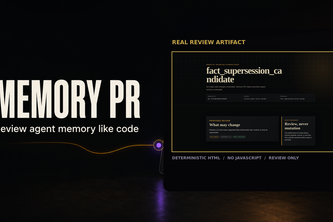
Memory PR is a self-reported tool that applies the pull-request (PR) model to AI agent memory — specifically, to persistent memory systems like those used in Qdrant-based agents. It enables review of proposed changes to agent memory before they are applied, using deterministic artifacts and static HTML outputs.
What changed
The project was built as part of a hackathon submission. The author describes it as an extension of the open-source Hermes Qdrant Memory plugin, with a focus on making memory changes traceable, reviewable, and non-mutating.
Single most important open question
Is there any evidence that this tool is being used or tested in real-world agent workflows beyond the hackathon context?
What The Product Actually Is
The description states that Memory PR:
- Reloads only the proposal's exact current Qdrant points.
- Verifies that the affected ID set still matches the persisted proposal.
- Labels review drift as unchanged, changed, or conservative unknown.
- Presents evidence, provenance, status labels, and proposed changes.
- Generates deterministic JSON and HTML review artifacts.
- Never mutates Qdrant, memory payloads, sources, reports, or apply authority.
It is described as a read-side tool that does not execute changes, but only reviews them. It includes:
- A dependency-free synthetic fixture.
- A pure packet builder, static renderer, offline fixture, verifier, provider integration, tests, architecture documentation, and safety documentation.
- A focus on deterministic output and offline verification.
Inference Memory PR is a review system for AI agent memory that uses static artifacts to present changes before application. It is not an execution engine but a governance layer.
Positioning & Claim Evolution
The author states:
- Memory PR applies the pull-request mental model to agent memory.
- It makes proposed changes visible, traceable, deterministic, and reviewable.
- It avoids mutating memory directly; it only generates artifacts for review.
Inference The positioning is that of a governance or audit tool for AI agents' persistent memory systems. It is not described as a product for general use but as a solution to a specific problem in agent memory management — the lack of visibility and control over changes.
Target Customer & ICP
Not evidenced.
Explanation
The description does not identify any specific customer segment or target persona. It does not describe who would use this tool, how they would integrate it, or what their needs are beyond the author’s own use case in a hackathon.
Business Model & Pricing Evidence
Not evidenced.
Explanation
There is no mention of pricing, monetization, or business model in the description. The project is described as a hackathon submission with no indication of commercial intent or revenue streams.
Technical & Delivery Signals
The description states:
- Built using codex-cli, css, github-actions, gpt-5.6, hermes-agent, html, python, qdrant.
- Extends the open-source Hermes Qdrant Memory plugin.
- Uses a frozen pre-event baseline tag.
- Implements test-first increments and iterates through reviewer and security findings.
- Final hardening moved from alias-based filtering to bounded, schema-first structural redaction.
- The resulting HTML is dependency-free, uses semantic landmarks, escaped untrusted content, restrictive CSP, visible focus states, responsive cards, forced-colors support, reduced-motion behavior, and print styles.
- Contains no JavaScript and loads no external resources.
Inference The tool is built with a strong emphasis on security, determinism, and offline usability. It is designed to be portable and safe for review without risk of mutation or data leakage.
Traction & Maturity Signals
The description states:
- The official project work was completed in one Codex CLI thread using GPT-5.6 Sol.
- Includes a dependency-free synthetic fixture.
- Judges can generate and verify the same Memory PR ID, content digest, JSON bytes, and HTML bytes in under five minutes without Hermes, Qdrant, embeddings, network access, or private user data.
- Accomplishments include:
- Deterministic fixture identity
- Full suite: 1477 passed, 7 skipped
- Focused Memory PR tests: 71 passed
- Independent formal reviewer: PASS
- Independent security reviewer: PASS
- GitHub Actions and GitGuardian checks: PASS
- Pull request merged into main
Inference The project has been tested in a controlled environment, with passing reviews from independent sources. It is described as a completed hackathon submission with no indication of ongoing use or adoption.
Competitive Context
Not evidenced.
Explanation
There is no mention of competitors or existing tools in the same space. The description does not reference any market landscape or prior art beyond the Hermes Qdrant plugin.
Open Questions & Risks
- No evidence of real-world use: The project is described as a hackathon submission with no indication of adoption or integration into workflows.
- Limited scope: It is presented as a read-side tool, not an execution engine — which may limit its utility in practice.
- Self-reported maturity: All claims are self-reported and unverified; there is no external validation or traction data.
- No customer or market signals: No evidence of target customers, pricing, or commercialization.
Questions the description leaves open
- What real-world agent workflows does this tool intend to support?
- Has it been tested in any production or semi-production environments beyond the hackathon?
- Are there any plans for integration with existing AI agent platforms or memory systems?
- How is the tool intended to be used by reviewers, and what is the process for approval?
- What are the limitations of the current deterministic approach, and how might they scale?
Overall Assessment
Not evidenced.
Explanation
There is no evidence of revenue, funding, or traction that would support an investment or partnership decision. The project is described as a hackathon submission with no indication of commercial viability or market readiness.
User Stories BotA demo video on every pull request
Get a demo video on every new feature
GitHub App that watches your pull requests and records a narrated, captioned demo.
Save time on demo prep and make informed decisions faster with a video walkthrough of every new feature.
Source
Submitted to the OpenAI 2026 hackathon on Devpost. Project home on Devpost. Back to the full gallery on Devpost.
This competitive analysis was produced by top-founders.com (opens in a new tab)
Generated by a language model from this project's public Devpost page — its tagline, the author's own write-up and any built-with tags listed there — as captured in August 2026. Short quotations are the author's words. It is an opinion on the idea as a business, not on the people behind it, and it reflects the description as published then. If the project has moved on, request a correction below. The analysis is not independent research and contains no verified traction, revenue or customer data.
An independent guide by KFG International LLC — not affiliated with, endorsed by, or connected to Devpost or OpenAI.