

Archive position — measured, not model output
0 likes on Devpost
2,263 of the 7,850 archived projects have more likes, and 5,587 share exactly 0 — so this project's #5,228 place in the like-ranked listing is a tie-break inside that group, not a ranking.
Projects (log scale)
Likes on Devpost. ▲ marks this project's group.
Show the figures
| Likes | Projects | Share of archive |
|---|---|---|
| 0 | 5,587 | 71.2% |
| 1 | 1,758 | 22.4% |
| 2 | 284 | 3.6% |
| 3–4 | 132 | 1.7% |
| 5–9 | 75 | 1.0% |
| 10+ | 14 | 0.2% |
 User Stories BotA demo video on every pull request
Get a demo video on every new feature
GitHub App that watches your pull requests and records a narrated, captioned demo.
Save time on demo prep and make informed decisions faster with a video walkthrough of every new feature.
Executive Summary
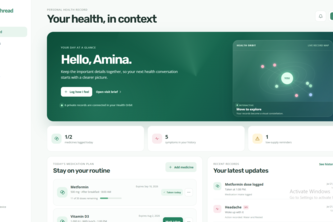
MediThread, as described by its author, is a browser-based prototype tool designed to help individuals organize personal health information — such as medications, symptoms, and care notes — into a structured, print-ready format for medical appointments. The product is presented as a demo-safe, privacy-conscious workspace that avoids clinical decision-making or diagnosis.
The project was built in a single-person effort using GPT-5.6 via Codex and browser technologies (HTML, CSS, JS). It includes features like a visual "Health Orbit" map and a print-ready Visit Brief workflow. The author emphasizes safety boundaries, user trust, and accessibility.
Key commercial due-diligence read: The description states that MediThread is a demo prototype with no evidence of revenue, customers or traction. The project’s positioning as a privacy-conscious health companion with safety boundaries is self-reported and unverified. The most important open question is whether the author can demonstrate a viable path to product-market fit beyond the current demo state.
What The Product Actually Is
The description states that MediThread is a browser-based prototype for organizing personal health information, including medicines, doses, symptoms, illnesses, and care notes. It allows users to:
- Review their health history in a readable format
- Prepare a print-ready Visit Brief for clinicians or pharmacists
- Navigate through a visual "Health Orbit" map
The tool uses semantic HTML, responsive CSS, ES modules, and browser localStorage for demo data. It was built with GPT-5.6 in Codex, and includes a local Node server for easy demo running.
It is described as a demo-safe product that avoids clinical decision-making or diagnosis.
Inference: The tool is not yet a production-ready SaaS offering, but rather an early-stage prototype with a defined end-to-end user flow.
Positioning & Claim Evolution
The author states that MediThread was inspired by the need to help people organize fragmented health memories into a clear story for medical appointments. It is positioned as:
- A calm, private, and simple way to prepare for care conversations
- Not intended to replace professional judgment
- A personal health workspace that helps users "prepare for care conversations without replacing professional judgment"
The project is described as evolving from a demo into a privacy-conscious health companion, with future features like encrypted persistence, richer insights, and caregiver workflows.
Inference: The positioning has evolved from a simple prototype to a more ambitious privacy-focused tool. However, the description does not indicate any shift in commercial intent or target market beyond the current demo scope.
Target Customer & ICP
The author states that MediThread is intended for people who arrive at medical appointments with fragmented health memories — such as those who are unsure of when a symptom started, which dose changed, what they already tried, or where a prescription was filled.
It is described as a tool for individuals preparing for care conversations, not for clinicians or healthcare systems.
Inference: The ICP appears to be health-conscious individuals or patients with chronic conditions or complex medication regimens who want to better organize their health data before appointments. No evidence of segmentation beyond this.
Business Model & Pricing Evidence
The description does not state any business model, pricing, monetization strategy, or revenue streams. It is described as a demo prototype, and no information about paid features, subscriptions, or commercial partnerships is provided.
Inference: There is no evidence of a defined business model or pricing structure beyond the current demo.
Technical & Delivery Signals
The project was built using:
- Browser-based technologies: semantic HTML, responsive CSS, ES modules
- Local Node server for demo running
- LocalStorage for fictional demo data
- Canvas-based Health Orbit for navigation
- GPT-5.6 in Codex to accelerate design and implementation
It is described as a lightweight, mobile-friendly interface, with a print-ready Visit Brief workflow.
Inference: The technical stack suggests a prototype built for ease of demo and accessibility, not scalability or enterprise-grade infrastructure.
Traction & Maturity Signals
The description states that MediThread is a demo-safe prototype. It includes:
- A complete end-to-end demo flow
- A polished interface
- A strong demo narrative
However, there is no evidence of:
- Revenue
- Customers
- User adoption
- Product-market fit
- Any traction beyond the demo
Inference: The project is in an early stage with no demonstrated traction or maturity.
Competitive Context
The description does not mention any competitors. It is unclear whether there are existing tools for organizing personal health data, such as:
- Personal health record (PHR) platforms
- Medication tracking apps
- Clinical note-taking tools
No evidence of competitive analysis or positioning against similar products is provided.
Inference: No competitive context is evident from the description. The author does not reference any existing solutions in this space.
Open Questions & Risks
- No revenue, customers or traction: The project is described as a demo prototype with no evidence of commercial viability.
- Single-person team: The entire project was built by one person (Ikechukwu Ezekiel), which raises questions about scalability and long-term development capacity.
- Unverified claims: All claims are self-reported, and there is no independent verification of the product’s functionality or safety boundaries.
- No business model: No monetization strategy or pricing structure is evident.
- Demo-only scope: The tool is not described as a production-ready offering.
Inference: The project is at a very early stage with significant risk due to lack of commercial evidence and limited development capacity.
Questions the description leaves open
- What specific user problems are you solving, and how do you know?
- Have you tested the prototype with actual users or clinicians?
- What is your plan for transitioning from a demo to a product that can be used in real-world settings?
- How will you ensure safety boundaries while scaling the tool?
- Are there any regulatory or compliance considerations for a health data tool like this?
- What are the key assumptions about user behavior and adoption?
- How do you plan to monetize or sustain the product beyond the demo phase?
Overall Assessment
The description states that MediThread is a demo prototype with no evidence of revenue, customers, or traction. It is described as a single-person effort, and there is no indication of any business model or commercial strategy.
Inference: The project is in an early stage and not yet ready for investment or partnership. There is insufficient evidence to assess its viability beyond the demo phase. A follow-up with more detailed product-market fit data, user feedback, and development plans would be necessary before considering further due diligence.
User Stories BotA demo video on every pull request
Get a demo video on every new feature
GitHub App that watches your pull requests and records a narrated, captioned demo.
Save time on demo prep and make informed decisions faster with a video walkthrough of every new feature.
Source
Submitted to the OpenAI 2026 hackathon on Devpost. Project home on Devpost. Back to the full gallery on Devpost.
This competitive analysis was produced by top-founders.com (opens in a new tab)
Generated by a language model from this project's public Devpost page — its tagline, the author's own write-up and any built-with tags listed there — as captured in August 2026. Short quotations are the author's words. It is an opinion on the idea as a business, not on the people behind it, and it reflects the description as published then. If the project has moved on, request a correction below. The analysis is not independent research and contains no verified traction, revenue or customer data.
An independent guide by KFG International LLC — not affiliated with, endorsed by, or connected to Devpost or OpenAI.