

Archive position — measured, not model output
1 like on Devpost
505 of the 7,850 archived projects have more likes, and 1,758 share exactly 1 — so this project's #1,304 place in the like-ranked listing is a tie-break inside that group, not a ranking.
Projects (log scale)
Likes on Devpost. ▲ marks this project's group.
Show the figures
| Likes | Projects | Share of archive |
|---|---|---|
| 0 | 5,587 | 71.2% |
| 1 | 1,758 | 22.4% |
| 2 | 284 | 3.6% |
| 3–4 | 132 | 1.7% |
| 5–9 | 75 | 1.0% |
| 10+ | 14 | 0.2% |
 User Stories BotA demo video on every pull request
Get a demo video on every new feature
GitHub App that watches your pull requests and records a narrated, captioned demo.
Save time on demo prep and make informed decisions faster with a video walkthrough of every new feature.
Executive Summary
What the company appears to be
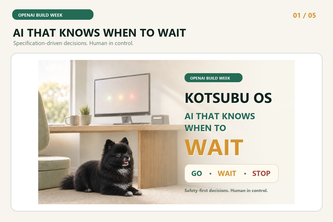
KOTSUBU OS is a self-reported specification-driven, safety-first AI decision system that evaluates whether an AI should answer a request based on five deterministic gates: Input Validation, Freshness, Evidence Requirements, Contradiction Detection, and Risk and Policy Constraints. It returns one of three states—GO, WAIT, or STOP—and includes an audit trail. The system is built with Python, Flask, HTML/CSS/JS, and integrates GPT-5.6 for bounded language tasks only.
What changed
The project was submitted as part of the OpenAI 2026 hackathon. It represents a focused, self-contained implementation of a decision-making framework that separates probabilistic language assistance from deterministic safety enforcement.
Single most important open question
Is there evidence of real-world application or integration beyond the synthetic demonstration and test cases?
What The Product Actually Is
The description states that KOTSUBU OS is a specification-driven, safety-first AI decision system. It evaluates requests through five deterministic gates before deciding whether to proceed with an answer:
- Input Validation
- Freshness
- Evidence Requirements
- Contradiction Detection
- Risk and Policy Constraints
It returns one of three outcomes:
- GO — sufficient evidence exists to proceed to human review
- WAIT — evidence is missing, stale, ambiguous, or contradictory
- STOP — continuing would violate a risk, safety, or policy constraint
The system includes:
- A readable audit trail
- Explanations for decisions (reason, rules applied, missing evidence, next action)
- Verification timestamp
- Human review requirement
- State transitions from WAIT to GO after evidence update
GPT-5.6 is used only for bounded tasks such as structuring input, extracting contradictions, and producing explanations; it cannot override the final decision state.
The system does not execute the final decision—it merely determines whether to allow a human to proceed.
Evidence
- The description explicitly defines KOTSUBU OS as a decision system with deterministic gates.
- It specifies that GPT-5.6 is used only for non-authoritative language tasks.
- The system includes audit trail, explanations, and state transitions.
- It distinguishes WAIT and STOP from errors.
Inference The system appears to be designed to prevent AI missteps by enforcing a structured decision boundary rather than allowing uncontrolled responses.
Positioning & Claim Evolution
The description states that KOTSUBU OS was inspired by repeated failures in long-running AI interactions, such as:
- Rules disappearing between conversations
- Inconsistent answers under same conditions
- Stale information being treated as current
- Numbers misunderstood
- Confident responses generated despite missing evidence
It repositions the AI question from “Can an AI system answer?” to “Can an AI system decide when to answer?”
The core positioning is:
Most AI systems answer. KOTSUBU OS decides when to answer.
This reflects a shift toward safety-first design and human-in-the-loop decision-making, emphasizing trust, continuity, and risk prevention.
Evidence
- The tagline directly states the positioning.
- The inspiration section outlines problems with current AI behavior.
- The North Star is explicitly stated as deciding when to answer.
Inference The project positions itself as a solution to AI inconsistency and overconfidence, focusing on structured decision-making over raw response generation.
Target Customer & ICP
Not evidenced. The description does not identify any specific customer segment or ideal customer profile (ICP). It describes the system’s functionality but does not indicate who would use it or how.
Evidence
- No mention of target users, industries, or roles.
- No indication of whether this is for developers, enterprises, end-users, or internal AI teams.
Business Model & Pricing Evidence
Not evidenced. There is no mention of pricing, monetization strategy, or business model in the description.
Evidence
- No revenue streams, licensing models, or pricing information provided.
- The project is presented as a hackathon submission with no commercial context.
Technical & Delivery Signals
The system was built using:
- Python, Flask, HTML/CSS/JS
- OpenAI SDK and GPT-5.6 (used only for bounded language tasks)
- Codex for engineering support during Build Week
- pytest for testing
- Jinja templates, JSON, REST APIs
Key technical features include:
- Separation of probabilistic language assistance from deterministic decision enforcement
- Deterministic core handling:
- Gate execution
- Freshness calculation
- Evidence validation
- Policy enforcement
- State transitions
- Audit facts
GPT-5.6 is used only for:
- Structuring natural-language input
- Extracting contradiction candidates
- Producing readable explanations of deterministic results
The system includes:
- A one-screen judge experience
- Seven synthetic demonstration scenarios
- 41 automated tests with zero failures
- Live verification of GPT-5.6 integration
- Clean-room startup verification
- Public repository without real user data or API keys
Evidence
- Technology stack is listed.
- System architecture and roles of components are described.
- Testing, demo, and verification details are provided.
Inference The system shows a strong engineering foundation with clear separation of concerns and test coverage. It was built under time constraints but includes reproducible artifacts.
Traction & Maturity Signals
Not evidenced. There is no evidence of revenue, customers, usage metrics, or adoption beyond the hackathon submission.
Evidence
- No mention of users, customers, or real-world deployment.
- The project is described as a hackathon submission with synthetic data.
- No traction indicators such as downloads, signups, or engagement.
Competitive Context
Not evidenced. The description does not compare KOTSUBU OS to existing systems or identify competitors in the AI decision-making space.
Evidence
- No mention of similar products or platforms.
- No competitive analysis or positioning relative to other tools.
Open Questions & Risks
- No real-world validation: The system is entirely synthetic and has not been tested in production environments or with actual users.
- Limited scope: The project was built for a hackathon, suggesting it may not be scalable or mature enough for commercial use.
- Unproven human-in-the-loop model: While the system emphasizes human review, there's no evidence of how this would scale or integrate into workflows.
- Dependency on GPT-5.6: The use of a proprietary and potentially unstable language model raises concerns about long-term reliability.
- Single-person team: With only one member, there may be limited capacity for development, maintenance, or scaling.
Evidence
- The project is described as a hackathon submission.
- No real-world data, users, or commercial deployment mentioned.
- The system uses GPT-5.6 in a bounded way but still relies on an external API.
Questions the description leaves open
- What are the specific use cases where this decision framework could be applied beyond the synthetic scenarios?
- How would you handle integration with existing AI workflows or platforms?
- Are there plans to expand beyond the current five gates, and how would that affect consistency?
- What is the long-term vision for maintaining and updating the policy constraints?
- How do you plan to validate this system in real-world settings before full deployment?
Overall Assessment
Not evidenced. No information is provided about funding rounds, valuation, or investment interest.
Evidence
- No mention of investors, funding history, or financials.
- No indication of strategic partnerships or commercial traction.
Inference Given the project’s current state as a hackathon submission with no demonstrated traction or revenue, it is not ready for investment or partnership at this stage. However, if the team can demonstrate real-world application and scalability, it may have potential in safety-focused AI governance.
User Stories BotA demo video on every pull request
Get a demo video on every new feature
GitHub App that watches your pull requests and records a narrated, captioned demo.
Save time on demo prep and make informed decisions faster with a video walkthrough of every new feature.
Source
Submitted to the OpenAI 2026 hackathon on Devpost. Project home on Devpost. Back to the full gallery on Devpost.
This competitive analysis was produced by top-founders.com (opens in a new tab)
Generated by a language model from this project's public Devpost page — its tagline, the author's own write-up and any built-with tags listed there — as captured in August 2026. Short quotations are the author's words. It is an opinion on the idea as a business, not on the people behind it, and it reflects the description as published then. If the project has moved on, request a correction below. The analysis is not independent research and contains no verified traction, revenue or customer data.
An independent guide by KFG International LLC — not affiliated with, endorsed by, or connected to Devpost or OpenAI.