

Archive position — measured, not model output
0 likes on Devpost
2,263 of the 7,850 archived projects have more likes, and 5,587 share exactly 0 — so this project's #5,161 place in the like-ranked listing is a tie-break inside that group, not a ranking.
Projects (log scale)
Likes on Devpost. ▲ marks this project's group.
Show the figures
| Likes | Projects | Share of archive |
|---|---|---|
| 0 | 5,587 | 71.2% |
| 1 | 1,758 | 22.4% |
| 2 | 284 | 3.6% |
| 3–4 | 132 | 1.7% |
| 5–9 | 75 | 1.0% |
| 10+ | 14 | 0.2% |
 User Stories BotA demo video on every pull request
Get a demo video on every new feature
GitHub App that watches your pull requests and records a narrated, captioned demo.
Save time on demo prep and make informed decisions faster with a video walkthrough of every new feature.
Executive Summary
What the company appears to be
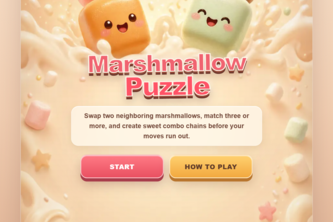
The author states that Marshmallow Puzzle is a three-stage match-3 browser game built with Codex and GPT-5.6, featuring marshmallow combos, cookie obstacles, ice challenges, and score chasing. It is described as a self-contained HTML file playable in any browser without installation or login.
What changed
The project description reflects an author-built game submitted to the OpenAI 2026 hackathon. No evidence of prior versions, product evolution, or commercial traction is provided.
Single most important open question
Is there any indication that this project has moved beyond a personal or hackathon experiment into a product with users, monetization, or growth potential?
What The Product Actually Is
The description states that Marshmallow Puzzle is a three-stage match-3 browser game. It is built using:
- HTML5
- CSS3 animations and responsive layout
- Vanilla JavaScript
- Web Audio API
- Web Speech API
- Local Storage
- No external libraries or frameworks
It is described as a self-contained, single-file HTML game, playable directly in the browser without installation or login. The author also notes that it uses Base64-encoded embedded assets and does not require a network connection after loading.
Inference This is a browser-based game prototype, likely built for demonstration or competition purposes, not a commercial product with users or monetization.
Positioning & Claim Evolution
The description states that the game was built using Codex and GPT-5.6, and it is submitted to the OpenAI 2026 hackathon. The tagline reads:
“A colorful three-stage match-3 browser game built with Codex and GPT-5.6, featuring marshmallow combos, cookie obstacles, ice challenges, and score chasing.”
The author does not describe any prior versions or commercial positioning beyond this one-off project.
Inference This is a self-reported hackathon submission, not a product with a defined market or brand evolution.
Target Customer & ICP
The description does not state who the target customer is. It describes gameplay mechanics and UI/UX elements, but no segment of users or personas are identified.
Inference No evidence of a defined ICP or target audience beyond general browser-based game players.
Business Model & Pricing Evidence
There is no evidence in the description of any business model, pricing structure, monetization strategy, or revenue streams. The game is described as free to play and self-contained.
Inference No commercial business model is evident from this description.
Technical & Delivery Signals
The author states that:
- The game is built with vanilla JavaScript, HTML5, CSS3
- Uses Web Audio API, Web Speech API
- No external libraries or frameworks
- No network connection required after page load
- Source code is available on GitHub
- Game is a single HTML file with embedded assets
Inference The technical delivery is minimalistic and self-contained, likely for portability or demonstration.
Traction & Maturity Signals
There is no evidence of traction, users, or adoption. The project is described as a hackathon submission, and no metrics, customer data, or usage statistics are provided.
Inference No signs of product maturity or user engagement beyond the author’s own development.
Competitive Context
The description does not mention any competitors or market context. It does not describe how this game compares to others in the match-3 genre or whether it addresses a specific gap.
Inference No competitive positioning or market differentiation is evident from the description.
Open Questions & Risks
- The project is described as a single-person hackathon submission, with no evidence of team, funding, or traction.
- No commercial model, revenue, or monetization strategy is evident.
- No mention of user data, retention, or engagement.
- The game is described as self-contained and browser-based, which may limit scalability or growth potential.
Inference This project appears to be a personal or experimental prototype, not a scalable product with commercial intent.
Questions the description leaves open
- What was the purpose of this project beyond the hackathon?
- Has there been any user testing or feedback on gameplay or design?
- Are there plans to expand the game beyond its current scope?
- Is there a longer-term vision for monetization or product development?
- How does the author intend to scale or grow this project, if at all?
Overall Assessment
Not evidenced.
The description provides no evidence of commercial traction, revenue, user base, or growth potential. It is a self-reported hackathon submission with no indication of product-market fit, monetization, or scalability.
Confidence Low — based entirely on self-reporting and no external validation.
User Stories BotA demo video on every pull request
Get a demo video on every new feature
GitHub App that watches your pull requests and records a narrated, captioned demo.
Save time on demo prep and make informed decisions faster with a video walkthrough of every new feature.
Source
Submitted to the OpenAI 2026 hackathon on Devpost. Project home on Devpost. Back to the full gallery on Devpost.
This competitive analysis was produced by top-founders.com (opens in a new tab)
Generated by a language model from this project's public Devpost page — its tagline, the author's own write-up and any built-with tags listed there — as captured in August 2026. Short quotations are the author's words. It is an opinion on the idea as a business, not on the people behind it, and it reflects the description as published then. If the project has moved on, request a correction below. The analysis is not independent research and contains no verified traction, revenue or customer data.
An independent guide by KFG International LLC — not affiliated with, endorsed by, or connected to Devpost or OpenAI.