

Archive position — measured, not model output
0 likes on Devpost
2,263 of the 7,850 archived projects have more likes, and 5,587 share exactly 0 — so this project's #5,160 place in the like-ranked listing is a tie-break inside that group, not a ranking.
Projects (log scale)
Likes on Devpost. ▲ marks this project's group.
Show the figures
| Likes | Projects | Share of archive |
|---|---|---|
| 0 | 5,587 | 71.2% |
| 1 | 1,758 | 22.4% |
| 2 | 284 | 3.6% |
| 3–4 | 132 | 1.7% |
| 5–9 | 75 | 1.0% |
| 10+ | 14 | 0.2% |
 User Stories BotA demo video on every pull request
Get a demo video on every new feature
GitHub App that watches your pull requests and records a narrated, captioned demo.
Save time on demo prep and make informed decisions faster with a video walkthrough of every new feature.
Executive Summary
Company: MarryMap
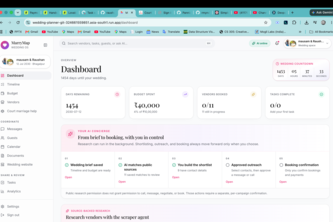
Self-reported purpose: An AI-powered wedding co-pilot that centralizes wedding planning tasks like vendor research, guest management, and communication through WhatsApp.
What changed: The description states the project was built for the OpenAI 2026 hackathon. It is a self-contained full-stack TypeScript application with AI integration, deployed on Google Cloud Run using Supabase for data storage and OpenWA for WhatsApp connectivity.
Single most important open question: Is there any evidence of real-world usage or traction beyond the hackathon submission? The description does not indicate whether users have adopted or paid for the product.
What The Product Actually Is
The description states that MarryMap is an AI-powered wedding co-pilot. It includes:
- Vendor research capabilities with source-backed vendor cards
- Guest management and bulk upload
- Tasks, budgets, timelines, and vendor shortlists
- Wedding website templates with AI and manual editing
- RSVP-ready publishing via shareable link
- WhatsApp-first communication with email and call as fallbacks
It was built as a full-stack TypeScript application using React, TanStack Start, Supabase, OpenWA, and Google Cloud Run.
Inference: The product appears to be a single-user or small-team planning tool, not a marketplace or platform for vendors. It is described as an intelligent workspace that centralizes fragmented wedding planning tasks.
Positioning & Claim Evolution
The description states that MarryMap was inspired by the fragmentation of wedding planning — couples manage vendors through WhatsApp, guest lists in spreadsheets, and budgets in notes.
It positions itself as a solution to this problem by offering:
- One intelligent workspace
- AI-powered vendor research with source-backed results
- Shared planning space for couples
Inference: The positioning is that of an AI assistant for personal wedding planning, not a marketplace or B2B SaaS product. It claims to reduce the chaos of fragmented tools and centralize planning.
Target Customer & ICP
The description states that MarryMap is intended for couples planning weddings. It supports:
- Vendor research
- Guest list management
- Budget tracking
- Communication via WhatsApp
It does not state whether it targets specific demographics, such as age groups or regions.
Inference: The primary user is a couple planning their wedding, likely in a Western or English-speaking context given the use of WhatsApp and Google Cloud services. No evidence of segmentation beyond this.
Business Model & Pricing Evidence
The description does not state any pricing model or business model. It only describes the features and functionality of the product.
Inference: There is no evidence of monetization, subscriptions, or paid features in the self-reported description.
Technical & Delivery Signals
The project was built with:
- Frontend: React, TanStack Start
- Backend: Node.js, REST API
- AI tools: GPT-5.6, Codex, OpenAI API
- Infrastructure: Docker, Google Cloud Run, Supabase, OpenWA
- Database: PostgreSQL
It integrates WhatsApp via OpenWA and QR-based device linking.
Inference: The technical stack suggests a modern, cloud-native application with AI integration and mobile-first communication. It is not a marketplace or platform for vendors but an internal planning tool.
Traction & Maturity Signals
The description states that this was a hackathon submission (OpenAI 2026). No evidence of revenue, customers, or adoption beyond the project's creation is provided.
Inference: There is no evidence of traction or product-market fit. The project appears to be in early development or prototype stage.
Competitive Context
The description does not mention any competitors or direct market comparison. It implies that wedding planning tools are fragmented and lack a centralized solution, but it does not name or describe existing alternatives.
Inference: The competitive landscape is unknown from the self-reported description. No evidence of existing players in this space is provided.
Open Questions & Risks
- No traction or monetization: The project was submitted to a hackathon and lacks any indication of real-world usage.
- Unverified AI claims: The use of GPT-5.6 is self-reported; no validation of performance or reliability is given.
- Limited scope: The product appears to be for couples, not vendors or service providers, which may limit its scalability.
- No customer feedback or data: No evidence of user testing, feedback loops, or usage analytics.
Questions the description leaves open
- What was the actual outcome of the hackathon submission? Did it win or receive any recognition?
- Has there been any real-world usage or user testing beyond the prototype phase?
- What is the plan for monetization if any?
- How does MarryMap differentiate from existing wedding planning tools (e.g., The Knot, WeddingWire)?
- Are there plans to expand beyond couples to include vendors or event planners?
Overall Assessment
Not evidenced: There is no evidence of revenue, customers, traction, or a clear business model. The project is described as a hackathon submission with no indication of commercial viability or adoption.
Confidence level: Very low — the description is self-reported and unverified, with no data on usage, monetization, or market fit. It appears to be an early-stage prototype or proof-of-concept.
User Stories BotA demo video on every pull request
Get a demo video on every new feature
GitHub App that watches your pull requests and records a narrated, captioned demo.
Save time on demo prep and make informed decisions faster with a video walkthrough of every new feature.
Source
Submitted to the OpenAI 2026 hackathon on Devpost. Project home on Devpost. Back to the full gallery on Devpost.
This competitive analysis was produced by top-founders.com (opens in a new tab)
Generated by a language model from this project's public Devpost page — its tagline, the author's own write-up and any built-with tags listed there — as captured in August 2026. Short quotations are the author's words. It is an opinion on the idea as a business, not on the people behind it, and it reflects the description as published then. If the project has moved on, request a correction below. The analysis is not independent research and contains no verified traction, revenue or customer data.
An independent guide by KFG International LLC — not affiliated with, endorsed by, or connected to Devpost or OpenAI.