

Archive position — measured, not model output
0 likes on Devpost
2,263 of the 7,850 archived projects have more likes, and 5,587 share exactly 0 — so this project's #5,132 place in the like-ranked listing is a tie-break inside that group, not a ranking.
Projects (log scale)
Likes on Devpost. ▲ marks this project's group.
Show the figures
| Likes | Projects | Share of archive |
|---|---|---|
| 0 | 5,587 | 71.2% |
| 1 | 1,758 | 22.4% |
| 2 | 284 | 3.6% |
| 3–4 | 132 | 1.7% |
| 5–9 | 75 | 1.0% |
| 10+ | 14 | 0.2% |
 User Stories BotA demo video on every pull request
Get a demo video on every new feature
GitHub App that watches your pull requests and records a narrated, captioned demo.
Save time on demo prep and make informed decisions faster with a video walkthrough of every new feature.
Executive Summary
What the company appears to be
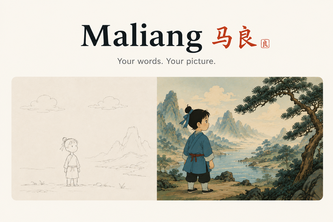
Maliang is a local-first, private comic creation tool that uses AI to render visual content based on user-written text. The system binds image generation directly to the words written by the user — each visual element corresponds to a specific span of text in the user's input. Vague or unspecified elements are rendered as pencil sketches; revisions that clarify meaning result in more detailed inked illustrations. The tool includes a coaching loop that rewards users for improving their writing through craft cards, which unlock upon successful revision.
What changed
The project is described as an experimental AI-powered comic studio built during the OpenAI 2026 hackathon. It introduces a novel interaction model where AI output is constrained to what the user explicitly writes, with no replacement or insertion of text by the AI. The system is designed to encourage precise expression and revision through visual feedback.
Single most important open question
Is there any evidence of traction, revenue, or customer adoption beyond the author’s own development efforts?
Note: This analysis is based entirely on self-reported information from the project description provided by the caller. No external verification or historical data are available. All claims in this report are labeled as “the description states” and should be treated as unverified.
What The Product Actually Is
- The description states that Maliang is a local-first comic studio where stories come to life only through the words written by the user.
- It renders visual content based on structured text input, with each renderable detail tied to a specific source span in the sentence.
- Visual elements not specified in the text appear as pencil sketches; revisions that clarify meaning result in more detailed inked illustrations.
- The system includes a consent-first helper that allows users to choose whether an image matches their idea and prompts one focus area for revision.
- It supports encrypted persistence, encrypted illustration cache, local dialogue composition, and PDF export.
- The core is built using Codex (as the runtime engine) and GPT-5.6, with sandboxed subprocesses and schema-constrained outputs.
Inference: The product appears to be a prototype or proof-of-concept tool developed for a hackathon, not yet commercialized or deployed at scale.
Positioning & Claim Evolution
- The description states that Maliang inverts the traditional AI fable where “mumble anything, get a masterpiece,” instead making revision the reward.
- It positions itself as a tool to teach expression and writing craft through visual feedback — turning weak expression into a learning opportunity.
- The author claims it avoids inserting text or story ideas, ensuring the user remains in control of their narrative.
- The system is described as aiming to bridge the gap between vague ideas and precise expression, similar to how writing teachers guide students.
Inference: The positioning reflects an educational focus on expressive writing and revision, but no evidence exists that this has been tested with real users or scaled beyond a single developer's prototype.
Target Customer & ICP
- The description states that the tool is designed for anyone learning to express an idea — particularly children and reluctant writers.
- It also mentions a classroom pilot with teacher-facing craft-card progress views, suggesting an educational market segment.
- The author notes that the same write-see-revise loop works for pre-writers, implying early childhood or literacy-focused use cases.
Inference: The ICP seems to be students, educators, and young writers who benefit from structured feedback on expression. However, no evidence of actual target customers or user groups is provided.
Business Model & Pricing Evidence
- The description does not mention any pricing model, revenue streams, or monetization strategy.
- It emphasizes local-first and private operation, suggesting no subscription or paid features are currently offered.
- No information is given about whether the tool will be sold, licensed, or offered as a service.
Inference: There is no evidence of a business model or pricing structure beyond the author’s own development efforts.
Technical & Delivery Signals
- The system uses GPT-5.6 as its runtime engine, not just a build tool.
- It employs sandboxed Codex subprocesses with schema-constrained output for safety classification, scene extraction, and render inspection.
- Image generation is orchestrated via gpt-5.6-sol against a deterministic render contract compiled from the scene graph.
- The app supports multiple rendering paths (raster, SVG vector-plan, Images API), benchmarked head-to-head for quality and latency.
- Subagents were used for product design work, including user walkthroughs and adversarial review of major design ideas.
- The demo video was created using Codex itself — screen recording, editing, and voiceover integration.
Inference: The technical architecture shows a high degree of sophistication and experimentation with AI tooling. However, no evidence exists that this has been deployed or scaled beyond the prototype stage.
Traction & Maturity Signals
- The description states that 70 passing tests were run across 15 files, plus a deterministic fake provider for development.
- It mentions overnight test runs and subagent-driven design reviews, indicating iterative development.
- No evidence of user adoption, customer base, or usage metrics is provided.
- The project was submitted to the OpenAI 2026 hackathon, suggesting it is still in early-stage development.
Inference: There are no signs of traction or maturity beyond a prototype built for a hackathon. No real-world data or user feedback is evident.
Competitive Context
- The description does not reference any direct competitors.
- It implies that existing AI image tools have taught the wrong lesson — “mumble anything, get a masterpiece.”
- It positions itself as distinct in its constraint-based approach to AI generation, where output is bound to explicit user input.
Inference: No competitive landscape or market positioning relative to other tools is described. The author does not identify similar products or markets.
Open Questions & Risks
- The tool is described as a hackathon project with no evidence of commercialization or traction.
- It relies heavily on the author’s own development and testing, with no third-party validation or user feedback.
- The system requires significant latency (~60 seconds) for image generation, which may hinder usability, especially for children.
- There is no indication of scalability, performance optimization, or long-term viability beyond the prototype.
Inference: The lack of commercial traction, user testing, and scalable infrastructure raises concerns about its readiness for market deployment.
Questions the description leaves open
- What are the actual use cases you've tested with real users?
- How do you plan to address the 60-second rendering latency in a way that enhances rather than hinders user experience?
- Have you validated the educational value of the craft cards and coaching loop with teachers or students?
- Is there any intention to monetize this tool, and if so, what is your business model?
- What are the technical challenges in scaling this system beyond a single developer’s environment?
Overall Assessment
- The description states that Maliang is a prototype built during a hackathon.
- There is no evidence of revenue, customers, or traction.
- The tool appears to be an experimental educational product with strong conceptual design but no demonstrated market readiness.
- No indication exists that it has moved beyond the idea or development phase.
Assessment: Not evidenced as a viable investment or partnership opportunity at this time. The project lacks commercial validation and user adoption, and remains in early-stage prototype form.
User Stories BotA demo video on every pull request
Get a demo video on every new feature
GitHub App that watches your pull requests and records a narrated, captioned demo.
Save time on demo prep and make informed decisions faster with a video walkthrough of every new feature.
Source
Submitted to the OpenAI 2026 hackathon on Devpost. Project home on Devpost. Back to the full gallery on Devpost.
This competitive analysis was produced by top-founders.com (opens in a new tab)
Generated by a language model from this project's public Devpost page — its tagline, the author's own write-up and any built-with tags listed there — as captured in August 2026. Short quotations are the author's words. It is an opinion on the idea as a business, not on the people behind it, and it reflects the description as published then. If the project has moved on, request a correction below. The analysis is not independent research and contains no verified traction, revenue or customer data.
An independent guide by KFG International LLC — not affiliated with, endorsed by, or connected to Devpost or OpenAI.