

Archive position — measured, not model output
1 like on Devpost
505 of the 7,850 archived projects have more likes, and 1,758 share exactly 1 — so this project's #1,404 place in the like-ranked listing is a tie-break inside that group, not a ranking.
Projects (log scale)
Likes on Devpost. ▲ marks this project's group.
Show the figures
| Likes | Projects | Share of archive |
|---|---|---|
| 0 | 5,587 | 71.2% |
| 1 | 1,758 | 22.4% |
| 2 | 284 | 3.6% |
| 3–4 | 132 | 1.7% |
| 5–9 | 75 | 1.0% |
| 10+ | 14 | 0.2% |
 User Stories BotA demo video on every pull request
Get a demo video on every new feature
GitHub App that watches your pull requests and records a narrated, captioned demo.
Save time on demo prep and make informed decisions faster with a video walkthrough of every new feature.
Executive Summary
What the company appears to be
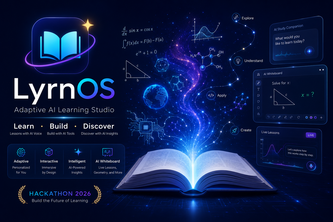
LyrnOS is a self-reported AI tutoring platform designed for South African students in Grades 7–12, with a focus on Physics and Chemistry lab simulations, whiteboard interaction, and adaptive learning paths. The product is built around an AI tutor named Mira that supports multiple modes of interaction: live whiteboard drawing, chat with inline visual diagrams, voice-based instruction, and autonomous lab operation using browser-based simulations.
What changed
The description indicates a shift from traditional AI tutoring tools that respond to text input to one that interprets handwritten drawings via computer vision. It also introduces the concept of autonomous lab simulation for students without access to physical science labs.
Single most important open question — the commercial due-diligence read
Is there evidence of real-world usage or adoption by students, educators, or institutions? The self-reported nature of the description means no traction data is available, and the project appears to be a hackathon submission with no indication of product-market fit or monetization strategy.
What The Product Actually Is
The description states that LyrnOS is an AI tutor platform for students in Grades 7–12 covering 8 subjects (Mathematics, Physical Sciences, Life Sciences, English, Accounting, History, Geography, and Computer Science). It includes:
- A Socratic AI tutor named Mira.
- Four interaction modes:
- Live whiteboard with real-time annotation using computer vision.
- Chat interface with inline visual diagrams generated by the model.
- Voice-based instruction with interrupt/resume flow.
- Autonomous lab simulations via browser automation (PhET and custom physics solvers).
- Adaptive tests and a cognitive graph for tracking mastery.
- A command palette, learning paths view, and past papers workspace.
The system uses technologies such as AWS Bedrock, Claude, PhET simulations, Excalidraw, Supabase, Clerk, and Browser-Use for automation.
Inference The product is described as a single-page application built in vanilla JavaScript with no frontend framework. It integrates AI models through a multi-provider gateway and includes backend services using Node.js and Python.
Positioning & Claim Evolution
The author claims that LyrnOS aims to close two gaps:
- The tutoring gap — where students’ learning experiences vary based on teacher quality or parental resources.
- The lab gap — where students in under-resourced schools lack access to practical science labs.
It positions itself as an alternative to generic AI chatbots, which it says break down when students need to show their working. Instead, LyrnOS allows students to draw on a whiteboard and have Mira interpret the drawing using computer vision.
Inference The positioning suggests a focus on equity in education, particularly for underserved communities in South Africa. However, there is no evidence of how this positioning has evolved from an initial idea or whether it has been validated with users.
Target Customer & ICP
The description states that LyrnOS targets students in Grades 7–12 in South Africa, covering the CAPS and IEB curricula. It also mentions a focus on subjects like Physics and Chemistry where practical lab access is limited.
Inference The primary customer segment appears to be individual learners (students), possibly supported by schools or parents. There is no mention of institutional adoption or B2B sales channels.
Business Model & Pricing Evidence
There is no evidence in the description of a business model, pricing strategy, or monetization approach. The author does not describe how they plan to charge for the service or whether there are any paid features.
Inference The lack of information implies either early-stage development or an unexplored commercial model. No revenue streams, subscriptions, or partnerships are mentioned.
Technical & Delivery Signals
Key technical elements include:
- Use of AWS Bedrock, Claude, Groq for AI inference.
- Browser automation via Chrome DevTools Protocol (CDP) and Steel-managed cloud browsers.
- Custom-built physics solver using Modified Nodal Analysis with Gaussian elimination.
- Real-time whiteboard interaction with timed annotations synchronized to speech.
- PhET simulations integrated into lab operations.
- Supabase for data storage with row-level security.
- Node.js backend, Python lab agent, and vanilla JavaScript frontend.
Inference The technical stack shows a high degree of customization and integration across AI, simulation, and real-time UI components. The use of browser automation and custom solvers suggests significant engineering effort, but also potential scalability challenges.
Traction & Maturity Signals
There is no evidence of traction or user adoption in the description. The project was submitted to a hackathon (OpenAI 2026), and there are no references to:
- Users or customers.
- Revenue or funding.
- Product usage metrics.
- Market validation.
Inference The product appears to be at an early stage, likely pre-launch or in prototype form. No signs of market traction or user engagement are evident.
Competitive Context
The description does not mention competitors directly. However, it implies a niche in AI tutoring for South African students with limited access to practical labs. It contrasts itself with generic AI chatbots and suggests a unique value proposition around:
- Drawing interpretation.
- Lab simulation.
- Real-time tutoring flow.
Inference There is no competitive analysis or awareness of existing players in the AI tutoring space, nor any indication of how LyrnOS differentiates from them in practice.
Open Questions & Risks
- No traction or user feedback: The product is described as a hackathon submission with no evidence of real-world usage.
- High engineering complexity without clear ROI: Custom-built physics solvers and browser automation may be costly to maintain or scale.
- Unproven commercial viability: No pricing, monetization, or business model is outlined.
- Single-person team: The entire project was built by one person (Tanweer Chiktay), raising questions about scalability and long-term maintenance.
- Self-reported nature of all claims: All information is unverified and based on the author’s own account.
Questions the description leaves open
- What is your plan for validating the product with actual students or schools?
- How do you intend to monetize this platform, and what pricing model are you considering?
- Have you tested the whiteboard OCR accuracy in real-world conditions?
- What is the expected cost of running the lab simulations at scale?
- Are there any partnerships or institutional ties that support the project beyond the hackathon?
- How do you plan to onboard teachers or educators into the platform?
Overall Assessment
Not evidenced.
The description provides no information on:
- Revenue or financials.
- Customer base or adoption.
- Market size or competitive landscape.
- Team traction or prior experience.
- Product-market fit or go-to-market strategy.
This is a self-reported, unverified account of a hackathon project with no indication of commercial readiness or viability. The author states that the product is built for students in Grades 7–12 in South Africa, but there is no evidence of real-world usage or validation.
Confidence: Low.
The only confirmed elements are:
- A single developer (Tanweer Chiktay).
- A hackathon submission.
- Technical architecture details.
- Self-reported claims about functionality and intent.
All other aspects — including commercial potential, user adoption, or scalability — remain unproven.
User Stories BotA demo video on every pull request
Get a demo video on every new feature
GitHub App that watches your pull requests and records a narrated, captioned demo.
Save time on demo prep and make informed decisions faster with a video walkthrough of every new feature.
Source
Submitted to the OpenAI 2026 hackathon on Devpost. Project home on Devpost. Back to the full gallery on Devpost.
This competitive analysis was produced by top-founders.com (opens in a new tab)
Generated by a language model from this project's public Devpost page — its tagline, the author's own write-up and any built-with tags listed there — as captured in August 2026. Short quotations are the author's words. It is an opinion on the idea as a business, not on the people behind it, and it reflects the description as published then. If the project has moved on, request a correction below. The analysis is not independent research and contains no verified traction, revenue or customer data.
An independent guide by KFG International LLC — not affiliated with, endorsed by, or connected to Devpost or OpenAI.