

Archive position — measured, not model output
0 likes on Devpost
2,263 of the 7,850 archived projects have more likes, and 5,587 share exactly 0 — so this project's #5,096 place in the like-ranked listing is a tie-break inside that group, not a ranking.
Projects (log scale)
Likes on Devpost. ▲ marks this project's group.
Show the figures
| Likes | Projects | Share of archive |
|---|---|---|
| 0 | 5,587 | 71.2% |
| 1 | 1,758 | 22.4% |
| 2 | 284 | 3.6% |
| 3–4 | 132 | 1.7% |
| 5–9 | 75 | 1.0% |
| 10+ | 14 | 0.2% |
 User Stories BotA demo video on every pull request
Get a demo video on every new feature
GitHub App that watches your pull requests and records a narrated, captioned demo.
Save time on demo prep and make informed decisions faster with a video walkthrough of every new feature.
Executive Summary
Company: Luna Grounding Auditor
Self-reported basis: The description is entirely self-reported by the author, unverified, and lacks any evidence of revenue, customers, or traction.
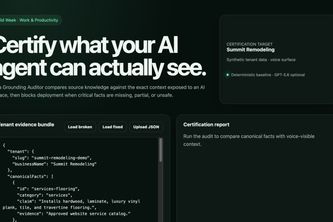
What it appears to be: A pre-deployment safety system for AI agents that audits whether deployed AI surfaces can actually access approved knowledge at runtime.
What changed: The project was submitted as a hackathon entry (OpenAI 2026) and is described as a standalone Next.js application with an audit engine, GPT-5.6 integration, and deterministic demo.
Most important open question: Does the system actually solve a real gap in AI agent safety or is it a conceptual prototype that lacks commercial viability?
What The Product Actually Is
The description states that Luna Grounding Auditor is "a CI system for AI agents". It is described as a tool that certifies whether an AI surface (e.g., voice agent, chatbot, copilot, or workflow) can actually see and safely use approved knowledge before deployment.
It includes:
- A deterministic audit engine
- Synthetic broken and corrected fixtures
- An evidence explorer
- A visual knowledge pipeline
- Downloadable certification reports
- Optional server-side GPT-5.6 workflow
The system is said to run adversarial questions, check expected evidence IDs, detect unsupported claims, identify where knowledge was lost, and return a release decision: CERTIFIED or NOT SAFE.
It is built using:
- Next.js
- React
- TypeScript
- Vitest
- Zod
- GitHub Actions
- OpenAI API (GPT-5.6)
- Codex
- DigitalOcean
Inference: The product appears to be a prototype for validating AI agent grounding at runtime, not a production-grade solution.
Positioning & Claim Evolution
The author states that Luna Grounding Auditor is "not another agent builder or observability dashboard", but instead a pre-deployment safety gate focused on the gap between knowledge that exists and what an active AI surface can actually access.
It positions itself as solving a specific problem:
“Agent teams often validate ingestion but not runtime visibility.”
The tagline is:
“The CI system for AI agents—certify that every deployed surface can actually see and safely use approved knowledge.”
Claim: The product addresses a gap in AI agent safety by ensuring runtime visibility of knowledge.
Inference: This is a conceptual positioning shift from post-deployment monitoring to pre-deployment validation, but no evidence supports whether this is a real market need or if the solution works at scale.
Target Customer & ICP
The description does not state who the target customer is. It implies that the product is for agent teams or AI developers building voice agents, chatbots, copilots, or workflows.
It is described as a pre-deployment safety gate, suggesting it is used by:
- AI engineering teams
- DevOps or platform teams
- Product teams working with AI agents
There is no evidence of customer segmentation, personas, or specific use cases beyond the hackathon demo.
Inference: The ICP likely includes early-stage AI product teams or developers building AI agents in enterprise or SaaS contexts, but this is not confirmed.
Business Model & Pricing Evidence
The description does not mention any pricing model, licensing, or monetization strategy. It is described as a standalone Next.js application with optional server-side GPT-5.6 workflow.
It includes:
- A deterministic demo
- Downloadable certification reports
- No indication of SaaS, API access, or subscription models
Inference: The business model is unclear. It may be a prototype or open-source tool, but no evidence supports commercial viability or monetization.
Technical & Delivery Signals
The system is built with:
- Next.js (frontend)
- React
- TypeScript
- Vitest (testing)
- Zod (schema validation)
- GitHub Actions (CI)
- OpenAI API (GPT-5.6)
- Codex (for acceleration)
- DigitalOcean (hosting)
It includes:
- A deterministic audit engine
- Adversarial question generation
- Evidence ID checking
- Knowledge loss diagnosis
- Smallest-safe remediation
The demo is said to be deterministic and requires no API key.
Inference: The system is technically feasible as a prototype but lacks evidence of scalability, performance, or production-grade delivery.
Traction & Maturity Signals
There is no evidence of traction, customers, or revenue. The project was submitted to the OpenAI 2026 hackathon, and the author states:
“The judge demo needs no API key.”
It is described as a standalone Next.js application with a deterministic demo, but there is no indication of adoption, usage metrics, or product-market fit.
Inference: The product is at a very early stage — likely a hackathon prototype — and lacks any maturity signals.
Competitive Context
The description does not mention competitors. It states:
“This is not another agent builder or observability dashboard.”
It implies that the solution is distinct from existing AI agent builders or monitoring tools, but no specific competitors are named.
Inference: The competitive landscape is unknown, and there is no evidence of existing solutions addressing the same problem.
Open Questions & Risks
- No traction or revenue: The project is a hackathon submission with no evidence of adoption.
- Unproven commercial viability: No pricing, monetization, or customer model is described.
- Unclear market need: The problem it solves is self-described but not validated in the market.
- Prototype-only: The system is described as a demo and prototype, not a production-grade tool.
- No scalability evidence: No mention of performance, infrastructure, or enterprise readiness.
Questions the description leaves open
- What specific AI agent use cases have you validated this solution against?
- How do you plan to scale this beyond the demo and prototype stage?
- Have you identified any real-world customers or partners who would pay for this?
- What is your path to monetization, if any?
- How does this product differ from existing AI observability or grounding tools (if any)?
- What are the technical limitations of using GPT-5.6 in a CI/CD context?
Overall Assessment
Not evidenced: There is no evidence to support investment or partnership viability.
The project is described as a hackathon submission, with no traction, revenue, customers, or commercial model. It is a prototype that solves a conceptual problem but lacks any demonstration of real-world applicability or scalability.
Confidence level: Very low — based entirely on self-reported claims and no external validation.
User Stories BotA demo video on every pull request
Get a demo video on every new feature
GitHub App that watches your pull requests and records a narrated, captioned demo.
Save time on demo prep and make informed decisions faster with a video walkthrough of every new feature.
Source
Submitted to the OpenAI 2026 hackathon on Devpost. Project home on Devpost. Back to the full gallery on Devpost.
This competitive analysis was produced by top-founders.com (opens in a new tab)
Generated by a language model from this project's public Devpost page — its tagline, the author's own write-up and any built-with tags listed there — as captured in August 2026. Short quotations are the author's words. It is an opinion on the idea as a business, not on the people behind it, and it reflects the description as published then. If the project has moved on, request a correction below. The analysis is not independent research and contains no verified traction, revenue or customer data.
An independent guide by KFG International LLC — not affiliated with, endorsed by, or connected to Devpost or OpenAI.