

Archive position — measured, not model output
0 likes on Devpost
2,263 of the 7,850 archived projects have more likes, and 5,587 share exactly 0 — so this project's #7,059 place in the like-ranked listing is a tie-break inside that group, not a ranking.
Projects (log scale)
Likes on Devpost. ▲ marks this project's group.
Show the figures
| Likes | Projects | Share of archive |
|---|---|---|
| 0 | 5,587 | 71.2% |
| 1 | 1,758 | 22.4% |
| 2 | 284 | 3.6% |
| 3–4 | 132 | 1.7% |
| 5–9 | 75 | 1.0% |
| 10+ | 14 | 0.2% |
 User Stories BotA demo video on every pull request
Get a demo video on every new feature
GitHub App that watches your pull requests and records a narrated, captioned demo.
Save time on demo prep and make informed decisions faster with a video walkthrough of every new feature.
Executive Summary
What the company appears to be
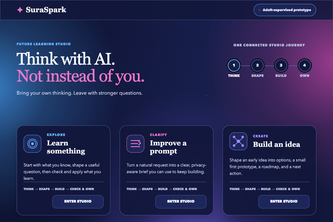
SuraSpark is an adult-supervised AI-literacy prototype designed for learners aged 11–14. The description states it guides users through a structured process—THINK → SHAPE THE ASK → BUILD WITH AI → CHECK & OWN—while maintaining learner agency, privacy, and human oversight. It is built as a web application using Next.js, React, Vite, and OpenAI’s GPT-5.6 Sol.
What changed
The project was submitted to the OpenAI 2026 hackathon on Devpost. The author describes it as a prototype with no accounts, database, analytics, or tracking. It is not yet in production or used by real users.
Single most important open question
Is there evidence of any real-world testing or adoption with target learners (ages 11–14), educators, or parents? The description does not indicate any such traction.
What The Product Actually Is
The description states that SuraSpark is an adult-supervised AI-literacy prototype for learners aged 11–14. It is a web application built with Next.js, React, Vite, and the OpenAI Responses API, using GPT-5.6 Sol for bounded, pathway-specific guidance.
It includes three learning pathways: Learn Something, Improve a Prompt, and Build an Idea. The system enforces learner contribution before AI interaction, ensures editable Working Briefs, and allows learners to check claims and own their final output.
The prototype is described as having no accounts, database, analytics, long-term memory, or tracking. It uses temporary browser memory for the Prompt-to-Idea handoff and avoids model calls during this phase.
Inference The product is a learning tool, not a general-purpose AI assistant or platform.
Positioning & Claim Evolution
The author states that SuraSpark was inspired by a question: “how can young people learn to use AI while keeping their judgment, privacy, authorship, and human support at the center?” This positions it as an educational tool focused on AI literacy, not just AI utility.
It is described as a prototype that aims to help learners think with AI—not instead of themselves. The system emphasizes learner agency, verification, and adult supervision.
The project’s positioning has evolved from a hackathon submission into a conceptual framework for AI education, but no evidence suggests it has moved beyond prototype status or gained traction in real-world settings.
Claim
The product is designed to teach young people how to use AI responsibly.
Evidence Yes, the description explicitly states this.
Target Customer & ICP
The target customer is young learners aged 11–14, with an emphasis on adult supervision. The system is built for educators and parents who want to guide youth in using AI thoughtfully.
The description does not mention specific educators or institutions, nor does it state whether the product has been tested with them.
Inference The ICP is likely parents, teachers, and educational institutions focused on AI literacy and responsible technology use.
Business Model & Pricing Evidence
There is no evidence of a business model or pricing structure in the description. The project is described as a prototype, not a commercial product.
The system does not include accounts, databases, analytics, or tracking—indicating it may be non-commercial or experimental in nature.
Claim
SuraSpark is not monetized.
Evidence Not evidenced; however, the lack of any commercial elements supports this inference.
Technical & Delivery Signals
SuraSpark is built with:
- Next.js, React, Vite
- OpenAI GPT-5.6 Sol
- Codex for implementation and testing
- Server-side requests with store: false, strict structured output, runtime validation, input limits, and controlled error handling
It uses temporary browser memory to carry learner-approved work without model calls during the Prompt-to-Idea phase.
The system is described as deterministic, safe, and privacy-focused. It avoids exposing technical details or fabricating guidance when responses are incomplete or invalid.
Inference The product is technically designed for safety, transparency, and control, not scalability or performance.
Traction & Maturity Signals
There is no evidence of traction, revenue, or customer adoption beyond the hackathon submission. The project is described as a prototype, with no mention of:
- Real-world testing
- User feedback
- Product usage metrics
- Customer base
- Commercial deployment
Claim
SuraSpark is not yet in production or used by real users.
Evidence Yes, the description explicitly states it is a prototype.
Competitive Context
The description does not mention any competitors or direct market comparisons. It focuses on AI literacy education, which may overlap with tools like:
- AI safety platforms
- Educational AI tools for children
- Prompt engineering guides
However, no evidence of existing competitive products or market positioning is provided.
Inference The product operates in a nascent or niche space, possibly without direct competitors yet.
Open Questions & Risks
- Prototype-only status: No real-world testing or adoption.
- No commercialization plan: No evidence of monetization, pricing, or business model.
- Single founder: The team size is listed as 1, which may limit execution capacity.
- Lack of user feedback or validation: No mention of educator or learner input beyond the author’s own account.
- Unproven scalability: The system is built for a specific use case and lacks evidence of broader applicability.
Questions the description leaves open
- What are your plans for testing with real learners, educators, or parents?
- How do you intend to scale beyond the prototype stage?
- Have you considered legal, privacy, or child-safety frameworks that apply to this product?
- Is there any interest from schools or educational institutions in piloting SuraSpark?
- What are the key challenges in transitioning from a hackathon prototype to a usable product?
Overall Assessment
Not evidenced: There is no evidence of revenue, customers, traction, or commercial viability beyond a hackathon submission.
The project is described as a prototype, not a product in use. It has no accounts, database, analytics, or tracking—indicating it is not yet monetized or deployed.
Inference The project is at an early conceptual stage and may be suitable for seed funding or partnership exploration if the founders plan to develop it into a scalable educational tool. However, there is no evidence of readiness for investment or commercial deployment.
User Stories BotA demo video on every pull request
Get a demo video on every new feature
GitHub App that watches your pull requests and records a narrated, captioned demo.
Save time on demo prep and make informed decisions faster with a video walkthrough of every new feature.
Source
Submitted to the OpenAI 2026 hackathon on Devpost. Project home on Devpost. Back to the full gallery on Devpost.
This competitive analysis was produced by top-founders.com (opens in a new tab)
Generated by a language model from this project's public Devpost page — its tagline, the author's own write-up and any built-with tags listed there — as captured in August 2026. Short quotations are the author's words. It is an opinion on the idea as a business, not on the people behind it, and it reflects the description as published then. If the project has moved on, request a correction below. The analysis is not independent research and contains no verified traction, revenue or customer data.
An independent guide by KFG International LLC — not affiliated with, endorsed by, or connected to Devpost or OpenAI.