

Archive position — measured, not model output
1 like on Devpost
505 of the 7,850 archived projects have more likes, and 1,758 share exactly 1 — so this project's #1,378 place in the like-ranked listing is a tie-break inside that group, not a ranking.
Projects (log scale)
Likes on Devpost. ▲ marks this project's group.
Show the figures
| Likes | Projects | Share of archive |
|---|---|---|
| 0 | 5,587 | 71.2% |
| 1 | 1,758 | 22.4% |
| 2 | 284 | 3.6% |
| 3–4 | 132 | 1.7% |
| 5–9 | 75 | 1.0% |
| 10+ | 14 | 0.2% |
 User Stories BotA demo video on every pull request
Get a demo video on every new feature
GitHub App that watches your pull requests and records a narrated, captioned demo.
Save time on demo prep and make informed decisions faster with a video walkthrough of every new feature.
Executive Summary
What the company appears to be
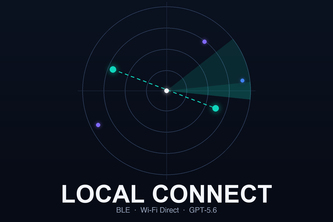
Local Connect is an offline-first Android proximity app that enables people to discover and connect with others nearby using Bluetooth Low Energy (BLE) and Wi-Fi Direct, without requiring accounts, servers, or internet connectivity. The app supports peer-to-peer communication with encrypted file transfer, chat, and optional AI-assisted profile generation.
What changed
The project was submitted as part of the OpenAI 2026 hackathon. It is described as a proof-of-concept built in a short timeframe (Build Week), incorporating advanced technical elements such as ECDH + AES-GCM encryption, structured outputs from GPT-5.6, and a custom protocol for secure communication.
Single most important open question
Is there any evidence of user adoption or traction beyond the hackathon submission? The description does not indicate whether the app has been released to users, tested in real-world settings, or monetized.
What The Product Actually Is
The description states that Local Connect is an offline-first Android proximity app. It uses:
- BLE for presence discovery
- Wi-Fi Direct for secure communication after consent
- A custom V4 protocol for rich profile exchange and messaging (including voice notes, images)
- End-to-end encryption via ECDH + AES-GCM
- Optional AI features powered by GPT-5.6 through an app-owned gateway
The app is designed to function without any server infrastructure, with all data staying on-device unless AI components are used.
Inference This is a technical prototype built for a hackathon, not a production-ready product. The use of terms like “V4 protocol” and “structured outputs” suggests an early-stage development effort focused on secure peer-to-peer communication and AI integration.
Positioning & Claim Evolution
The author claims:
- Phones discover each other directly via BLE + Wi-Fi Direct
- No accounts, no servers, no signal required
- Optional GPT-5.6 enhances user profiles and breaks the ice
- Data stays on-device
- The AI is consent-gated, quota-metered, and optional
Inference The positioning emphasizes privacy, offline-first design, and AI augmentation. It positions itself as an alternative to traditional social apps that rely on cloud infrastructure and centralized identity systems.
There is no indication of prior positioning or evolution from earlier versions; this appears to be a new concept introduced in the hackathon project.
Target Customer & ICP
The description does not specify a target customer segment or ideal customer profile (ICP). It focuses on the technical architecture and use case ("meet people actually around you") but does not describe who would use it, how many users might exist, or what demographic or behavioral traits define its audience.
Inference The app targets individuals in physical proximity seeking spontaneous social interaction — possibly urban dwellers, travelers, event attendees, or those looking for low-friction networking. However, no evidence supports assumptions about market size or user behavior beyond the author’s own claims.
Business Model & Pricing Evidence
There is no evidence of a business model or pricing strategy in the description. The app is described as working offline and optionally using AI features, but there are no mentions of monetization, subscriptions, advertising, or paid tiers.
Inference The project may be exploratory or experimental, with no clear indication of how it would generate revenue if developed further.
Technical & Delivery Signals
Key technical elements mentioned:
- Kotlin/Android for core functionality
- BLE scanning and advertising using foreground services
- ECDH + AES-GCM for credential exchange
- TCP-based V4 protocol with JSON schema validation
- Structured outputs from OpenAI API via an app-owned gateway
- On-device quota metering, consent switches, rate-limiting IDs
- Protocol bounds enforced at both gateway and client
Inference The team shows strong technical capability in building secure, privacy-focused P2P systems. The inclusion of structured outputs, schema validation, and encryption practices suggests a mature approach to handling sensitive data.
Traction & Maturity Signals
There is no evidence of traction or user adoption beyond the hackathon submission. No customers, revenue, usage metrics, or product releases are mentioned.
Inference This is an early-stage prototype with no demonstrated market traction or product maturity. It was built in a short time frame and submitted to a hackathon — not a commercial product.
Competitive Context
The description does not reference existing competitors or similar products. The focus is on the unique technical approach (offline-first, P2P, AI-assisted profiles) rather than market positioning or competitive analysis.
Inference While there are other apps focused on proximity-based social discovery (e.g., Bumble BFF, Meetup), Local Connect’s emphasis on offline-first and AI-enhanced profiles sets it apart. However, no evidence exists of prior competition or market validation.
Open Questions & Risks
- Unproven concept: The app is a hackathon prototype with no real-world testing or user feedback.
- AI dependency: Reliance on GPT-5.6 raises questions about scalability and cost if the feature becomes mainstream.
- Limited scope: No mention of cross-platform support, iOS compatibility, or broader ecosystem integration.
- Privacy vs. usability trade-offs: The strict privacy controls may limit ease-of-use or engagement.
- No monetization path: No indication of how the product would be monetized or scaled.
Questions the description leaves open
- What is the intended user journey beyond the initial discovery phase?
- How does the team plan to scale the AI layer without relying on external APIs?
- Has the app been tested in real-world environments, and what were the results?
- Are there plans for cross-platform support (iOS, web)?
- What are the long-term goals for monetization or product development?
- How does the team intend to address potential privacy concerns related to AI profile generation?
Overall Assessment
Not evidenced
There is no evidence of revenue, customers, traction, or any commercial activity beyond a hackathon submission. The project is described as a technical prototype with strong engineering foundations but no indication of market readiness or business viability.
The description states:
“Everything above is the authors' own account. It is not independently verified, and no revenue, customer or traction data is available beyond what they state.”
This is a preliminary idea, not a product in development. Any investment or partnership would require further evidence of traction, user testing, or commercialization plans.
User Stories BotA demo video on every pull request
Get a demo video on every new feature
GitHub App that watches your pull requests and records a narrated, captioned demo.
Save time on demo prep and make informed decisions faster with a video walkthrough of every new feature.
Source
Submitted to the OpenAI 2026 hackathon on Devpost. Project home on Devpost. Back to the full gallery on Devpost.
This competitive analysis was produced by top-founders.com (opens in a new tab)
Generated by a language model from this project's public Devpost page — its tagline, the author's own write-up and any built-with tags listed there — as captured in August 2026. Short quotations are the author's words. It is an opinion on the idea as a business, not on the people behind it, and it reflects the description as published then. If the project has moved on, request a correction below. The analysis is not independent research and contains no verified traction, revenue or customer data.
An independent guide by KFG International LLC — not affiliated with, endorsed by, or connected to Devpost or OpenAI.