

Archive position — measured, not model output
1 like on Devpost
505 of the 7,850 archived projects have more likes, and 1,758 share exactly 1 — so this project's #1,379 place in the like-ranked listing is a tie-break inside that group, not a ranking.
Projects (log scale)
Likes on Devpost. ▲ marks this project's group.
Show the figures
| Likes | Projects | Share of archive |
|---|---|---|
| 0 | 5,587 | 71.2% |
| 1 | 1,758 | 22.4% |
| 2 | 284 | 3.6% |
| 3–4 | 132 | 1.7% |
| 5–9 | 75 | 1.0% |
| 10+ | 14 | 0.2% |
 User Stories BotA demo video on every pull request
Get a demo video on every new feature
GitHub App that watches your pull requests and records a narrated, captioned demo.
Save time on demo prep and make informed decisions faster with a video walkthrough of every new feature.
Executive Summary
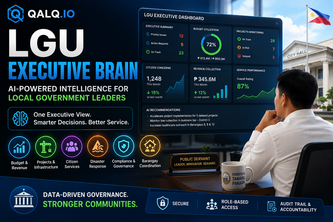
The description states that the project is a self-contained AI platform for Local Government Units (LGUs), designed to act as an "Executive Brain" that aggregates information from fragmented systems and provides executive-level insights. The author claims this system uses agentic AI with specialized agents for different domains such as budgeting, infrastructure, citizen services, and emergency response.
The platform is described as an intelligence layer integrating multiple operational systems into a unified executive view, with a focus on human validation and accountability. It includes concepts like an "Executive Score" that combines KPIs and risk penalties to prioritize recommendations.
Key commercial signals are absent: no revenue, customers, or traction data are provided. The project is presented as a hackathon submission with no evidence of market adoption or product maturity beyond conceptual design.
The single most important open question is whether this concept can be practically implemented at scale within the constraints of public sector IT systems and governance requirements — particularly around integration, security, auditability, and human accountability.
What The Product Actually Is
- The description states that the platform is an "Agentic AI architecture" with specialized agents for different domains (e.g., budgeting, infrastructure, citizen services).
- It is described as an "intelligence layer" that integrates information from existing LGU systems.
- The system includes a central "Executive Brain" that synthesizes domain-specific intelligence and cross-agent reasoning.
- It features a concept called the "Executive Score," which combines KPIs and risk penalties to prioritize recommendations.
- The platform is said to support both proactive identification of risks and opportunities, as well as coordination across departments.
Not evidenced: actual product functionality, technical architecture details, or whether any working prototype exists beyond the conceptual description.
Positioning & Claim Evolution
- The author positions the system as an "Executive Brain" for LGU leaders — a tool that augments rather than replaces executive decision-making.
- It is described as an AI-powered intelligence platform that continuously understands the entire organization and provides actionable insights instead of static reports.
- The platform is framed as a transformational tool for public governance, aiming to enable evidence-based decisions, faster coordination, and improved transparency.
- The author notes that this concept was previously envisioned for enterprises but adapted for public sector use.
Inferred: The positioning implies a shift from reactive reporting to proactive intelligence. However, the claim of being "revolutionary" or "cutting-edge" is not substantiated by evidence.
Target Customer & ICP
- The primary target customer is identified as Local Government Unit (LGU) Chief Executives.
- The system is intended for use within LGUs that manage budgets, infrastructure, disaster response, health services, business permits, citizen concerns, and regulatory compliance.
- It is designed to support LGUs with varying levels of digital maturity.
Not evidenced: No specific customer segments or personas are defined beyond the general category of LGU leaders. There is no evidence of market segmentation or targeting strategy.
Business Model & Pricing Evidence
- The description does not provide any information about pricing, licensing models, or monetization strategies.
- It is unclear whether the platform will be sold as a SaaS offering, implemented as a government contract, or otherwise deployed.
- No revenue streams or business model details are mentioned.
Not evidenced: No commercial structure or financial viability indicators are present in the description.
Technical & Delivery Signals
- The system uses agentic AI with multi-agent architectures that mirror organizational structures.
- It incorporates specialized agents for different domains such as budgeting, infrastructure, citizen services, and emergency response.
- The platform integrates with existing LGU systems including finance, planning, engineering, health, social welfare, permits, human resources, GIS, and others.
- It is built using technologies like React, TypeScript, Vite, TailwindCSS, OpenAI GPT-5, Retrieval-Augmented Generation (RAG), Knowledge Graphs, and Large Language Models.
- The system includes concepts like explainable AI, audit trails, and human validation to ensure trustworthiness.
Inferred: The technical stack suggests a modern web-based application with AI capabilities. However, no evidence of actual implementation or delivery is provided beyond the conceptual design.
Traction & Maturity Signals
- The project was submitted to the OpenAI 2026 hackathon.
- It is described as a "conceptual" design and not yet implemented in production.
- There is no evidence of customer adoption, usage metrics, or product development milestones.
- No mention of pilot programs, partnerships, or early users.
Not evidenced: No traction data, user feedback, or maturity indicators are available.
Competitive Context
- The description does not reference existing competitors or similar platforms.
- It does not indicate whether the author is aware of other AI tools for government use or public sector decision support systems.
- No competitive landscape analysis or differentiation strategy is provided.
Not evidenced: No competitive positioning or market context is described.
Open Questions & Risks
- The platform relies heavily on integration with heterogeneous government information systems, which may pose significant technical challenges.
- There are concerns about cybersecurity, data privacy, and auditability in public sector environments.
- The system must prevent hallucinations by grounding outputs in verified operational data — a known challenge in AI development.
- Balancing automation with accountability is highlighted as a key challenge, suggesting potential governance issues if not properly addressed.
- The project is presented as a hackathon submission without evidence of product-market fit or scalability.
Inferred: These risks are based on the general nature of public sector AI deployment and the complexity of integrating diverse legacy systems.
Questions the description leaves open
- What specific LGU systems will this platform integrate with, and what is the expected level of integration effort?
- How does the system ensure data privacy and security compliance in a public sector context?
- Can you describe how human validation is implemented in practice? Who makes final decisions?
- What are the key assumptions about user behavior or organizational readiness that underpin this design?
- Are there any existing pilots or test cases with LGUs, even informal ones?
- How does the platform handle uncertainty or incomplete data in its recommendations?
- What is the plan for scaling beyond a single LGU or region?
Overall Assessment
The description states that this is a hackathon submission and does not provide evidence of traction, revenue, or customer adoption.
At this stage, there is no commercial due-diligence basis to recommend investment or partnership. The project appears conceptually aligned with trends in government digital transformation but lacks substantiated evidence of viability, execution capability, or market demand.
The author's claims about AI augmentation and multi-agent systems are self-reported and unverified. No evidence exists regarding product development progress, technical feasibility, or commercialization strategy beyond the initial idea.
The project is positioned as a potential future solution for public sector governance but currently lacks any demonstrated value proposition or path to monetization.
User Stories BotA demo video on every pull request
Get a demo video on every new feature
GitHub App that watches your pull requests and records a narrated, captioned demo.
Save time on demo prep and make informed decisions faster with a video walkthrough of every new feature.
Source
Submitted to the OpenAI 2026 hackathon on Devpost. Project home on Devpost. Back to the full gallery on Devpost.
This competitive analysis was produced by top-founders.com (opens in a new tab)
Generated by a language model from this project's public Devpost page — its tagline, the author's own write-up and any built-with tags listed there — as captured in August 2026. Short quotations are the author's words. It is an opinion on the idea as a business, not on the people behind it, and it reflects the description as published then. If the project has moved on, request a correction below. The analysis is not independent research and contains no verified traction, revenue or customer data.
An independent guide by KFG International LLC — not affiliated with, endorsed by, or connected to Devpost or OpenAI.