

Archive position — measured, not model output
0 likes on Devpost
2,263 of the 7,850 archived projects have more likes, and 5,587 share exactly 0 — so this project's #5,024 place in the like-ranked listing is a tie-break inside that group, not a ranking.
Projects (log scale)
Likes on Devpost. ▲ marks this project's group.
Show the figures
| Likes | Projects | Share of archive |
|---|---|---|
| 0 | 5,587 | 71.2% |
| 1 | 1,758 | 22.4% |
| 2 | 284 | 3.6% |
| 3–4 | 132 | 1.7% |
| 5–9 | 75 | 1.0% |
| 10+ | 14 | 0.2% |
 User Stories BotA demo video on every pull request
Get a demo video on every new feature
GitHub App that watches your pull requests and records a narrated, captioned demo.
Save time on demo prep and make informed decisions faster with a video walkthrough of every new feature.
Executive Summary
Project: Live Coach
Self-reported basis only — no independent verification of claims, traction, customers, or financials.
Confidence level: Low. The description is a self-reported project write-up from a hackathon submission. It contains no evidence of revenue, ARR, customer base, or adoption.
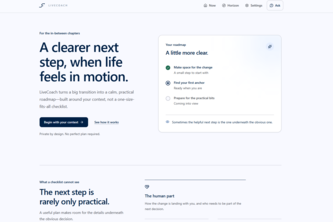
Key insight: Live Coach appears to be a just-in-time guidance platform for life transitions, built as an MVP during a hackathon using AI and structured content. The author states it uses GPT 5.6, Next.js, FastAPI, and PostgreSQL. It is not evidenced to have launched or scaled beyond the hackathon.
Most important open question: Is there evidence of user engagement or adoption post-hackathon?
What The Product Actually Is
The description states that Live Coach is a just-in-time guidance platform for major life transitions, such as relocating abroad, becoming a parent, changing careers, or retiring. It builds a personalized roadmap based on user input and surfaces daily actions from authoritative sources.
- The product uses a concern bank of verified content, curated to cover real-life needs.
- It provides day-by-day guidance, with each action explained in plain language.
- It includes hidden factor detection, flagging non-obvious issues that generic checklists miss.
- Users can ask follow-up questions and get answers from verified sources.
- The platform is built with a deterministic priority ranker and supports offline functionality.
Inference: The product is a structured, AI-assisted, personalized guidance tool for life transitions. It is not a marketplace or SaaS platform but a content-driven, step-by-step assistant.
Positioning & Claim Evolution
The author states that Live Coach aims to turn major life transitions from anxiety into calm, day-by-day roadmaps. The positioning is centered on:
- Just-in-time guidance: Actions surface when motivation and relevance peak.
- Personalization: Based on user input, it builds a tailored roadmap.
- Authority and clarity: Content comes from verified sources, with plain-language explanations.
The claim evolution appears to be:
- From a hackathon MVP to a scalable platform for life transitions.
- The product is described as structured, reliable, and offline-first — suggesting a focus on usability and accessibility.
Inference: The positioning is focused on user-centric, structured support during high-stakes life moments, not on monetization or scale at this stage.
Target Customer & ICP
The description states that Live Coach targets people facing major life transitions, such as:
- Relocating abroad
- Becoming parents
- Changing careers
- Retiring
It is designed for users who are scrambling to find fragmented advice and want a structured, personalized learning path.
Inference: The ICP appears to be individuals in transitional life phases, likely with some digital literacy and a need for clarity and guidance during uncertain times. No specific demographics or user segments are described.
Business Model & Pricing Evidence
The description does not state any business model, pricing, monetization strategy, or revenue streams.
Not evidenced: No mention of subscriptions, freemium tiers, B2B partnerships, or paid features.
Technical & Delivery Signals
- Built with Next.js 16, FastAPI, and PostgreSQL
- Uses GPT 5.6 for development acceleration
- Supports offline-first functionality with local caching and replay logic
- Includes a deterministic priority ranker and resilient grounding provider
- Uses Docker Compose, Redis, OpenTelemetry Collector, and Prometheus metrics
- Content is stored in a hand-curated concern bank with source citations
Inference: The technical stack suggests a modern, scalable MVP built for reliability and offline use. It is not evidenced to be production-ready or deployed beyond the hackathon.
Traction & Maturity Signals
The description states:
- A fully functional MVP was built during the hackathon
- The card lifecycle state machine was refined through multiple iterations
- The concern bank is hand-curated and verified
- The platform supports offline-first behavior
Not evidenced: No user data, adoption metrics, or usage statistics. No mention of launch, retention, or engagement.
Competitive Context
The description does not reference any competitors or market positioning in relation to existing tools for life transitions or guidance.
Not evidenced: No competitive analysis, no mention of similar products or platforms.
Open Questions & Risks
- No traction evidence: The product is described as an MVP built during a hackathon with no known users or adoption.
- Unverified content: Content is hand-curated and verified, but there’s no indication of how this will scale or be maintained.
- AI dependency: Reliance on GPT 5.6 for development suggests possible dependency on external models or APIs that may not be stable or scalable.
- Limited scope: Only one life phase (relocation) is mentioned in the MVP, with others listed as future plans.
Questions the description leaves open
- What is the plan to scale beyond the current concern bank and content model?
- How will you ensure content accuracy and relevance over time?
- Are there any plans for monetization or user engagement beyond the MVP?
- Has the platform been tested with real users post-hackathon?
- What are the long-term technical and content maintenance costs?
Overall Assessment
Not evidenced: No financials, revenue, or customer data to assess viability or investment potential.
Inference: This is a pre-MVP prototype, built during a hackathon. It shows early design thinking and technical execution but lacks evidence of traction, adoption, or scalability. The product is not ready for commercial deployment or investment without further development and validation.
User Stories BotA demo video on every pull request
Get a demo video on every new feature
GitHub App that watches your pull requests and records a narrated, captioned demo.
Save time on demo prep and make informed decisions faster with a video walkthrough of every new feature.
Source
Submitted to the OpenAI 2026 hackathon on Devpost. Project home on Devpost. Back to the full gallery on Devpost.
This competitive analysis was produced by top-founders.com (opens in a new tab)
Generated by a language model from this project's public Devpost page — its tagline, the author's own write-up and any built-with tags listed there — as captured in August 2026. Short quotations are the author's words. It is an opinion on the idea as a business, not on the people behind it, and it reflects the description as published then. If the project has moved on, request a correction below. The analysis is not independent research and contains no verified traction, revenue or customer data.
An independent guide by KFG International LLC — not affiliated with, endorsed by, or connected to Devpost or OpenAI.