

Archive position — measured, not model output
0 likes on Devpost
2,263 of the 7,850 archived projects have more likes, and 5,587 share exactly 0 — so this project's #5,022 place in the like-ranked listing is a tie-break inside that group, not a ranking.
Projects (log scale)
Likes on Devpost. ▲ marks this project's group.
Show the figures
| Likes | Projects | Share of archive |
|---|---|---|
| 0 | 5,587 | 71.2% |
| 1 | 1,758 | 22.4% |
| 2 | 284 | 3.6% |
| 3–4 | 132 | 1.7% |
| 5–9 | 75 | 1.0% |
| 10+ | 14 | 0.2% |
 User Stories BotA demo video on every pull request
Get a demo video on every new feature
GitHub App that watches your pull requests and records a narrated, captioned demo.
Save time on demo prep and make informed decisions faster with a video walkthrough of every new feature.
Executive Summary
What the company appears to be:
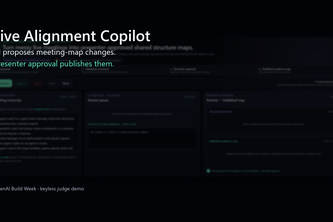
Live Alignment Copilot is a self-reported project that proposes an AI-assisted tool for live meetings. The system allows presenters to control what content is published from AI-generated meeting artifacts, using a typed command interface and structured validation.
What changed:
The description indicates this is a hackathon submission (OpenAI 2026) with no evidence of prior traction or commercial activity. It is a narrow prototype built in a short timeframe, focused on demonstrating a specific control layer around AI-generated content in real-time collaborative settings.
Single most important open question:
Is there any evidence that this concept has been validated by users beyond the hackathon context, and if so, what are the commercial viability and scalability assumptions?
What The Product Actually Is
The description states that Live Alignment Copilot is a meeting artifact drafting tool, where AI proposes diagram changes based on live meeting transcripts. It includes:
- A live transcript sample.
- An AI proposal queue with typed
SceneCommandJSON (e.g.,add_node,connect_nodes,highlight). - A presenter-controlled preview and published audience map.
The AI output is not directly published but must pass through a review queue where the presenter can approve, reject, undo, or reset changes. The system uses Zod schemas for validation and supports both GPT-5.6 (with API key) and deterministic fixture planner (without API key).
The UI is a single-screen web app, built with TypeScript, Node.js, Playwright, and Vite.
Claim: The product is described as a tool that turns meeting transcripts into reviewable diagram changes.
Evidence: The author states this in the “What It Does” section.
Positioning & Claim Evolution
The project is positioned as an AI assistant for live meetings, specifically targeting alignment debt — where teams make decisions during conversation but don’t have a shared artifact until later. It is described as a safer version of AI assistance that keeps human control over what gets published.
Claim: The tool aims to reduce “alignment debt” in real-time collaborative environments.
Evidence: The author states: “Live meetings create alignment debt... the shared artifact usually appears later, after someone manually rewrites the meeting into notes, diagrams, or slides.”
The positioning evolved from a broader AI copilot idea to a narrower control layer. The team chose to constrain the AI output through typed commands and validation to avoid ambiguity.
Claim: The product’s value lies in its control layer, not in raw generation.
Evidence: “The most useful AI product surface was not 'generate a diagram.' It was the control layer around generation.”
Target Customer & ICP
The description does not name specific customer segments or personas. However, it implies use cases such as:
- Live sales calls
- Support escalations
- Requirements workshops
- Webinars
These are described as environments where a shared view is needed while the conversation is happening.
Claim: The tool targets teams in real-time collaborative settings.
Evidence: The author lists these use cases under “Inspiration.”
No evidence of customer interviews, personas, or market research is provided.
Business Model & Pricing Evidence
There is no evidence of a business model or pricing strategy. The project is described as a hackathon submission, with no mention of monetization, subscriptions, or revenue streams.
Claim: No business model or pricing information is provided.
Evidence: The description does not include any details on how the product would be sold or who pays for it.
Technical & Delivery Signals
The project is built as a TypeScript monorepo with:
- Zod schemas for validation
- GPT-5.6 Responses API adapter (optional)
- Deterministic fixture planner (fallback)
- Playwright, Vite, and Node.js stack
- Server-side API key handling
- Unit, e2e, and build testing
It supports English-first input but is built to support multilingual data paths.
Claim: The system uses a typed command boundary and structured validation.
Evidence: “Each command is validated before it reaches the review queue.”
Claim: The demo works with or without API keys.
Evidence: “Without a key, the same UI automatically uses a deterministic fixture planner.”
Traction & Maturity Signals
There is no evidence of traction, customers, revenue, or adoption beyond the hackathon submission. The project is described as a demo, not a product in use.
Claim: No traction or adoption data is provided.
Evidence: The description explicitly states this is a hackathon submission with no prior commercial activity.
Competitive Context
There is no evidence of competitive analysis, market positioning, or competitor mentions. The project does not reference existing tools for meeting note-taking, diagramming, or AI collaboration.
Claim: No competitive context is provided.
Evidence: The description does not mention any competitors or similar products.
Open Questions & Risks
- No commercial traction or revenue evidence — it’s a hackathon demo.
- Unproven market need — no user feedback, interviews, or adoption data.
- Limited scope — the system is constrained to a narrow use case and demo flow.
- AI dependency without clear path to production — relies on GPT-5.6 but lacks cost controls or monitoring.
- No evidence of scalability or infrastructure planning.
Inference: The product may not be ready for commercialization without significant development and user validation.
Questions the description leaves open
- What specific real-world use cases have you identified that justify this tool?
- Have you tested the control layer with actual users, or is it based on assumptions?
- How do you plan to scale beyond a single presenter and single session?
- What are your plans for cost management and production monitoring around AI usage?
- Are there any existing customers or partners interested in this product?
Overall Assessment
Not evidenced — the project is described as a hackathon submission with no evidence of traction, revenue, or commercial viability.
Inference: This appears to be an early-stage idea or prototype, not a viable investment or partnership opportunity without further development and market validation.
User Stories BotA demo video on every pull request
Get a demo video on every new feature
GitHub App that watches your pull requests and records a narrated, captioned demo.
Save time on demo prep and make informed decisions faster with a video walkthrough of every new feature.
Source
Submitted to the OpenAI 2026 hackathon on Devpost. Project home on Devpost. Back to the full gallery on Devpost.
This competitive analysis was produced by top-founders.com (opens in a new tab)
Generated by a language model from this project's public Devpost page — its tagline, the author's own write-up and any built-with tags listed there — as captured in August 2026. Short quotations are the author's words. It is an opinion on the idea as a business, not on the people behind it, and it reflects the description as published then. If the project has moved on, request a correction below. The analysis is not independent research and contains no verified traction, revenue or customer data.
An independent guide by KFG International LLC — not affiliated with, endorsed by, or connected to Devpost or OpenAI.