

Archive position — measured, not model output
0 likes on Devpost
2,263 of the 7,850 archived projects have more likes, and 5,587 share exactly 0 — so this project's #4,964 place in the like-ranked listing is a tie-break inside that group, not a ranking.
Projects (log scale)
Likes on Devpost. ▲ marks this project's group.
Show the figures
| Likes | Projects | Share of archive |
|---|---|---|
| 0 | 5,587 | 71.2% |
| 1 | 1,758 | 22.4% |
| 2 | 284 | 3.6% |
| 3–4 | 132 | 1.7% |
| 5–9 | 75 | 1.0% |
| 10+ | 14 | 0.2% |
 User Stories BotA demo video on every pull request
Get a demo video on every new feature
GitHub App that watches your pull requests and records a narrated, captioned demo.
Save time on demo prep and make informed decisions faster with a video walkthrough of every new feature.
Executive Summary
What the company appears to be
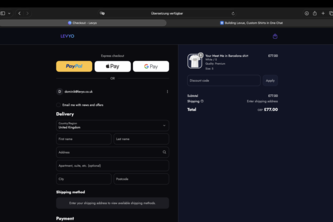
Levyo is a self-reported AI-powered custom shirt creation tool that allows users to generate personalized shirts through conversational interaction with an AI assistant, without using traditional design editors.
What changed
The project was submitted as part of the OpenAI 2026 hackathon. It represents an experimental approach to simplifying custom clothing creation via chat-based interaction and AI-assisted design.
Single most important open question
Does Levyo demonstrate a viable path to commercial traction or adoption beyond a hackathon prototype, given that no revenue, customer data or market validation is evidenced?
What The Product Actually Is
The description states that Levyo is "a conversational tool" that turns user input into "personalized, production-ready shirt." It uses GPT models for conversation and image generation, with Shopify integration for storefront functionality.
- Claimed functionality: Users chat with an AI assistant (GPT 5.6 Sol) to refine shirt designs iteratively.
- Technical stack: OpenAI models (GPT-5.6 Sol, GPT-5.5), Codex, Firebase, Printful, Shopify.
- User journey: Conversation → design generation → revisions → mockups → checkout.
Inference The product appears to be a prototype built for demonstration purposes rather than a production-ready service.
Positioning & Claim Evolution
The authors state that Levyo is inspired by the simplicity of describing what you want to a designer and refining it through conversation. They claim their solution avoids "emotionless" AI-generated designs and aims for personalization over complexity.
- Positioning: Custom shirts made easy via chat.
- Evolution of claims: From a hackathon experiment to a potential learning-based system that improves with usage.
- Key differentiator (as stated): Simplicity in interaction, no need for design tools.
Inference The positioning is centered on ease-of-use and emotional connection rather than technical sophistication or scalability.
Target Customer & ICP
The description does not explicitly define a target customer segment or ideal customer profile (ICP). It focuses more on the user experience than on who would use it.
- Self-reported intent: Anyone looking for a simple way to create custom shirts.
- User behavior described: Users start with an idea, refine through conversation, and purchase.
Not evidenced No indication of demographics, psychographics, or specific market segments.
Business Model & Pricing Evidence
There is no evidence in the description regarding pricing models, monetization strategies, or business model details.
- Claimed value delivery: Users get from idea to wearable shirt quickly.
- No stated pricing structure.
- No mention of subscription, transaction fees, or other revenue streams.
Inference The business model remains undefined in the self-report.
Technical & Delivery Signals
The authors describe a complex technical architecture involving multiple AI models, Shopify integration, Firebase, and Printful for production.
- Technical components: GPT-5.6 Sol (chat), GPT-5.5 (prompt generation), Codex (orchestration), Firebase (history), Printful (production).
- Delivery approach: End-to-end experience with persistent design history, version control, and checkout flows.
- Challenges mentioned: Maintaining consistent state across devices, network issues, performance constraints.
Inference The system is built for conversational interaction but lacks evidence of production stability or scalability beyond a prototype.
Traction & Maturity Signals
There is no evidence of any traction, customers, revenue, or adoption metrics.
- Self-reported maturity: Prototype built for a hackathon.
- No data on usage, retention, or conversion rates.
- No indication of user base or market testing.
Inference No signs of commercial viability or real-world usage beyond the development phase.
Competitive Context
The description does not mention competitors or competitive positioning.
- No reference to existing players in custom shirt creation or AI design tools.
- No evidence of market analysis or differentiation strategy.
Inference The competitive landscape is unknown, and no comparative advantage is stated.
Open Questions & Risks
Several risks are implied by the self-reported nature of the project:
- Unproven commercial viability: No revenue, customers, or traction.
- Prototype limitations: Built for a hackathon, not scalable or production-ready.
- Technical complexity vs. simplicity claim: The system is described as complex but aims to be simple to use.
- AI dependency risk: Heavy reliance on OpenAI models without clear long-term strategy.
Inference The project may lack the foundation for sustainable growth or market entry.
Questions the description leaves open
- What specific user feedback has been gathered during development?
- How does the team plan to validate demand and test product-market fit?
- Are there any early adopters or pilot users who have engaged with the prototype?
- What is the roadmap for moving from a hackathon demo to a commercial product?
- How will the system handle scalability, performance, and reliability at scale?
Overall Assessment
The description presents Levyo as an experimental project built for a hackathon. There is no evidence of traction, revenue, or customer validation.
- Self-reported: The project is described as a prototype with limited commercial potential.
- No financials, customers, or adoption data.
- High uncertainty around product-market fit and scalability.
Assessment Not evidenced as a viable investment or partnership opportunity at this stage. The project lacks the foundational signals required for due-diligence evaluation beyond its initial concept.
User Stories BotA demo video on every pull request
Get a demo video on every new feature
GitHub App that watches your pull requests and records a narrated, captioned demo.
Save time on demo prep and make informed decisions faster with a video walkthrough of every new feature.
Source
Submitted to the OpenAI 2026 hackathon on Devpost. Project home on Devpost. Back to the full gallery on Devpost.
This competitive analysis was produced by top-founders.com (opens in a new tab)
Generated by a language model from this project's public Devpost page — its tagline, the author's own write-up and any built-with tags listed there — as captured in August 2026. Short quotations are the author's words. It is an opinion on the idea as a business, not on the people behind it, and it reflects the description as published then. If the project has moved on, request a correction below. The analysis is not independent research and contains no verified traction, revenue or customer data.
An independent guide by KFG International LLC — not affiliated with, endorsed by, or connected to Devpost or OpenAI.