

Archive position — measured, not model output
0 likes on Devpost
2,263 of the 7,850 archived projects have more likes, and 5,587 share exactly 0 — so this project's #4,958 place in the like-ranked listing is a tie-break inside that group, not a ranking.
Projects (log scale)
Likes on Devpost. ▲ marks this project's group.
Show the figures
| Likes | Projects | Share of archive |
|---|---|---|
| 0 | 5,587 | 71.2% |
| 1 | 1,758 | 22.4% |
| 2 | 284 | 3.6% |
| 3–4 | 132 | 1.7% |
| 5–9 | 75 | 1.0% |
| 10+ | 14 | 0.2% |
 User Stories BotA demo video on every pull request
Get a demo video on every new feature
GitHub App that watches your pull requests and records a narrated, captioned demo.
Save time on demo prep and make informed decisions faster with a video walkthrough of every new feature.
Executive Summary
What the company appears to be
Letter Friends is a self-reported local-first macOS application designed for children aged 6 and above to practice reading and writing through letter-writing to animal friends. The app uses AI to generate personalized, level-appropriate replies that adapt to the child’s literacy level. It was built as part of an OpenAI 2026 hackathon submission.
What changed
The project is described as a prototype or proof-of-concept built in a short timeframe (a hackathon), with no evidence of prior commercial traction, revenue, or customer base. The author states it was developed with a single developer and tested with their own child.
Single most important open question
Is there any evidence that this product has been validated with real users beyond the founder's family? If not, what is the path to scaling beyond the prototype stage?
What The Product Actually Is
The description states that Letter Friends is a local-first reading and writing app for children aged 6 and above, built as a native macOS application using React, TypeScript, Vite, and Tauri. It supports German and British English with ten selectable reading levels.
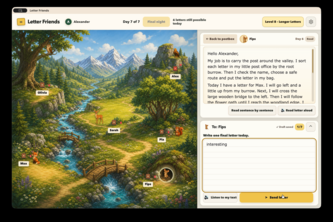
Children choose an animal friend from a map, write a letter, and receive a sealed reply the next morning. The AI tailors each reply to match the child’s reading level in vocabulary, sentence structure, length, questions, and writing prompts, while preserving the child's agency and avoiding correction or grading.
The app includes optional features such as:
- Daily feedback from Olivia the owl (a personal coach)
- Final learning summary for adults
- Focused reading mode with sentence-by-sentence navigation and text-to-speech support
All data is stored locally; no account is required. The AI pipeline uses GPT-5.6 via OpenAI API, with safeguards including deterministic prompt assembly, JSON schema validation, and moderation.
Evidence
- The author describes the app as a local-first React 19, TypeScript, and Vite web app packaged into a native macOS application using Tauri 2.
- AI-generated letters are tailored to reading level and include character-specific personalities.
- The app supports German and British English with ten reading levels.
- Features like focused reading mode, text-to-speech, and local storage are described.
Inference The app appears designed for a specific age group (6+), with an emphasis on motivation through personalization and agency. It is not described as a general-purpose writing or literacy tool but rather a structured experience around letter-writing.
Positioning & Claim Evolution
The author positions Letter Friends as:
- A joyful learning adventure that makes reading and writing practice more motivating.
- An app that meets children at their current literacy level, avoiding one-size-fits-all content.
- A tool that preserves the child’s agency in writing, without grading or correction.
Key claims include:
- AI can generate on-demand letters that adapt to a child’s exact reading level.
- The experience feels warm and personal, with animal characters maintaining consistent voices.
- The app avoids replacing the child’s own writing with AI-generated content.
Evidence
- The author states: “The central idea was to make one-to-one guidance feel warm and attainable without replacing the child's agency or turning the experience into an open chat box.”
- “Each animal has a recognisable voice and a reason to write back, while the child remains the author of the journey.”
Inference The positioning reflects a focus on child-centered design, emphasizing emotional engagement over technical features. It is not positioned as a replacement for traditional education tools but as an alternative or supplement that leverages AI to personalize learning.
Target Customer & ICP
The description identifies the primary user as:
- Children aged 6 and above
- Parents or caregivers who support literacy development
- Families interested in educational apps that promote motivation and agency
Evidence
- The app targets children aged 6 and above.
- It includes optional adult summaries and feedback features.
- The author mentions testing with their own six-year-old son.
Inference The ICP is likely a parent or educator seeking tools to encourage reading and writing practice, especially in contexts where traditional methods may not be engaging enough. The app does not appear aimed at schools or institutional use, but rather at home-based learning.
Business Model & Pricing Evidence
There is no evidence provided about:
- Revenue streams
- Pricing models
- Monetization strategy
- Subscription plans or one-time purchases
Evidence
- No mention of pricing, subscriptions, or monetization.
- The app is described as local-first with no account required.
Inference The business model remains unclear. Based on the description, it appears to be a prototype or proof-of-concept, not yet commercialized. There is no indication that the project intends to charge users or sell data.
Technical & Delivery Signals
The app was built using:
- React 19, TypeScript, Vite
- Tauri 2 for packaging into a native macOS app
- GPT-5.6 (via OpenAI API) for AI generation
- Codex for development assistance
Key technical elements include:
- Local-first architecture with no account required
- Deterministic prompt assembly and JSON schema validation
- Safeguards such as strict moderation, refusal handling, and error recovery
- Native macOS speech support and browser fallbacks
- Sentence-by-sentence reading mode and word highlighting
Evidence
- The app is built using modern web technologies and packaged natively.
- AI generation uses OpenAI API with safeguards like JSON validation and prompt guardrails.
- Local storage and privacy controls are emphasized.
Inference The technical stack suggests a developer-focused approach, prioritizing performance, safety, and accessibility. The use of Tauri indicates an intent to offer a native experience without sacrificing cross-platform compatibility or future web deployment potential.
Traction & Maturity Signals
There is no evidence of:
- Revenue
- Customer base
- User adoption metrics
- Product-market fit validation beyond the founder’s family
- Any form of user testing outside the developer’s household
Evidence
- The project was submitted to a hackathon.
- Testing occurred with the author’s own six-year-old son.
- No mention of external users, feedback loops, or product iterations.
Inference The product is at a very early stage, likely a prototype or MVP. There is no evidence of traction or market validation beyond internal testing.
Competitive Context
No competitive analysis or comparison to existing products is provided in the description.
Evidence
- No mention of competitors, similar tools, or market positioning.
- The author does not reference other literacy apps or AI-powered writing tools.
Inference
The competitive landscape is unknown. However, given the focus on child literacy and AI-generated personalization, it may overlap with:
- Educational apps for reading/writing practice
- AI-powered storytelling platforms
- Gamified learning experiences
Open Questions & Risks
Several risks are implied or raised in the description:
- Lack of external validation: The only testing was done with one child.
- Limited scalability: The app is built for macOS and has no evidence of cross-platform support beyond that.
- AI safety concerns: The author notes challenges in balancing moderation and fluency, with early tests showing over-blocking of innocent questions.
- No monetization strategy: There is no indication of how the product will be commercialized or funded.
- Single-person development: The entire project was built by one person, which may limit long-term maintainability or growth.
Evidence
- “We built everything with a single thread.”
- “Balancing safety with a fluent experience proved tricky.”
- “No account required” implies no user tracking or monetization path.
- No mention of future expansion beyond the prototype.
Questions the description leaves open
- What specific feedback did you receive from children during testing, and how did it shape the product?
- How do you plan to address AI moderation issues that were noted in early testing?
- Is there any intention to expand beyond macOS or support multiple languages beyond German and British English?
- What is your long-term vision for monetization or commercialization?
- Have you considered how to scale this experience without relying on a single developer?
- How do you intend to validate the effectiveness of the reading level adaptations?
Overall Assessment
There is no evidence that Letter Friends has achieved any form of traction, revenue, or customer base beyond internal testing with one child.
The project is described as a hackathon prototype, not yet commercialized. It lacks:
- Revenue data
- Customer validation
- Product-market fit confirmation
- Clear monetization strategy
Confidence Level Low This is a pre-MVP concept with no demonstrated market readiness or business model. Any investment or partnership would be speculative, based on the potential of the idea rather than evidence of execution.
Inference If the founder intends to develop this further, it may require significant iteration and validation before becoming viable for broader adoption or funding. The core idea shows promise in addressing child literacy through engagement, but the current state is unproven.
User Stories BotA demo video on every pull request
Get a demo video on every new feature
GitHub App that watches your pull requests and records a narrated, captioned demo.
Save time on demo prep and make informed decisions faster with a video walkthrough of every new feature.
Source
Submitted to the OpenAI 2026 hackathon on Devpost. Project home on Devpost. Back to the full gallery on Devpost.
This competitive analysis was produced by top-founders.com (opens in a new tab)
Generated by a language model from this project's public Devpost page — its tagline, the author's own write-up and any built-with tags listed there — as captured in August 2026. Short quotations are the author's words. It is an opinion on the idea as a business, not on the people behind it, and it reflects the description as published then. If the project has moved on, request a correction below. The analysis is not independent research and contains no verified traction, revenue or customer data.
An independent guide by KFG International LLC — not affiliated with, endorsed by, or connected to Devpost or OpenAI.