

Archive position — measured, not model output
0 likes on Devpost
2,263 of the 7,850 archived projects have more likes, and 5,587 share exactly 0 — so this project's #4,948 place in the like-ranked listing is a tie-break inside that group, not a ranking.
Projects (log scale)
Likes on Devpost. ▲ marks this project's group.
Show the figures
| Likes | Projects | Share of archive |
|---|---|---|
| 0 | 5,587 | 71.2% |
| 1 | 1,758 | 22.4% |
| 2 | 284 | 3.6% |
| 3–4 | 132 | 1.7% |
| 5–9 | 75 | 1.0% |
| 10+ | 14 | 0.2% |
 User Stories BotA demo video on every pull request
Get a demo video on every new feature
GitHub App that watches your pull requests and records a narrated, captioned demo.
Save time on demo prep and make informed decisions faster with a video walkthrough of every new feature.
Executive Summary
Company: Legatus
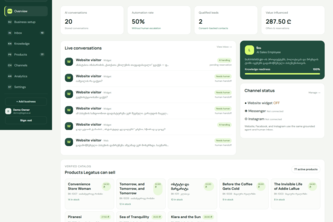
Self-reported purpose: An AI sales and shopping agent that turns product catalogs into intelligent conversations, helping businesses sell more with autonomous AI.
Key claim: The product enables autonomous AI-driven selling through conversational interfaces built on product catalog data.
What changed: Submitted to the OpenAI 2026 hackathon — no evidence of prior traction or commercial deployment.
Single most important open question: What is the actual functionality of the "agent" and how does it interact with product catalogs?
This is a self-reported, unverified project description from a hackathon submission. No revenue, customers, pricing, or technical implementation details are provided. The author states the product uses GPT-5.6 and OpenAI tools, but no evidence of actual use or performance exists.
What The Product Actually Is
The description states:
"Legatus is an AI sales and shopping agent that turns product catalogs into intelligent conversations, helping businesses sell more with autonomous AI."
Inference: Based on the tagline, Legatus appears to be a conversational AI tool designed to automate or enhance sales processes by enabling customers to interact with product information through dialogue.
Evidence:
- The author describes it as an "AI sales and shopping agent"
- It is said to “turn product catalogs into intelligent conversations”
- It claims to help businesses “sell more with autonomous AI”
Not evidenced:
- No details on how the agent works or what it actually does
- No information about the interface, user experience, or integration points
- No mention of whether this is a SaaS tool, API, chatbot, or something else
Positioning & Claim Evolution
The description states:
"Legatus is an AI sales and shopping agent that turns product catalogs into intelligent conversations, helping businesses sell more with autonomous AI."
Claim: Legatus positions itself as an AI-driven solution to improve business sales by enabling conversational commerce from product data.
Inference: The positioning implies a shift toward automation in customer engagement, using AI to reduce friction in the buying process.
Not evidenced:
- No mention of prior versions or evolution of the idea
- No indication of how this differs from existing chatbots or e-commerce tools
- No evidence of market research or competitive differentiation
Target Customer & ICP
The description states:
"helping businesses sell more with autonomous AI."
Claim: The target customer is businesses seeking to increase sales through AI automation.
Inference: The ICP likely includes e-commerce platforms, retailers, or B2B sellers who want to automate their sales process using conversational AI.
Not evidenced:
- No specific business verticals or use cases mentioned
- No indication of whether the tool is for small businesses, enterprises, or niche markets
- No evidence of customer personas or buyer motivations
Business Model & Pricing Evidence
The description states:
"helping businesses sell more with autonomous AI."
Claim: The product is intended to help businesses increase sales, which implies a value proposition tied to revenue growth.
Inference: A possible business model could be SaaS or API-based, where businesses pay for access to the AI agent functionality.
Not evidenced:
- No pricing information
- No mention of monetization strategy
- No indication of whether it's sold to end-users or integrated into existing platforms
Technical & Delivery Signals
The description states:
"Built with (author-declared): agents, ai, api, bootstrap, codex, css, engineering, gpt-5.6, html, javascript, laravel, mysql, openai, php, prompt, rest, search"
Inference: The project is built using a mix of AI tools and web development technologies, including Laravel (PHP framework), OpenAI APIs, and GPT-5.6.
Not evidenced:
- No details on how the AI agent interacts with product catalogs
- No evidence of actual delivery or deployment
- No information about scalability or performance
Traction & Maturity Signals
The description states:
"This project was submitted to the OpenAI 2026 hackathon on Devpost."
Claim: The project is a hackathon submission, suggesting early-stage development.
Inference: This implies no commercial traction, revenue, or customer adoption. It is likely an experimental prototype.
Not evidenced:
- No evidence of user testing or feedback
- No mention of product iterations or roadmap
- No indication of any live deployment or usage
Competitive Context
The description states:
"Legatus is an AI sales and shopping agent that turns product catalogs into intelligent conversations, helping businesses sell more with autonomous AI."
Inference: The space includes AI chatbots for e-commerce, conversational commerce platforms, and AI-driven sales tools.
Not evidenced:
- No mention of competitors or market positioning
- No evidence of competitive analysis or differentiation
- No indication of how this product compares to existing solutions
Open Questions & Risks
Risk 1: The project is a hackathon submission — no commercial traction, no validation.
Risk 2: No technical details or implementation plan provided — unclear if it’s more than a concept.
Risk 3: No pricing or monetization strategy — unclear how the product will generate revenue.
Risk 4: No evidence of target customer feedback or market demand — may not solve a real problem.
Questions the description leaves open
- What specific problem does Legatus solve, and how is it different from existing chatbots or e-commerce tools?
- How exactly does the AI agent interact with product catalogs? Is there an API or integration point?
- What are the technical limitations of the current prototype?
- Have you tested this with any real users or businesses?
- What is your plan for monetization and scaling beyond a hackathon project?
Overall Assessment
Assessment: Not evidenced.
The description provides no evidence of traction, revenue, customer adoption, or clear business model. It is a self-reported hackathon submission with no indication of commercial viability or product-market fit. The author states the tool uses GPT-5.6 and OpenAI APIs but gives no insight into functionality, delivery, or real-world application.
Confidence: Low
Next Steps: If this is a prototype, further due diligence would require access to working demos, user feedback, or evidence of product development beyond the hackathon stage.
User Stories BotA demo video on every pull request
Get a demo video on every new feature
GitHub App that watches your pull requests and records a narrated, captioned demo.
Save time on demo prep and make informed decisions faster with a video walkthrough of every new feature.
Source
Submitted to the OpenAI 2026 hackathon on Devpost. Project home on Devpost. Back to the full gallery on Devpost.
This competitive analysis was produced by top-founders.com (opens in a new tab)
Generated by a language model from this project's public Devpost page — its tagline and any built-with tags listed there, since the author published no write-up — as captured in August 2026. Short quotations are the author's words. It is an opinion on the idea as a business, not on the people behind it, and it reflects the description as published then. If the project has moved on, request a correction below. The analysis is not independent research and contains no verified traction, revenue or customer data.
An independent guide by KFG International LLC — not affiliated with, endorsed by, or connected to Devpost or OpenAI.