

Archive position — measured, not model output
0 likes on Devpost
2,263 of the 7,850 archived projects have more likes, and 5,587 share exactly 0 — so this project's #4,947 place in the like-ranked listing is a tie-break inside that group, not a ranking.
Projects (log scale)
Likes on Devpost. ▲ marks this project's group.
Show the figures
| Likes | Projects | Share of archive |
|---|---|---|
| 0 | 5,587 | 71.2% |
| 1 | 1,758 | 22.4% |
| 2 | 284 | 3.6% |
| 3–4 | 132 | 1.7% |
| 5–9 | 75 | 1.0% |
| 10+ | 14 | 0.2% |
 User Stories BotA demo video on every pull request
Get a demo video on every new feature
GitHub App that watches your pull requests and records a narrated, captioned demo.
Save time on demo prep and make informed decisions faster with a video walkthrough of every new feature.
Executive Summary
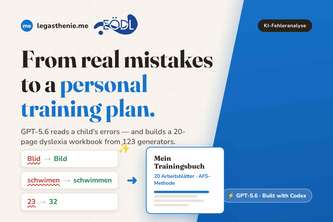
The company appears to be a single-person project (Mario Engel) building an AI-powered error analysis tool for dyslexia training in German-speaking regions. The author states that the tool uses GPT-5.6 to analyze real spelling mistakes and generate personalized 20-page workbooks based on AFS methodology, using 123 existing worksheet generators. It is described as having shipped to production during a hackathon, with no account required and data processed client-side except for anonymous error lists sent to the model.
What changed
The project was built during a hackathon (OpenAI 2026) and deployed live in production within a few days, using GPT-5.6 and structured outputs to map user input into existing training materials. It is not clear whether this represents a new product or an extension of an existing platform.
The single most important open question
Is there any evidence of prior traction, revenue, or customer adoption beyond the author's own description? The project is self-reported, unverified, and lacks any data on usage, customers, or monetization.
What The Product Actually Is
- The description states that legasthenie.me is an AI-powered error analysis tool for dyslexia training.
- It accepts real spelling mistakes from users (e.g., "Blid -> Bild") and uses GPT-5.6 to classify them into AFS symptom categories.
- The system then generates a personalized 20-page A4 workbook, assembled from existing worksheet generators.
- The tool is described as running in production, using structured outputs via the Responses API, and includes server-side validation of model responses.
- It is built with PHP, GPT-5.6, Apache, Cloudflare, MySQL, and other technologies.
Inference The product appears to be a rule-based educational engine powered by AI diagnostics, using pre-existing content (123 generators, 37,058 worksheets) and an AI model to match user input to appropriate training materials.
Positioning & Claim Evolution
- The author positions the tool as a way to "close the gap between 'here are great materials' and 'here is exactly what YOUR child needs today."
- It is described as a diagnostic front-end for an existing platform that already hosts 123 free generators, 95 learning games, and 37,058 worksheets.
- The tool is framed as solving a gap in dyslexia training: parents or trainers can now get expert-level analysis from mistakes, without needing specialized knowledge.
- It is described as free, no account required, and the child's name never leaves the browser.
Inference The positioning suggests this is an extension of an existing platform, not a standalone product. The AI component is positioned to bridge user input with pre-existing content.
Target Customer & ICP
- The target audience is parents or trainers of children with dyslexia or dyscalculia in German-speaking regions (Germany, Austria, Switzerland).
- The tool is described as serving the German-speaking dyslexia community, and the UI is in German.
- The author states that 15% of all children live with dyslexia or dyscalculia, and that specialists trained in AFS method interpret these patterns, but parents usually cannot.
Inference The ICP appears to be parents or educators working with children who have dyslexia, particularly those in German-speaking regions. The tool is positioned as a parent-facing diagnostic tool.
Business Model & Pricing Evidence
- The description states that the platform already offers 123 free worksheet generators, 95 learning games, and 37,058 hand-made worksheets.
- It is described as free to use, with no account required.
- No pricing model or monetization strategy is mentioned in the description.
Inference The business model appears to be freemium or donation-based, with existing content being free. There is no evidence of paid features, subscriptions, or revenue streams.
Technical & Delivery Signals
- The tool uses GPT-5.6 via the Responses API with structured outputs.
- It is built in a framework-free PHP codebase, including server-side validation and rate limiting.
- The system includes offline tests with mocked model responses.
- The author states that the feature was shipped to production during a hackathon, within a few days.
Inference The technical implementation is lightweight and focused on rapid deployment, using existing infrastructure. It is not clear whether this is a new product or an extension of an existing platform.
Traction & Maturity Signals
- The project was built and deployed in a hackathon setting (OpenAI 2026).
- It is described as having shipped to production during Build Week, with no mention of user feedback or usage metrics.
- The platform already hosts 37,058 worksheets contributed by 2,681 trainers, and has 123 free generators and 95 learning games.
Inference There is no evidence of traction beyond the author's own description. No data on user engagement, adoption, or revenue is provided.
Competitive Context
- The platform is described as part of a larger ecosystem that already includes:
- 123 free worksheet generators
- 95 learning games
- 37,058 hand-made worksheets
- 17,000 certified trainers since 1997
- The author mentions the AFS method, a known approach to dyslexia training.
- No direct competitors are named in the description.
Inference The competitive landscape is not clearly defined. It appears to be part of an existing ecosystem that already offers significant content, but there is no evidence of how this AI tool differentiates from or competes with other tools in the space.
Open Questions & Risks
- The project is self-reported and unverified.
- No evidence of revenue, customers, or usage metrics.
- The tool is described as a single-person effort, with no team or funding mentioned.
- The AI model (GPT-5.6) is used in a structured output mode, but the author notes that model outputs sometimes need repair rather than rejection — this could indicate reliability concerns.
- The tool is limited to German-speaking regions, which may limit scalability.
Inference There are no clear signs of traction or commercial viability. The project appears to be a proof-of-concept or prototype, not a mature product with a customer base.
Questions the description leaves open
- What is the actual user base or adoption rate for the existing platform (123 generators, 95 games, 37,058 worksheets)?
- How many users are actively using the AI error analysis feature?
- Is there any feedback from trainers or parents about the accuracy of the AI classifications?
- What is the plan for monetization beyond the current free offerings?
- How does the AI model’s performance vary across different types of spelling errors or languages?
- Are there plans to expand beyond German-speaking regions?
Overall Assessment
- The project is self-reported and unverified, with no evidence of revenue, customers, or traction.
- It appears to be a single-person hackathon project that was deployed quickly, not a mature product.
- There is no indication of commercial viability or scalability beyond the current platform.
Assessment Not evidenced as a viable investment or partnership opportunity. The tool is described as a proof-of-concept, and there is no evidence of traction, monetization, or customer adoption. It may be an early-stage idea with potential, but lacks the commercial due-diligence signals required for evaluation.
User Stories BotA demo video on every pull request
Get a demo video on every new feature
GitHub App that watches your pull requests and records a narrated, captioned demo.
Save time on demo prep and make informed decisions faster with a video walkthrough of every new feature.
Source
Submitted to the OpenAI 2026 hackathon on Devpost. Project home on Devpost. Back to the full gallery on Devpost.
This competitive analysis was produced by top-founders.com (opens in a new tab)
Generated by a language model from this project's public Devpost page — its tagline, the author's own write-up and any built-with tags listed there — as captured in August 2026. Short quotations are the author's words. It is an opinion on the idea as a business, not on the people behind it, and it reflects the description as published then. If the project has moved on, request a correction below. The analysis is not independent research and contains no verified traction, revenue or customer data.
An independent guide by KFG International LLC — not affiliated with, endorsed by, or connected to Devpost or OpenAI.