

Archive position — measured, not model output
0 likes on Devpost
2,263 of the 7,850 archived projects have more likes, and 5,587 share exactly 0 — so this project's #3,006 place in the like-ranked listing is a tie-break inside that group, not a ranking.
Projects (log scale)
Likes on Devpost. ▲ marks this project's group.
Show the figures
| Likes | Projects | Share of archive |
|---|---|---|
| 0 | 5,587 | 71.2% |
| 1 | 1,758 | 22.4% |
| 2 | 284 | 3.6% |
| 3–4 | 132 | 1.7% |
| 5–9 | 75 | 1.0% |
| 10+ | 14 | 0.2% |
 User Stories BotA demo video on every pull request
Get a demo video on every new feature
GitHub App that watches your pull requests and records a narrated, captioned demo.
Save time on demo prep and make informed decisions faster with a video walkthrough of every new feature.
Executive Summary
What the company appears to be
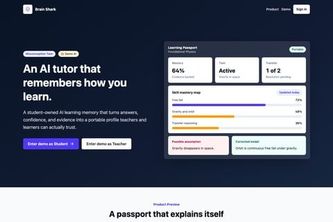
Brain Shark is an AI-powered learning memory system designed to track and understand a student’s knowledge, misconceptions, and learning progress. It aims to create a portable, structured profile of a learner's educational history that can be shared across platforms, teachers, or schools.
What changed
The project was submitted as part of the OpenAI 2026 hackathon. The author describes it as an experimental full-stack application built with Next.js and React, using AI services like OpenAI’s API for structured outputs and intervention generation. It includes a conceptual framework for tracking misconceptions through five lifecycle states (suspected, active, improving, resolved, resurfaced) and supports exportable JSON-based learning passports.
The single most important open question — the commercial due-diligence read
Is there evidence of real-world adoption or integration with existing educational systems? The description contains no mention of actual users, customers, partnerships, revenue, or traction beyond a hackathon submission. The system is described as a prototype with deterministic demo mode and lacks any indication of production use.
What The Product Actually Is
The description states that Brain Shark is an AI-powered learning memory system that records student mastery, misconceptions, confidence levels, and intervention history. It tracks:
- Skill mastery
- Active and resolved misconceptions
- Confidence vs performance
- Repeated mistake patterns
- Intervention history
- Verification evidence
- Recommended next actions
It uses a "Misconception Twin" approach where the system analyzes not only the correctness of an answer but also the reasoning behind it, identifying underlying mental models.
The core AI workflows include:
- Attempt analysis
- Intervention generation
- Verification evaluation
- Teacher insight generation
It is built as a full-stack application using Next.js, React, TypeScript, and integrates with OpenAI APIs for structured outputs. The system supports exportable JSON learning passports that contain structured data about the learner’s progress.
Evidence
- Self-reported by author
- Described as a prototype built for a hackathon
- No evidence of production deployment or real-world usage
Positioning & Claim Evolution
The author positions Brain Shark as an AI-powered, portable learning memory owned by the student. It claims to help tutors understand learners before lessons begin and enables students to carry their learning history between platforms.
Key claims:
- A system that understands what a student knows, where they struggle, and why they make mistakes.
- Enables a portable learning profile across tutors, courses, schools, and AI platforms.
- Provides structured evidence-based understanding of misconceptions.
- Supports a complete learning loop: Attempt → Analysis → Misconception Detection → Intervention → Verification → Passport Update.
Evidence
- Self-reported by author
- Described as an experimental prototype for a hackathon
- No external validation or market positioning beyond the submission
Target Customer & ICP
The description states that Brain Shark targets students and teachers in educational settings. It aims to support:
- Students who need personalized learning experiences
- Teachers who want insights into class-wide misconceptions
- Institutions looking for tools to track student progress and interventions
It also mentions potential future integrations with LMS, assessment platforms, and parent-facing dashboards.
Evidence
- Self-reported by author
- No evidence of actual customers or institutional adoption
- No indication of specific ICP segments beyond general education
Business Model & Pricing Evidence
There is no mention in the description of pricing models, monetization strategies, or business model assumptions. The project is described as a hackathon submission with no indication of commercial viability or revenue streams.
Evidence
- Not evidenced
- No information on how the product would be sold or who pays for it
Technical & Delivery Signals
The application was built using:
- Next.js
- React
- TypeScript
- Tailwind CSS
- shadcn/ui
- Prisma
- SQLite
- Zod
- OpenAI Responses API
- Structured Outputs
- Codex for implementation and iteration
It uses a provider architecture to separate the AI layer from the rest of the application. The AI workflows are:
- Attempt analysis
- Intervention generation
- Verification evaluation
- Teacher insight generation
The system validates all AI responses against structured schemas before saving them.
Evidence
- Self-reported by author
- Described as a prototype with deterministic demo mode
- No evidence of scalability, performance metrics, or production-grade delivery
Traction & Maturity Signals
There is no evidence of traction, customers, revenue, or adoption beyond the hackathon submission. The project is described as a prototype and includes a note about building a reliable live demo using a deterministic AI provider.
Evidence
- Not evidenced
- No mention of users, usage data, or real-world deployment
Competitive Context
The description does not provide any information on competitors or the competitive landscape. It does not reference existing tools in the edtech space or how Brain Shark differentiates from them.
Evidence
- Not evidenced
- No comparison to other platforms or market positioning
Open Questions & Risks
Several risks and open questions are present:
- No traction or adoption: The project is described as a hackathon submission with no real-world usage.
- Prototype nature: The system uses a deterministic demo mode, suggesting it has not been tested in production.
- Unproven AI accuracy: The author notes challenges distinguishing mistakes from misconceptions and avoiding unsupported labels.
- Lack of commercial viability: No pricing, monetization, or business model described.
- No institutional integration: No evidence of partnerships or integrations with schools or LMS platforms.
Evidence
- Self-reported by author
- No external validation or market traction
Questions the description leaves open
- What is the current status of the product? Is it being used in any educational environments?
- How do you plan to validate the accuracy of AI-generated misconceptions and interventions?
- Have you tested the system with real students and teachers?
- What are your plans for scaling beyond a hackathon prototype?
- Are there any existing partnerships or pilot programs with schools or edtech platforms?
- How will you ensure privacy compliance, especially regarding student data in teacher dashboards?
- What is the roadmap for monetization or commercialization?
Inference These questions are necessary because the description lacks concrete evidence of traction, validation, or business model.
Overall Assessment
There is no evidence that Brain Shark has achieved any level of traction, revenue, or customer adoption. It is described as a hackathon submission with no indication of real-world usage or commercial viability.
Confidence Level Low — based on self-reported description only.
Assessment Not ready for investment or partnership consideration without further evidence of product-market fit, user validation, or traction.
Evidence
- Self-reported by author
- No revenue, customers, or adoption data
- Prototype nature and lack of production use
User Stories BotA demo video on every pull request
Get a demo video on every new feature
GitHub App that watches your pull requests and records a narrated, captioned demo.
Save time on demo prep and make informed decisions faster with a video walkthrough of every new feature.
Source
Submitted to the OpenAI 2026 hackathon on Devpost. Project home on Devpost. Back to the full gallery on Devpost.
This competitive analysis was produced by top-founders.com (opens in a new tab)
Generated by a language model from this project's public Devpost page — its tagline, the author's own write-up and any built-with tags listed there — as captured in August 2026. Short quotations are the author's words. It is an opinion on the idea as a business, not on the people behind it, and it reflects the description as published then. If the project has moved on, request a correction below. The analysis is not independent research and contains no verified traction, revenue or customer data.
An independent guide by KFG International LLC — not affiliated with, endorsed by, or connected to Devpost or OpenAI.