

Archive position — measured, not model output
1 like on Devpost
505 of the 7,850 archived projects have more likes, and 1,758 share exactly 1 — so this project's #1,327 place in the like-ranked listing is a tie-break inside that group, not a ranking.
Projects (log scale)
Likes on Devpost. ▲ marks this project's group.
Show the figures
| Likes | Projects | Share of archive |
|---|---|---|
| 0 | 5,587 | 71.2% |
| 1 | 1,758 | 22.4% |
| 2 | 284 | 3.6% |
| 3–4 | 132 | 1.7% |
| 5–9 | 75 | 1.0% |
| 10+ | 14 | 0.2% |
 User Stories BotA demo video on every pull request
Get a demo video on every new feature
GitHub App that watches your pull requests and records a narrated, captioned demo.
Save time on demo prep and make informed decisions faster with a video walkthrough of every new feature.
Executive Summary
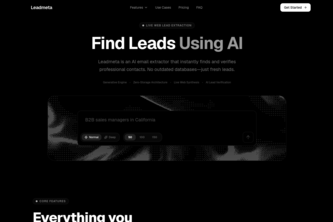
Leadmeta is an AI-powered lead discovery platform that the author describes as transforming a business description into verified leads by generating search strategies, extracting public emails from the live web, and validating them locally in the browser. It is presented as a real-time, privacy-friendly alternative to traditional lead databases, built with a frontend-first architecture using Next.js, React, and TypeScript.
The project is self-reported and unverified. The author states that it was built for a hackathon and includes no evidence of revenue, customers, or traction beyond the author’s own claims. The tool is described as stateless, with search results and verification running client-side, avoiding backend complexity or databases.
Key commercial due-diligence question: Is there any evidence that the described workflow can scale to deliver reliable, high-volume lead discovery in a real-world B2B SaaS context?
What The Product Actually Is
The description states that Leadmeta is an AI-powered lead discovery platform. It transforms a business description into verified leads by:
- Generating search strategies using AI.
- Searching the live web for relevant information.
- Extracting publicly available email addresses from search results.
- Optionally visiting relevant pages (Deep Mode) to discover additional contacts.
- Verifying emails in the browser.
- Exporting results as a clean CSV.
The author describes it as a tool that discovers fresh, publicly available business contacts directly from the live web instead of relying on static databases. It is built with Next.js 16, React 19, TypeScript, Tailwind CSS 4, and uses APIs like TinyFish for search and OpenRouter for AI query generation.
Inference: The product appears to be a browser-based lead discovery tool that leverages AI to automate parts of the process but avoids backend infrastructure or persistent data storage.
Positioning & Claim Evolution
The author positions Leadmeta as an alternative to traditional lead databases, emphasizing:
- Real-time discovery from the live web.
- Privacy-friendly approach (no reliance on static datasets).
- Transparency in how leads are found and verified.
- AI-powered workflows that orchestrate existing tools rather than replace them.
It is described as a tool that makes lead generation faster, more transparent, and privacy-friendly. The author notes that traditional tools rely on expensive, outdated databases, while Leadmeta searches the live web for fresh data.
Inference: The positioning reflects a shift toward AI-assisted, real-time discovery over static data models, but no evidence is provided of how this compares to existing solutions or whether it has traction in the market.
Target Customer & ICP
The author does not clearly define a specific customer segment. However, the tool is described as useful for users who need to find business leads from publicly available sources, particularly those seeking email addresses.
It is implied that the tool targets individuals or teams looking to generate leads without relying on expensive, outdated databases — possibly small businesses, sales professionals, or marketers.
Inference: The ICP appears to be B2B lead generation professionals or small teams who want a lightweight, real-time solution. No explicit customer personas or use cases are provided.
Business Model & Pricing Evidence
There is no evidence in the description of a business model or pricing structure. The author describes the tool as a hackathon project and does not mention monetization, subscriptions, or any commercial offering beyond its self-reported functionality.
Not evidenced: No indication of how the product would be sold or whether it has a revenue model.
Technical & Delivery Signals
The system is built with:
- Next.js 16
- React 19
- TypeScript
- Tailwind CSS 4
- shadcn/ui
- TinyFish Search & Fetch APIs
- OpenRouter for AI query generation
- Gemini/OpenAI for optional query editing
Key technical decisions include:
- Keeping the application stateless.
- Running verification entirely in the browser.
- Avoiding backend databases or persistent storage.
The author notes that Codex was used extensively during development, helping with features, refactoring, and debugging.
Inference: The architecture is client-side focused, which may limit scalability or data persistence but aligns with a lightweight, privacy-conscious approach.
Traction & Maturity Signals
There is no evidence of traction or maturity beyond the author’s own description. The tool was built for a hackathon and has no reported users, revenue, or adoption metrics.
Not evidenced: No data on customer acquisition, usage patterns, or product performance.
Competitive Context
The author does not reference competitors or market positioning in terms of existing lead generation tools. However, the description implies that Leadmeta is positioned as an alternative to traditional lead databases and static datasets.
Inference: It likely competes with tools like Hunter.io, Clearbit, or LinkedIn Sales Navigator, but no evidence is provided about how it differentiates or performs against them.
Open Questions & Risks
- Scalability concerns: The tool runs entirely in the browser and avoids backend infrastructure. This may limit its ability to scale for high-volume use cases.
- No commercial traction: No evidence of revenue, customers, or adoption beyond a hackathon project.
- Unproven verification pipeline: The description mentions email verification but does not provide details on accuracy or reliability.
- Limited functionality: The tool is described as focused on email discovery and basic verification; no evidence of enrichment or CRM integrations.
- Self-reported only: All claims are from the author, with no external validation.
Questions the description leaves open
- What is the accuracy rate of email extraction and verification in real-world usage?
- How does the tool handle edge cases like dynamic web content or CAPTCHA-protected pages?
- Has there been any user testing or feedback from potential customers?
- What are the limitations of the current browser-based architecture for scaling?
- Are there plans to integrate with CRM tools or other business platforms?
- How is the AI search strategy generation validated in practice?
- What is the expected performance and latency for Deep Mode vs. standard mode?
Overall Assessment
Not evidenced: No data on financials, traction, or commercial viability exists beyond the author’s self-report.
Confidence level: Low. The project is described as a hackathon prototype with no evidence of product-market fit, revenue, or customer adoption.
Assessment: This is an early-stage concept that may evolve into a viable product, but there is no evidence to support its commercial readiness or scalability. It would require significant due diligence and validation before any investment or partnership consideration.
User Stories BotA demo video on every pull request
Get a demo video on every new feature
GitHub App that watches your pull requests and records a narrated, captioned demo.
Save time on demo prep and make informed decisions faster with a video walkthrough of every new feature.
Source
Submitted to the OpenAI 2026 hackathon on Devpost. Project home on Devpost. Back to the full gallery on Devpost.
This competitive analysis was produced by top-founders.com (opens in a new tab)
Generated by a language model from this project's public Devpost page — its tagline, the author's own write-up and any built-with tags listed there — as captured in August 2026. Short quotations are the author's words. It is an opinion on the idea as a business, not on the people behind it, and it reflects the description as published then. If the project has moved on, request a correction below. The analysis is not independent research and contains no verified traction, revenue or customer data.
An independent guide by KFG International LLC — not affiliated with, endorsed by, or connected to Devpost or OpenAI.